Measure AI ROI
It's hard to measure AI ROI, but don’t let that deter you. Use this assessment to quantify impact so you can prove value, get funding, and keep the momentum going.


PREP TIME
0m

Run TIME
2-3hr

Persons
2-10+
5-second summary
- Create a list of leaders who can estimate their team’s AI readiness, adoption, and gains.
- Ask these leaders to take a short AI ROI metrics assessment.
- Analyze and share the results to determine the best AI metric to focus on.
WHAT YOU WILL NEED
PLAY resources
How to Measure AI ROI
Learn how to measure the impact of AI investments to prove value, get funding, and keep the momentum going.
What is AI ROI?
AI ROI is the value an organization gains from its investments in artificial intelligence. But ROI isn’t just one number. With a technology as novel as AI, returns must be measured in stages, from adoption and efficiency through to quality and innovation.
Why is the ROI of AI difficult to measure?
So far, 96% of executives report little meaningful impact of their AI initiatives. Part of the problem is that they struggle with measuring the return on AI investments.
AI ROI is hard to measure because both the benefits and the boundaries can be fuzzy.
- Benefits are often indirect and not always quantitative (micro-efficiencies, better quality, better ideas, smoother collaboration).
- Attribution is messy because AI changes tend to happen alongside process and org changes.
- Traditional ROI models don’t fit a constantly evolving, embedded capability.
- Value appears on different timelines as teams use AI to explore, optimize, enhance, and then transform.
- Most organizations are still in pilot/experimentation mode, where learning > earning.
- Costs are often easier to see than benefits, especially for finance leaders.
- There’s no single agreed “unit of value” (e.g., time saved, revenue, satisfaction, retention, etc.).
-
Realized value depends heavily on human behavior, trust, and adoption, not just the tech.
Classic ROI math assumes stable inputs and clean cause-and-effect. AI rarely fits that pattern.
Why run the Measure AI ROI Play?
Measuring the ROI of AI turns vague AI experiments into focused, accountable investments. When you quantify impact – even with basic metrics – you can prove value to executives and the board, keep funding for what’s working, and stave off skepticism.
Measuring ROI also encourages teams to connect their AI work to real business outcomes, not just novelty.
In short, measuring AI ROI isn’t about calculating perfect numbers. It’s about making smarter decisions about what to scale, what to stop, where to double down, and how to sustain momentum.
What do you measure to see the ROI of AI?
At Atlassian, we see AI value emerge in four areas: Exploring, Optimizing, Enhancing, and Transforming. Value is realized over time and measured with unique metrics. Focusing on the right measures is essential to avoid misjudging progress or scaling back too soon.
Exploring AI: You’re letting teams experiment and see what they can do with AI. Focus on measuring adoption with metrics like:
- AI weekly or monthly active users and superusers
- AI incubators or labs formed
- AI experiments or pilots run
AI hackathon participation
Optimizing with AI: You’re using AI to make current team workflows faster or cheaper. Focus on measuring efficiency with metrics like:
- Cycle time per workflow
- Time saved per task with AI
- Automation rate
Cost reduction attributable to AI
Enhancing with AI: You’re making team outputs higher quality with AI. Focus on measuring quality with metrics like:
- Accuracy, quality, or consistency of work
- Adherence to standards
- CSAT
Pre-AI company KPIs
Transforming with AI: You’re using AI to deliver superior organizational outcomes and create new value. Focus on measuring innovation with metrics like:
- New features, products, patents, or offerings
- New revenue attributable to AI
When do you measure the ROI of AI?
Start measuring AI ROI as soon as your team or organization is intentional about using it. What you measure changes by stage.
Early on, the goal is adoption and learning. As you move from experiments to real workflows and then to new products, you can gradually shift from “Are people using this?” to “Is this faster/cheaper?” to “Is this higher quality?” and finally “Is this creating new revenue or strategic advantage?”
Here’s a simple way to think about what to measure and when:
- Exploring (early pilots, labs, hackathons) → measure adoption and learning (e.g., usage, # of pilots, participation in AI labs or hack weeks)
- Optimizing (embedding AI into existing workflows) → measure efficiency (e.g., cycle time, time saved per task, automation rate, cost avoided)
- Enhancing (AI improving quality of team outputs) → measure quality (e.g., accuracy, consistency, CSAT, error rates vs. pre‑AI baseline)
- Transforming (new AI-powered products/business models) → measure innovation + financial ROI (e.g., new revenue attributable to AI, adoption of new features, margin impact)
What are the benefits of measuring AI ROI?
By tracking outcomes across the four modes of AI value – exploring, optimizing, enhancing, and transforming – you can:
- Help leaders decide where to double down or stop by showing which AI use cases actually deliver measurable value.
- Build executive and stakeholder confidence by turning vague AI experiments into quantified outcomes.
- Ensure that efficiency gains turn into real business impact, like translating time saved and automation into clear annual savings and capacity.
- Create a repeatable playbook (baseline → rollout → measure → scale or sunset) that can be reused across AI projects.
- Track AI progress over time so you don’t misjudge progress or scale back too early.
1. Brainstorm a list of participants
Est. time: 10 MIN
The AI ROI Metrics Assessment is for organizational leaders who can speak to AI across a function, business unit, or region – not just their personal usage.
To start, create a list of leaders who understand and can measure the following elements. Focus on quantity over quality right now, and you can narrow down the list in the next step.
- AI readiness
- Data accessibility (data debt, documentation, systems)
- Access to AI tools
- Skills and training coverage
- AI adoption
- Rough percentage of their org using AI
- Efficiency, Quality, Innovation
- Are their teams saving time and/or money?
- Are quality and consistency improving?
Are there new offerings or revenue streams from AI?
Typical roles to include:
- C‑suite (CIO, CDO, CTO, CPO, COO, CHRO, where relevant)
- Business unit / regional leaders (e.g., SVP of a region, GM of each product line)
- Functional leaders (e.g., VP Engineering, VP Product, VP Customer Success, VP Finance, VP Marketing)
- Heads of internal platforms / data / AI (e.g., Head of AI/ML, Head of Data & Analytics, etc.)
tip: Think about owners and users
Who owns the budgets of each function, business unit, or region? Which teams might heavily use the data or insights that come out of your AI tools? Who will be accountable for achieving the end outcomes of AI? Those are the types of people who could be included on this list of potential participants.
2. Narrow down the list of participants
Est. time: 10 MIN
Now it’s time to refine the list to an appropriate number based on the size of your organization.
For small orgs (≤ 500 people):
3–8 leaders covering:
- Technology / Platform / Data
At least 2–3 major business functions (e.g., Product/Engineering, GTM, Operations)
For mid‑size orgs (500–5,000):
- 8–20 leaders
Include at least one leader per major function or business unit
For large enterprises (> 5,000):
- 10–30 leaders across:
- Major business units / regions
- Business functions (IT, HR, Finance)
- Product/Engineering
- At least one central AI/data owner
tip: Avoid over‑ or under‑representation
Beyond AI champions and tech leaders, include skeptical or neutral leaders to surface adoption and readiness issues, as well as business leaders to better understand opportunities to innovate and impact revenue.
3. Plan the timeline
Est. time: 5 min
The whole cycle of assessment and analysis typically takes at least 2-3+ weeks. Determine when you need the results ready for presentation, and work back from there to determine:
- Invite send date
- Assessment open window: typically 1-2 weeks
- Reminder schedule: 3 days before the deadline + day before or day of the deadline
- Results presentation date
4. Draft the invitation
Est. time: 5 min
To get as many high-quality responses as possible, draft a short invitation that provides some background and context, including:
- Purpose
- The five dimensions in the assessment: AI readiness, adoption, efficiency, quality, and innovation
- Instructions to send the results to you or the Project Owner for analysis
- Time commitment
- Deadline
- Perspective (answering the assessment as a team leader, not as an individual user)
- How the results will be used
Sample invitation:
Team,
We’re running a short AI ROI assessment to understand where our organization is today and which AI metric we should focus on next: adoption, efficiency, quality, or innovation. Please take 5-10 minutes to complete this assessment, and send the results to [me / Project Owner’s name] by [date].
The assessment asks about:
- AI readiness: data accessibility, access to AI tools, skills & training, and whether AI is used by individuals or teams
- Adoption: what % of your org is actively using AI
- Efficiency: whether teams are saving time and/or reducing costs
- Quality: whether AI has improved accuracy, consistency, and/or quality, and whether it’s enabling more ambitious goals
Innovation: whether we’ve changed our structure/processes for AI innovation, and whether AI is driving new offerings or revenue
Your answers should be from your perspective as a leader of your team, not as an individual user.
How the results will be used: We’ll use your responses to pinpoint the primary AI focus area for our next phase (e.g., boosting adoption vs. deepening efficiency gains vs. focusing on quality or innovation), and to shape our AI roadmap and investments.
Thanks in advance for your time and insights!
5. Run the assessment
Est. time: 30 min
Do a quick test run of the AI ROI Metrics Assessment with 1–2 colleagues first. Then, send your invitation to the list of participants you narrowed down in Step 3, using the message you drafted in Step 4.
Send at least two reminders: one a few days before the deadline, and one the day before or day of the deadline.
6. Analyze results
Est. time: 30 min
Once the assessment window has closed and participants have shared their results, consider how the trends in those results will inform which core metric to focus on and next steps to take.
7. Share results
Est. time: 30-60 min
To close the loop, report back to participants with the results of the assessment, highlighting overall patterns, the core metric to focus on, and recommendations for next steps.
Next Steps | ||||
|---|---|---|---|---|
| Results of assessment | What to focus on | What to do next | ||
| Readiness or adoption is low | Adoption | Invest in training, enablement, AI labs, and exploration time | ||
| Teams are saving time but mostly as individuals | Efficiency | Codify and scale individual use cases into team workflows | ||
| Teams are collaborating and quality is improving | Quality | Build AI into review processes and standards | ||
| Innovation is happening | Innovation | Support AI incubators, new offerings, and revenue experiments | ||
This report could be delivered live or asynchronously through a document (such as a Confluence page or slide deck) and/or video recording using a tool like Loom.
Remember to calibrate expectations with stakeholders upfront. It’s impossible to realize full financial ROI from a week‑old pilot.
Instead, you’ll track adoption and early efficiency/quality signals, and reserve hard ROI (revenue, margin, retention impact) for when a use case is scaled across teams or the organization.
tip: Record a video walkthrough
Using a tool like Loom to share a pre-read before the live presentation or record the meeting for async viewing can help make the time together more productive and make it easy for people to refer back to the content. Use the Record a Great Loom Play for tips.
Follow-up
Measure progress
The first assessment your participants take can also serve as a baseline for future comparison. Re-assess 6-12 months later to track progress and make adjustments for the next cycle of AI investment.

Still have questions?
Start a conversation with other Atlassian Team Playbook users, get support, or provide feedback.
Other plays you may like

Optimize with AI
AI Innovation Day
Get the most out of GenAI with a focused day of learning and doing.

Optimize with AI
AI Teammate
Build your first AI agent

Innovate with AI
AI Training Workshop
Run a workshop to help anyone learn the basics of how to use AI at work.

Innovate with AI
Define AI’s Project Role
Identify opportunities to use AI to support the success of your next project.
Stay up to date
Get the latest Plays and work life advice when you sign up for our newsletter.
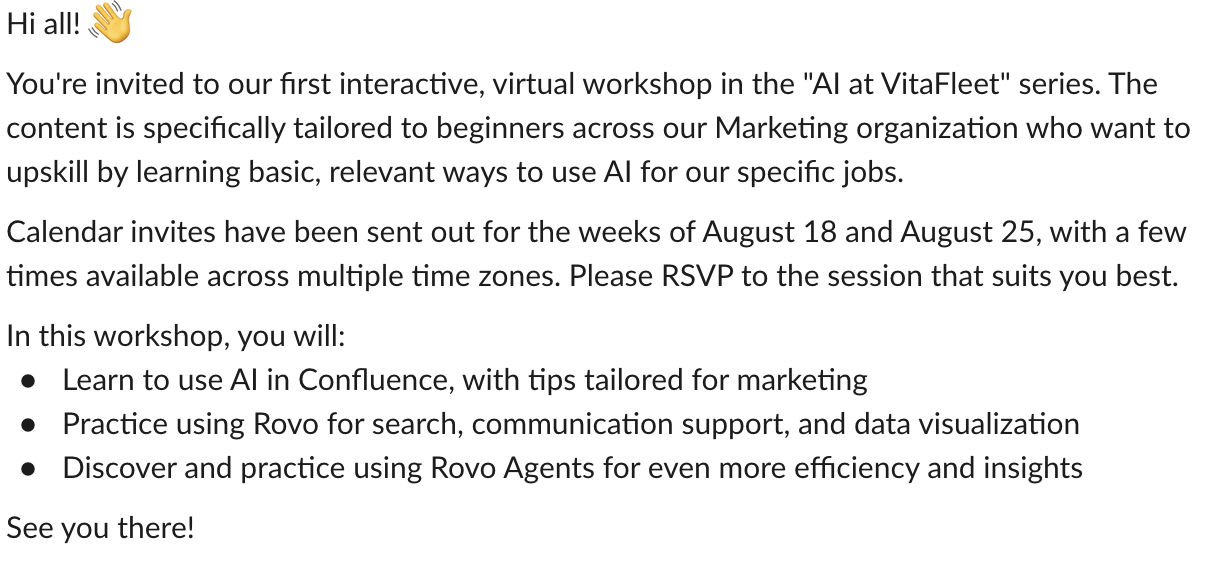
Sample announcement in Slack
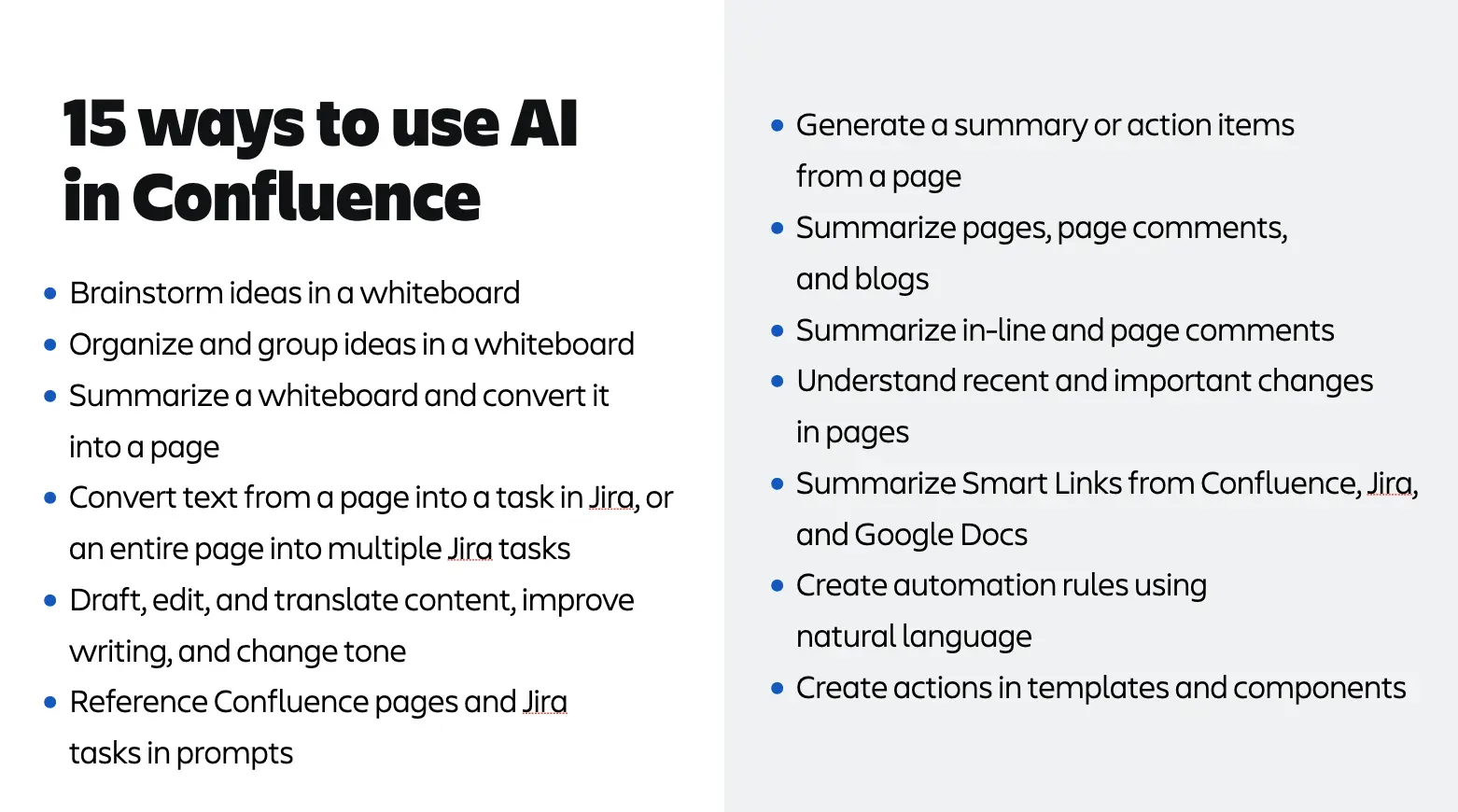
Sample use cases: AI in Confluence