Every company investing in AI tools is asking the same question: how many people actually need to be good at this for it to make a difference?
It’s a fair question. AI adoption is uneven. Some people use it constantly; others barely touch it. Leaders are left wondering whether the investment pays off unless everyone gets fluent, or whether a smaller critical mass is enough.
My team, the Teamwork Lab, got a chance to test this at Atlassian. Twice a year, Atlassian runs a company-wide hackathon called ShipIt, where employees form small teams and have 24 hours to build something — a prototype, a tool, a fix, or a wild idea brought to life. It’s voluntary, self-organized, and judged on innovation, customer impact, and completeness.
That makes ShipIt a useful testing ground: teams work within the same 24-hour time limit, follow the same basic format, and are judged against the same criteria. They also vary naturally in their size and AI fluency, giving us a rare chance to examine how team composition relates to outcomes in a real-world setting.
For our most recent ShipIt, the Teamwork Lab compared project judging scores against internal AI usage data for over 2,500 participants across 1,200+ teams. We wanted to know: does it matter how many AI-skilled people are on a team?
The answer was clear — and surprisingly specific. The biggest jump in team performance came from adding just one AI superuser to a team that previously had none. That single addition was associated with an 18-percentage-point increase in the likelihood of achieving a top score (defined as above the median across all judged teams).
More superusers continued to help, but the sharpest return came from the first.

Our research at a glance
What we did: We linked judging outcomes from Atlassian’s most recent ShipIt hackathon to internal AI usage data for 2,574 participants across 1,271 teams, then analyzed the 870 teams that submitted demos and received scores.
What we learned: Team size predicts whether a team ships. AI superuser presence predicts how strong the work is. The largest quality jump comes when a team goes from zero superusers to one. That single addition was associated with an 18-percentage-point increase in the likelihood of being a top-scoring team.
The 0→1 effect: how one superuser moves the needle
Atlassian defines an AI superuser as someone in the top quartile of weekly AI interactions within their function — a relative bar, since AI usage varies widely across departments. It’s not about how much someone uses AI in absolute terms; it’s whether they’re meaningfully ahead of peers doing similar work.
Nearly half of ShipIt participants (49%) cleared that bar, but they weren’t evenly spread across teams. Of the 870 scored teams, close to a quarter had no superuser at all.
Those teams paid for it. Compared to teams with just one superuser, teams with none were 18 percentage points less likely to receive a top (above the median) score for their project. The boost comes almost entirely from that first superuser; teams with 2+ superusers scored about the same as teams with one.
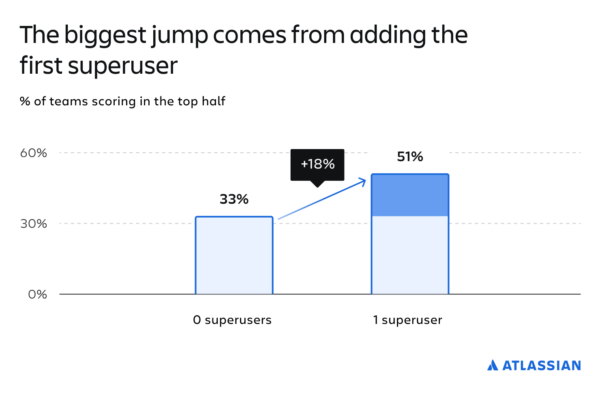
Compared to teams with no superusers, teams with at least one were:
- 19 pp more likely to be rated highly innovative
- 15 pp more likely to have high customer impact
- 14 pp more likely to be close to project completion
For team leaders, the practical implication is simple: if you can’t build an all-superuser team, getting to one may matter more than getting to many.
Team size determines whether you ship. AI fluency determines whether it’s any good.
One reason this finding interested us is that it separates two outcomes that often get blurred together.
Shipping and quality were not driven by the same thing.
- Team size predicted whether a team submitted a demo at all
- Superuser composition predicted whether that submitted work was top-scoring
According to our analysis, each additional team member made a team 79% more likely to ship. But team size had no meaningful effect on demo quality. Superusers showed the reverse pattern: they were strongly associated with better judged outcomes, but not with whether a team shipped in the first place.
What this means for team design
Two practical implications stand out:
- Know who your superusers are. These findings are only actionable if you can measure AI fluency across your teams. Atlassian’s approach: define superusers relative to their function, not against a single company-wide bar.
- Don’t assume AI skill is evenly distributed. Atlassian’s State of Teams 2026 research found that while 85% of knowledge workers use AI, only 29% have embedded it in their day-to-day workflows — and 55% of executives say AI is widening performance gaps between teams. A team with zero advanced AI users may be meaningfully disadvantaged, and you may have more of those teams than you think.
Most companies are focused on getting everyone to use AI at least a little. This research suggests the bigger lever is making sure every team has at least one person who uses it deeply. You don’t need universal fluency. You just need one superuser to act as a force multiplier.
Methodology
Atlassian’s Teamwork Lab linked ShipIt project ratings to internal AI usage data to identify whether each participant was an AI superuser, then modeled the relationship between team superuser composition and project judging outcomes. The dataset included 2,574 unique participants across 1,271 teams who competed in ShipIt 62 between April 16 and April 20, 2026. Analyses focused on the 870 teams that submitted demos and received judge scores. Top-scoring teams were defined as those with an overall judge rating above the median across all 870 scored teams, and we applied the same above/below-median split for each individual dimension (innovation, customer impact, and completeness). Superusers were defined as Atlassians in the top quartile of weekly AI interactions within their executive group. To isolate the effect of superuser composition, we controlled for team size in all models.