Imagine hiring a brilliant new employee who never reads their onboarding docs, doesn’t know your company’s history, and has to be reminded of the strategy every single meeting. That’s essentially what most organizations are getting from AI today — not because the technology is bad, but because it’s operating without context. And yet, when companies try to measure whether AI is working, they look at adoption: seat counts, prompt volume, usage dashboards. Those metrics tell you whether people are using AI. They don’t tell you whether it’s actually helpful.
New research from the Teamwork Lab suggests those two things are very different. In a survey of 1,002 U.S. knowledge workers, the bigger predictor of how much AI helps wasn’t how much employees used it. It was how much of their work the AI understood.

Key findings
- The more context your AI has, the more it helps. Knowledge workers whose AI has the greatest understanding of their work are up to 6x more likely to say it’s helpful across their core tasks.
- But most workers’ AI doesn’t really know their business. Just 12% of knowledge workers say their AI understands the company as well as a senior employee, while nearly half (45%) compare it to a brand-new hire, at best.
- There’s a major gulf between what workers need their AI to know and what it actually knows. For example, 77% of knowledge workers say it’s important for AI to thoroughly understand their company’s institutional knowledge, but only 21% believe it does. A similar gap holds across all types of context.
- Not all context is equal. The types that do the most to move AI’s output from “a good start” to “ready to go” are company data (insights, metrics, dashboards) closely followed by institutional knowledge (past decisions, documented processes, lessons learned).
- The better AI understands your work, the less of its output you have to fix. AI that understands your work produces up to 48% more outputs you can use without revision.
The AI that helps most is the AI that understands your work
For the last year, the story about AI at work has focused on adoption: how many people use it, how often, how deeply. By that measure, the battle’s won. But usage turns out to be a poor predictor of whether AI actually provides real organizational value.
Our latest Pulse survey of 1,002 knowledge workers points to a different driving factor, one that holds even when usage is constant: how much of a person’s work their AI understands. Those whose AI understands most of their work were up to 6x* more likely to say it’s helpful across their core tasks.
“Everyone’s been optimizing for adoption,” says Molly Sands, future-of-work expert and head of the Teamwork Lab. “But the workers getting real value aren’t the ones prompting the most; they’re the ones whose AI actually understands their business. That’s a different problem to solve, and most companies haven’t started.”
*Based on a logistic regression comparing knowledge workers who said AI understands their business like a tenured senior employee versus others, controlling for variables.
When AI lacks context, using it is like working with a newly hired junior employee
Too many organizations’ AI lacks concrete information about the business. Past Teamwork Lab research has found this lack of information results in a fragmentation tax that costs the Fortune 500 $161B per year. In our latest survey, when asked how well their AI understands their organization — the people, the history, the way things actually get done — only 12% of workers compared it to a tenured, senior colleague. Nearly half (45%) said it’s more like a newly-hired junior employee, at best. As one might expect, the workers whose AI has the least context are most likely to describe it as comparable to a brand-new junior hire.
How well does AI understand your business?
“We keep buying smarter models and wondering why the output’s still generic,” says Sands. “It’s not the model. It’s that the model isn’t connected closely enough to the specifics of your day-in and day-out, and most companies aren’t giving it a way to learn.”
Behavioral data backs up the survey findings
Our survey captures what knowledge workers believe. To see whether that belief holds up in practice, we looked at it from a different angle: behavioral data from DX, Atlassian’s engineering intelligence platform.
To test whether better context leads to better results, we analyzed anonymized user data from 272 customer organizations and found that those whose work heavily queried the Teamwork Graph — a tool that unifies, connects, and contextualizes insights for work — shipped up to 64% more work.
Critically, this trend held regardless of a user’s industry, region, or sector, demonstrating the value of context across sectors and segments.
Workers want to trust AI with real work, but don’t think it knows enough yet
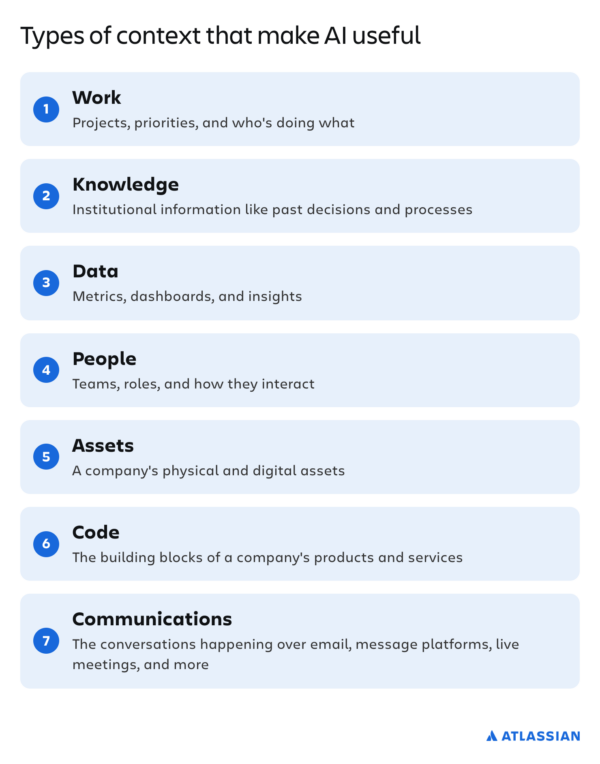
When AI doesn’t know the business, the cost isn’t just weaker output — it’s trust. Workers say the way to earn their trust is to genuinely understand what’s happening across their business, and they’re equally clear that today’s tools fall short. For example, 77% say it’s important that their AI thoroughly understands their company’s institutional knowledge, but only 21% believe it does. A similar pattern holds across every type of context.

“People aren’t skeptical of AI in the abstract,” says Sands. “They’re skeptical of handing real work to something that doesn’t know how their company actually operates. That’s a reasonable instinct. But it goes away the moment the AI proves it understands the work.”
Start with the most valuable context: company data and institutional knowledge
The good news for leaders staring at a sprawling knowledge base: you don’t have to connect everything at once. All types of context matter, and which ones pay off most will depend on your industry and the functions you lead. But if you’re looking for a place to start, the research points toward company data and institutional knowledge.

And that better understanding doesn’t just make AI feel more helpful; it prevents rework. AI that understands your work produces up to 48% more outputs you can use without revision.
“Think back to the new hire versus senior colleague distinction,” says Sands. “What makes a tenured employee so much more valuable isn’t just their skills — it’s what they know: the past decisions, documented processes, and lessons learned that only come from time inside the organization. Giving AI access to that institutional memory is the most direct path to closing the gap between ‘new hire’ and ‘trusted colleague.’”
Methodology
Between July 28 and August 3, 2026, Atlassian’s Teamwork Lab conducted a double-blind survey of 1,002 full-time U.S. knowledge workers on AI use, contextual understanding, output quality, and trust in AI at work. Respondents spanned industries, functions, seniority levels, and generations. Analyses of the drivers of AI helpfulness account for role, generation, industry, function, company size, and usage intensity. The survey measured how well workers believe their AI understands types of business context — data, knowledge, people, communications, work, assets, and code — how important that understanding is to trusting AI with their work, and the share of AI output usable with little or no editing. Data on developer productivity is from an analysis of 272 DX and Atlassian customers, and combines productivity metrics with product telemetry.