For the past two years, the enterprise AI message was simple: use more of it. Experiment, adopt, scale. But a recent survey of U.S. knowledge workers from Atlassian’s Teamwork Lab finds that as AI becomes central to daily work, its costs are coming into focus and a new question is surfacing: are we getting our money’s worth?

KEY FINDINGS
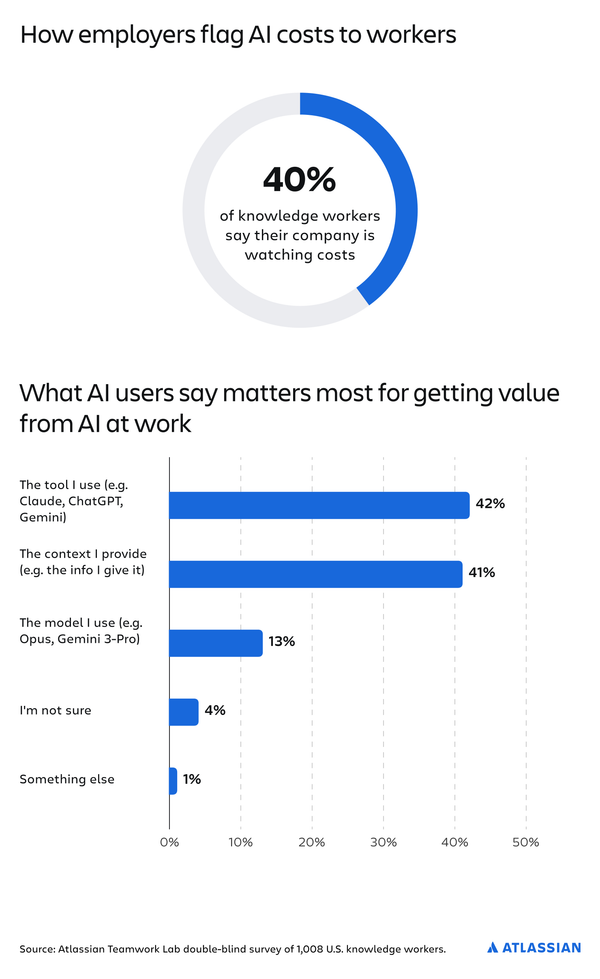
- Cost awareness is arriving. Two in five AI users (40%) say that in the past three months they’ve been asked to watch or justify their usage, or hit a real limit: a usage cap, lost access, or a move to a cheaper tool.
- Commitment to AI is holding, even as cost discipline grows. 84% of AI users say their company is holding steady (48%) or going all-in (36%). Only 3% report a pullback.
- Many people can’t see what AI costs. Nearly half of AI users (49%) don’t know, or aren’t sure, what their company pays for the tools they use. Visibility is concentrated at the top: 67% of leaders can see AI spend, versus 37% of managers and 22% of individual contributors.
- Being told to be mindful of costs doesn’t stick. Of the workers who’ve felt squeezed on AI costs, fewer than a third (31%) actually changed how they work; the rest carried on as before. And 39% of all AI users say they’d resist changing even if explicitly asked to save money.
- Context beats model type in driving AI value. Asked what makes AI worth the cost, workers point to the tool they use (42%) and the context they give it (41%) far more than the specific model (13%).
The scrutiny is real, but it’s barely changing how people work
In Atlassian’s latest survey of more than 1,000 U.S. knowledge workers, two in five AI users (40%) say that in the past three months they’ve been asked to watch or justify their AI use, or even run into a hard limit: a usage cap, lost access, or a move to a cheaper tool.
It would be easy to read the growing cost scrutiny as the start of a retreat, but business commitment to AI transformation is holding strong; 84% of AI users say their employer is steady on AI investment or going all-in, and just 3% report a pullback. Together those numbers describe cost discipline: companies still betting on AI while they start asking what each dollar returns. The mandate is maturing, from “use more” toward “use it well.”
And yet, the data also shows that asking people to be careful does little on its own. Of the workers asked to watch their AI costs, fewer than a third (31%) actually changed how they work. The rest carried on as before.
“Telling people to ‘be careful’ with AI mostly bounces off. It’s easy to say and almost impossible to act on,” says Dr. Molly Sands, head of Atlassian’s Teamwork Lab. “When people can see what their AI costs, hone their understanding of where using AI pays off, and have the context to get more from every interaction, the spend takes care of itself.”
Many people can’t see what AI costs, or how to lower it
The real obstacle is visibility. Nearly half of AI users (49%) don’t know what their company pays for the AI tools they use, and 46% don’t know how to lower their costs beyond the blunt option of using AI less. Many people have neither a number to measure against nor a way to bring it down.
The visibility tracks with technical skill. 77% of technical employees know what their AI use costs, versus 45% of everyone else.
Perhaps more troublingly, the blind spot also tracks with seniority. Two-thirds of leaders (67%) can see what AI costs, but that visibility thins fast on the way down: just 37% of managers and 22% of individual contributors can see it.
That leaves managers in a bind. When a mandate for AI efficiency comes down from the top, they’re the ones expected to carry it out, yet most can’t see the very spend they’d be accountable for managing.
“Most people don’t think about it because we never directly feel or see the cost of using AI at work,” said one respondent. (Manager, Business Administration, Government)
The workers getting the most from AI aren’t looking to give it back
Thirty-nine percent of AI users say they’d be reluctant to change how they work even if explicitly asked to save money. As one respondent put it: “I don’t care how much AI costs, I need it to do my job and the company can pay for it.” (VP, Finance, Tech)
That reluctance is strongest among the workers who’ve changed their work the most. Among those for whom AI is “my new normal” or “my team’s standard,” half (50%) have been told to watch costs, versus under a third (32%) of lighter users. Yet they’re the least likely to act on it: among the deep users, 61% say they’d be reluctant to change even if it saved the company money. This pattern is clearest in marketing, the one function where a majority (66%) report being asked to watch their usage in some way.
“The instinct to make your heaviest AI users cut back is backwards,” says Sands. “They’re the ones getting the most value from it, which makes them the first people who should get visibility into their spend and the tools to work efficiently, not the first asked to slow down.”
What makes AI worth the cost: context, not the model
Ask workers what makes AI valuable and two answers effectively tie: the tool they use (42%) and the context they give it (41%). The specific model runs a distant third, at 13%.

Our own data backs the instinct. A recent Teamwork Lab study found that workers whose AI understood their work were up to 6x more likely to call it helpful, and got up to 48% more output they could use without reworking it, compared with workers whose AI had the least context. Better context makes AI more useful and cuts the expensive rework of fixing weak output. That’s where the real savings are.
“As models and tools converge, what sets AI apart is how much of your organization it actually understands: your institutional knowledge, your active work, your people, your data,” says Sands.
What companies can do
The path to lower AI costs is to make good use easy, not to make access hard. Three moves matter:
- Give people visibility into what their AI use costs. You can’t ask someone to be careful with a number they’ve never seen. At Atlassian, we’ve built every employee a real-time view of their own AI spend, a budget to work within, the freedom to use whatever tool fits the job, and a simple way to request more when the work calls for it. Those requests are mostly approved. The point is to make cost visible and put people in control of their own usage.
- Help people get more from every interaction. Beyond sharper prompts, that means giving AI richer organizational context that’s connected, relevant, and complete, and choosing the right tool for the task instead of defaulting to the most powerful and most expensive one.
- Treat context as infrastructure. The companies that get the most value per dollar won’t be the ones using AI least. They’ll be the ones feeding it the best context.
“The economics of AI are still taking shape, but the smart move is already clear: help people get more from every dollar rather than asking them to spend less,” says Sands. “Let them see what their AI costs, pick the tool that fits, and get the context that makes AI genuinely useful. And put that in everyone’s hands, not just the budget owners’. That’s what we’re doing at Atlassian, and what we’d tell any company to do.”
Methodology
Between August 25 and 28, 2026, Atlassian’s Teamwork Lab conducted a double-blind survey of 1,008 full-time U.S. knowledge workers on AI use, the cost scrutiny taking shape around it, and what workers believe drives AI’s value. Respondents spanned industries, functions, seniority levels, and generations. The survey measured how workers use AI and how they feel about it; whether they’ve been asked to watch, justify, or limit their AI use and how they’ve responded; how much visibility they have into what their AI costs and their confidence in reducing that spend; and whether they attribute AI’s value most to the tool they use, the context they give it, or the underlying model.