New research from Atlassian’s Teamwork Lab surfaces a tension at the heart of AI at work: adoption is nearly universal, but acceptance is lagging far behind.

Key findings
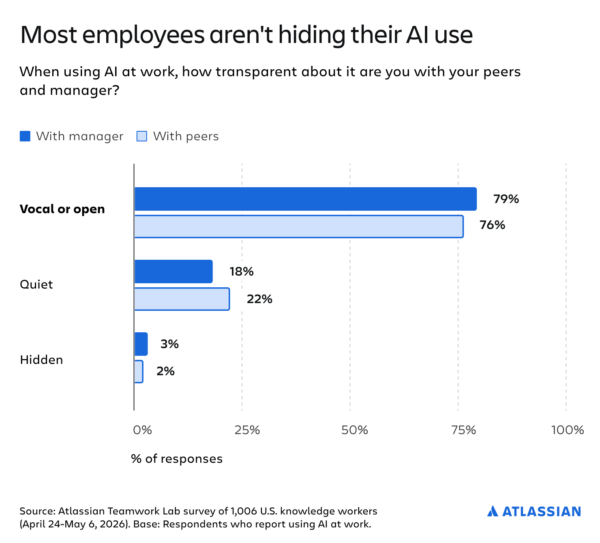
- AI at work is near-universal and employees are remarkably transparent about using it. 94% of U.S. knowledge workers report using AI at work and roughly 3 in 4 are vocal about that use with their manager and peers.
- But disclosing use of AI carries a steep penalty. In a controlled experiment of nearly 1,000 U.S. knowledge workers, participants rated a hypothetical peer who disclosed their AI use as 10x lazier, and were 24 percentage points less likely to recommend them for a high-visibility project, even when the output was identical.
- Framing matters, but silence is safer. Workers who framed their AI use as team-focused were rated 11 percentage points higher on effort and 8 points more likely to be recommended than those who cited personal efficiency. But both groups still ranked well below employees who didn’t mention AI at all.
- Culture is the real fix. In companies that actively celebrate AI use, the laziness penalty almost entirely disappears, and AI users are rated as more efficient than peers who don’t disclose.
Everyone does it, but the honest ones get punished
The secrecy around workplace AI is officially lifting. While 94% of knowledge workers report they used AI last month (and two-thirds did so regularly), they aren’t hiding it: nearly 80% are entirely transparent with their managers and peers.
And yet, researchers found that disclosing AI use carries a steep professional cost. Even when evaluating identical work, colleagues rate AI users as 10 times lazier and are 24 percentage points less likely to recommend them for high-visibility projects, indicating that while the secrecy around AI use may be fading, the stigma is still severe.
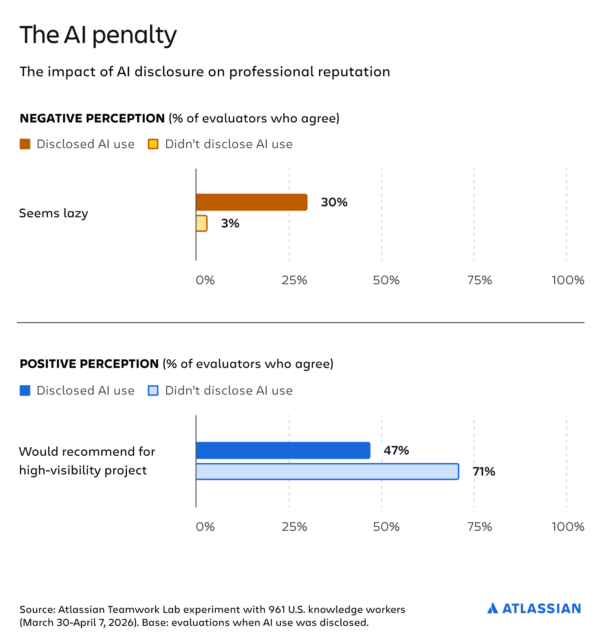
These insights come from a controlled experiment with 961 U.S. knowledge workers, run alongside a 1,006-person pulse survey on AI adoption and attitudes. In the experiment, workers evaluated identical pieces of written work — the main variable was whether they were told AI helped create it. When AI use was disclosed, evaluators rated the creator as significantly lazier, less principled, and less worthy of recommendation.
Together, the data reveal a workforce that’s adopting AI faster than its culture can absorb. Traditional workplace norms—how much to share in a meeting, when to CC your boss, how to take credit gracefully—were established through years of observation and osmosis. But AI doesn’t have that runway. Workers are improvising a brand-new etiquette in real time, and, as the data shows, guessing wrong carries a real cost.
“This isn’t a technology problem; it’s a social and cultural one,” says Molly Sands, head of the Teamwork Lab. “Companies are telling the workforce to use AI, but employees are penalizing each other for being honest about it. Until leaders change the culture, you don’t have an AI strategy; you have an AI contradiction.”
The AI penalty is real, but it’s not inevitable. Here’s how to shrink it.
Frame AI use as “for the team,” not “for me”
Compared to those who said using AI “saved me time,” workers who framed AI use as “supporting the team and client” were rated 11 points higher on effort (45% → 56%) and 8 points more likely to be recommended (43% → 51%). But both still landed well below workers who didn’t mention AI at all.
Culture is the real differentiator
In companies that actively celebrate AI use—where peers and leaders model it and wins are highlighted—the laziness stigma nearly disappears, and AI users are actually rated as more efficient than colleagues who don’t disclose.
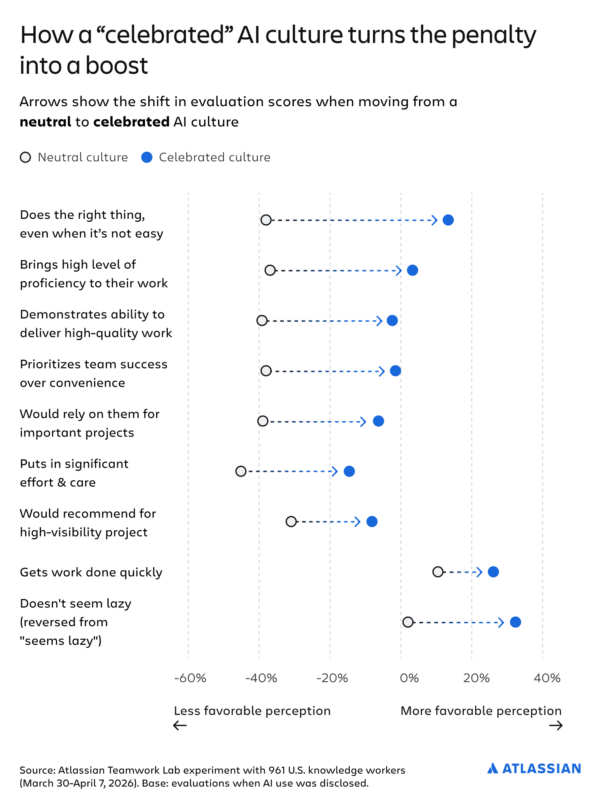
Prior research, including Atlassian’s own, consistently shows that AI-celebrating cultures are concentrated in pockets — tech-forward industries and functions where AI tools have been embedded the longest. That means the same behavior that earns trust in one workplace invites suspicion in another.
“The gap between workplaces is bigger than many people realize,” says Sands. “In my world working in tech, if you’re not using AI at all, you’re the one who has to explain yourself. But these findings make clear that my experience is the exception. Most workers are navigating an environment where that same openness is a liability.”
The takeaway
Corporate leaders have spent years trying to solve the AI adoption problem, but that battle is already won — 94% of knowledge workers are using the technology. The new, much harder problem is the cultural fallout: an environment that penalizes employees for the exact honesty it claims to value.
That’s not just a morale issue. It’s a strategy risk. When workers learn that honesty about AI gets them labeled as lazy, the rational response is to stop talking about it. And organizations where AI use goes underground lose the ability to learn from it, scale what works, and catch what doesn’t.
Workers can’t solve this on their own, says Sands. “Saying you’re using AI in service of the team can soften the stigma, but it doesn’t erase it. The fix is culture: leaders who use AI visibly, teams that treat it as a shared tool rather than a shortcut, and organizations that reward outcomes over optics.”
Methodology
This research draws on two complementary data sources:
Controlled experiment. Between March 30 and April 7, 2026, we conducted an experiment with 961 full-time U.S. knowledge workers. All participants were asked to evaluate the same work product (an email summarizing a business proposal) from the same hypothetical colleague. The only variable was a short note describing how the work was completed — either with no mention of AI (control) or with an AI disclosure that varied in level of detail and stated motivation. Participants then rated the colleague across several dimensions, including perceived effort, competence, laziness, and how willing they were to recommend the colleague to a senior leader for a high-visibility project. We also asked participants to describe their own team’s norms around AI, from “prohibited” to “celebrated,” allowing us to test whether workplace culture moderates the AI penalty.
Pulse survey. Between April 24 and May 6, 2026, we conducted a double-blind survey of 1,006 U.S. knowledge workers on their AI adoption, usage patterns, disclosure behaviors, and attitudes. Respondents spanned industries, functions, seniority levels, and generations. The survey measured how frequently workers use AI, the depth of their integration (from ad-hoc use to team-wide standard), and how openly they share their AI use with managers and peers.