When a tool can do in seconds what used to take hours, it’s natural to wonder if there will be any work left for humans. But new research from Atlassian’s Teamwork Lab suggests the opposite: Rather than shrinking an employee’s remit, AI appears to be expanding both the breadth of what employees take on and the depth at which they operate.
Earlier this year, researchers at Berkeley Haas studied AI adoption at a single technology company over eight months and found that workers who used AI took on broader responsibilities and tasks that previously sat with other roles.
The Teamwork Lab findings expand on that research at a wider population scale, with new data on where the expanded effort is actually going.

Key findings
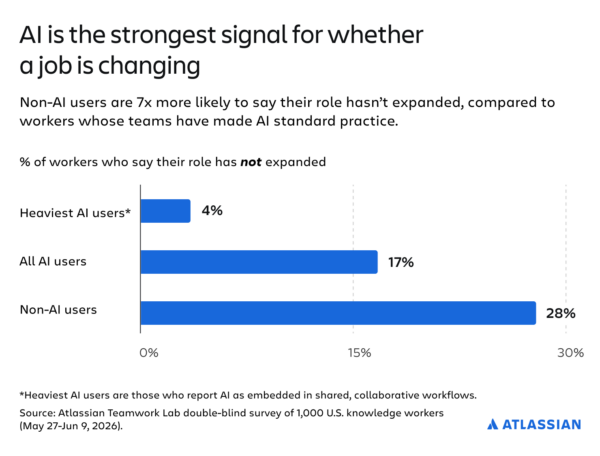
- AI appears to be expanding roles, not shrinking them. 92% of knowledge workers report their responsibilities have expanded beyond their original job description over the last year, but AI use is the clearest dividing line. Workers who don’t use AI are 7x more likely to say their role has stayed the same, compared to the heaviest AI users.
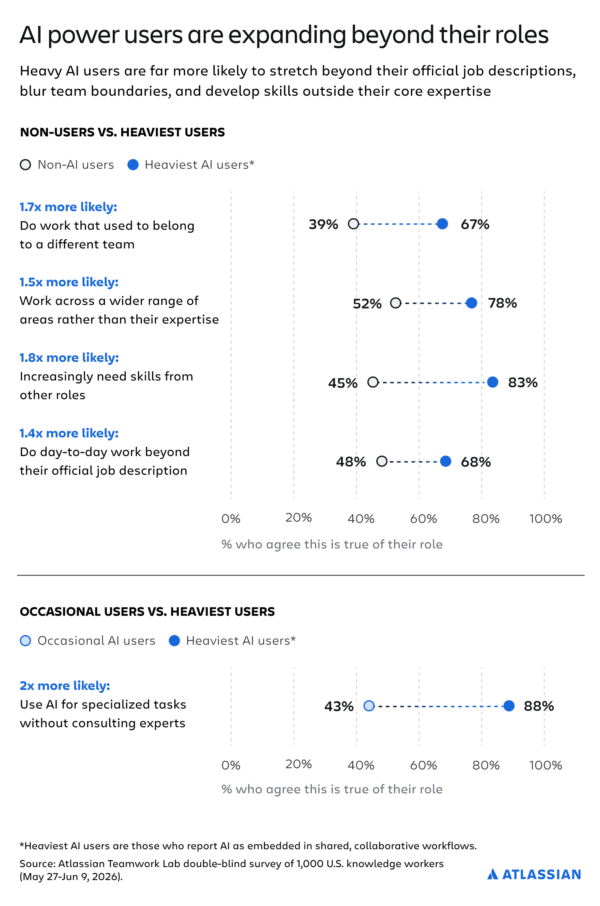
- The more you use AI, the more your territory expands. Workers who’ve made AI a daily habit are nearly twice as likely to take on work from other teams — and twice as likely to handle specialized tasks without looping in an expert.
- AI shifts your job from doing to leading. The more workers use AI, the more their role shifts from execution to oversight. Heavy AI users spend their gained time on management and direction; non-users spend theirs heads-down. The deeper the AI habit, the faster the shift from doing the work to leading it.
- AI widens your cross-functional reach, but not your relationships. Heavy AI users are up to 72% more likely to take on cross-functional work. But every AI user group ranks time with colleagues dead last, while non-users rank it third. This suggests AI users are collaborating across more teams without actually getting closer to anyone on them.
Role expansion is the rule, not the exception
Atlassian’s Teamwork Lab surveyed 1,000 U.S. knowledge workers between May 27 and June 9, 2026. Role expansion turned out to be nearly universal: 92% of respondents say their responsibilities have grown beyond their original job description in the last year. But the gap between AI users and non-users is stark. Non-AI users are 7x more likely to say their role hasn’t changed, compared to the heaviest AI users — making AI adoption the single strongest signal in the data for whether someone’s job is changing.
New territory, not just more territory
The expansion isn’t simply “more of the same work, faster.” Workers with the deepest AI habits report doing fundamentally different work — tasks that used to require a specialist or belong to another team entirely.
The heaviest AI users are stretching beyond their official job descriptions and blurring team boundaries. They’re nearly twice as likely to take on work from other teams and they’re twice as likely to use AI to handle specialized tasks without looping in an expert.
The expansion plays out differently by function. Marketers are the only group where over half of heavy AI users report stretching into both more creative work and more technical work. In IT and engineering, the stretch is into communications and cross-functional coordination — territory that’s traditionally belonged to other teams.
But the most consequential shift may be where heavy AI users are spending their time. While non-AI users report more heads-down execution time, the heaviest AI users report the opposite — they’re spending the most on oversight, management, and directing work rather than doing it themselves.

The pattern holds across seniority levels, suggesting AI use itself, not just career stage, is driving the altitude shift.
“Experts have long predicted that AI would let employees operate at a higher level,” says Molly Sands, future-of-work expert and head of the Teamwork Lab. “They were right—it’s just happening faster than anyone expected. Heavy AI users aren’t staying in their lane. They’re stretching across functions they never used to touch, with more capability than ever.”
The connection gap
There’s a tension buried in the data. Heavy AI users are working across more teams than ever — they’re 72% more likely than non-users to report an increase in cross-functional work. But when asked how they actually spend their time, AI users rank connecting with colleagues dead last. Non-users rank it third.
Connection ranks low across all AI sophistication groups, not just the heaviest users — which means the relationship between AI use and workplace connection is more complex than a simple trade-off. It’s a question other researchers are watching too — recent studies have flagged fewer informal interactions and greater reliance on machine support over human support as AI adoption grows.
What’s clear is that roles are stretching wider and faster, but the connective tissue that makes cross-functional work actually function may not be keeping pace. It’s a signal worth watching.
“Role expansion without connection is fragile,” says Sands. “You can stretch a job to work across more teams, but if the relationships underneath aren’t growing with it, you’re building on scaffolding that won’t hold.”
What leaders can do about it
Role expansion is already happening — the question is whether organizations shape that growth or just let it sprawl.
Two places to start:
Make AI use visible, valued, and normal. If roles are expanding because of AI, but disclosing AI use carries a professional penalty, you’ve created a system that punishes the very behavior driving growth. In a recent Teamwork Lab experiment, workers who disclosed using AI on a task were perceived as 10x lazier, even when the work was identical. But that stigma nearly disappeared in teams where leaders actively celebrated AI use. Role expansion stalls when people have to hide how they’re getting it done.
Don’t let people stretch into new territory alone. Cross-functional expansion works when it comes with lightweight support from the people who already own that domain. Not a formal training program, but a consultative relationship: a short scoping conversation, a shared example of what “good” looks like, and a channel for quick questions. Without that, expanded roles produce shaky work and frustrated people. With it, the person stretching builds real capability and the expert’s knowledge becomes more valuable, not less. Atlassian’s Network of Teams play offers one starting framework for building those connections deliberately.
“Simply handing people more responsibility isn’t a strategy,” says Sands. “Expanded roles only hold up when organizations invest in what sits underneath them — the norms, the relationships, the support structures that turn a bigger job into a sustainable one.”
Methodology
Between May 27 and June 9, 2026, Atlassian’s Teamwork Lab conducted a double-blind survey of 1,000 U.S. knowledge workers on AI use, job scope, time allocation, and attitudes toward AI at work. Respondents spanned industries, functions, seniority levels, and generations. The survey measured how frequently workers use AI, the depth of their integration (from ad-hoc use to team-wide standard), time allocation across key work categories, and the extent to which roles have expanded beyond original job descriptions.