
Think about your to-do list for a given work week. From responding to a colleague’s quick message to building a team strategy, how do you prioritize how much time and energy to allocate to each task?
Behavioral science tells us most of us don’t optimize; we satisfice — we find the first “good enough” option, and we move on. The term, a mash‑up of “satisfy” and “suffice,” was coined by Herbert A. Simon, a mid‑century Nobel Prize–winning economist and sociologist who studied workplace decision making. Satisficing, Simon argued, is a pragmatic way to work, especially for quick-turn, low-stakes tasks or for complex decisions where the complete picture is ambiguous or unknowable.
But while satisficing may have made sense for generations of workers, AI has rewritten the rules. Now, “good enough” appears instantly, often before anyone thinks deeply about the question or challenge at hand. That speed might be great for the small stuff, but when it becomes the norm for everything, teams risk sliding into sameness, shallow reasoning, and — at worst — making the humans in the equation entirely irrelevant.
Atlassian’s view is simple: AI should amplify human judgment, not replace it. But given our natural inclination to satisfice, that won’t happen by default. Teams need to intentionally decide how and when to invite AI into the room, choosing the mode of collaboration that best fits the project at hand.
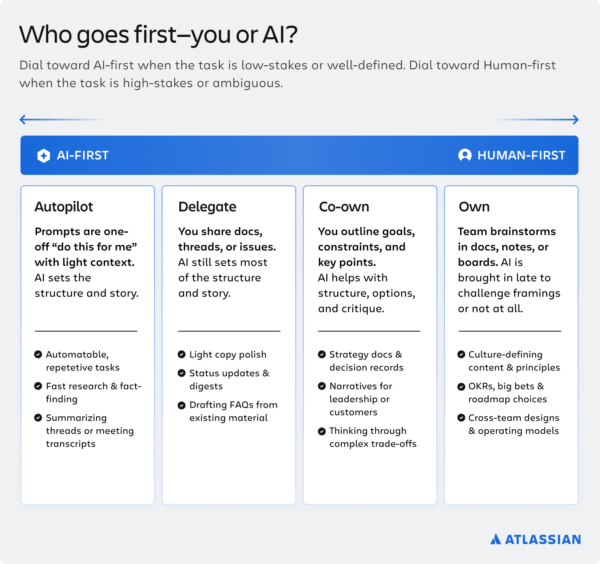
This post introduces the AI Collaboration Framework: a tool designed by Atlassian’s Teamwork Lab that teams can use to turn the dial from AI‑first to human‑first thinking, depending on the needs of the project. Use it to safeguard the capabilities that make your people valuable: human judgment, taste, and the ability to think deeply and originally.
Why over‑reliance on AI is risky: three evidence‑backed pitfalls
Pitfall 1: AI‑induced groupthink
Good leaders don’t let the loudest voice go first. They use techniques like brainwriting to surface diverse ideas before discussion. But with AI, many teams are doing the opposite: asking the model to go first, then reacting. Research is beginning to quantify the cost of this approach. Studies of human-AI creative writing show individuals may look more creative on average when they use AI, but the set of outputs as a group narrows and clusters around model‑suggested patterns.
When every whiteboard starts with an AI‑generated draft, you get speed at the expense of variety. That’s dangerous for strategy and innovation, where outliers and contrarian angles often drive breakthroughs.
Pitfall 2: “Cognitive surrender” and loss of deep work muscle
Early neuroscience and human-computer interaction research indicates heavy reliance on AI corresponds with lower neural engagement and weaker recall of one’s own reasoning. In one MIT study, LLM users showed the weakest brain response during a writing task and struggled most to accurately quote their own work. Even more concerning, when heavy AI users switched to writing without AI, their neural response remained lower, indicating a lasting decline.
Researchers at Wharton coined the term “cognitive surrender” to describe this effect, finding that when study participants had access to AI they often deferred their own reasoning to it, getting more accurate when the AI was right but missing mistakes when it was wrong. The researchers also found that simply having access to AI inflated participants’ confidence in their accuracy, even on incorrect answers. And this isn’t just a lab effect: in a recent Anthropic survey of 81,000 global AI users, cognitive atrophy was the fourth most cited concern.
Teamwork Lab observed a similar pattern in our qualitative research studies. While AI may make some work feel easier, that convenience can dull your thinking and erode your appetite for tackling the hard problems. “It’s easy to just plug every question you have into AI,” said one software engineer. “When you need to think through something that’s too complex for AI, or you can’t trust AI to do it, then you’re faced with, ‘Oooh, I haven’t done this in a while.’ It feels harder than would have been maybe a year or two ago.”
Pitfall 3: Hollowing out your own value
In a world where anyone can instantly generate a decent draft, the most precious resources are your judgment and taste: your innately human ability to decide what matters, spot what’s missing, and shape a point of view that fits this customer, this market, this moment.
In cognitive science, the “illusion of explanatory depth” describes how humans often believe we understand complex systems until we are forced to try to explain them. With AI, the new risk is that insta-smooth explanations intensify this illusion, creating a false and unearned sense of mastery. When we start with a model’s explanation, we can feel informed without doing the sense‑making ourselves, becoming forwarders of plausible answers rather than owners of the reasoning.
Do this often enough, and you may be forwarding yourself right out of a job.
“Whatever your core value is that you’re bringing to Atlassian, you want to get really good at that and understand what you bring to the table that a ChatGPT Pro account doesn’t,” said another software engineer.
The AI Collaboration Framework: a tool to protect your team’s right to think
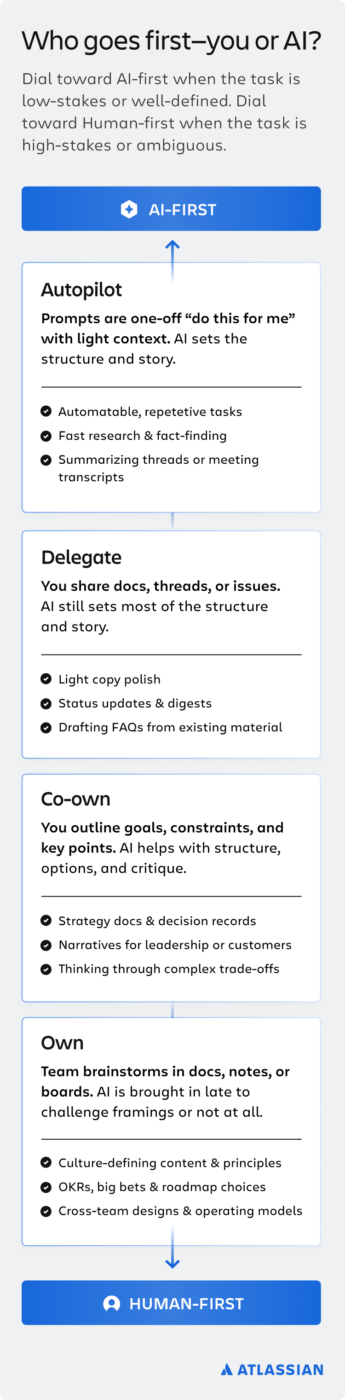
If your team is guessing when to go fast with AI and when to slow down and think, you’re liable to fall into the satisficing trap. Use this framework to help your people make that choice explicit.
Putting the framework to work: practical guidance for teams
The first step to protecting your team’s right to think is to name this concern explicitly and weave it into your ways of working. For years, teams have heard the vague directive to “use AI more,” but rarely with clarity on how, when, or why it should be used in their unique context. (Case in point: Atlassian’s latest State of Teams report found that while 85% of knowledge workers use AI in some capacity, 40% say they aren’t being taught how to use it.) That ambiguity breeds anxiety (“Am I doing this wrong?”) and over‑reliance (“If AI says it, it must be right”).
To strike the right balance, leaders need to treat AI as a team sport, not a solo effort. That means intentionally designing how AI shows up in shared rituals, decisions, and collaboration patterns, not just encouraging individuals to squeeze more output into already overloaded days.
1) Set explicit norms with AI working agreements
Start by establishing AI working agreements, living guidelines that you revisit and update at a regular cadence. These agreements set the tone for how your team approaches AI as part of your ongoing culture.
Then, at every project kickoff, make it a habit to define AI’s role, deciding together where to set the dial for each part of the project.
- Try the AI working agreements play
- Try the Define AI’s project role play
2) Make human thinking visible before AI
Guard against AI‑anchored groupthink with a simple ritual: think first, capture, then use AI. For higher ambiguity and higher stakes group projects like strategy docs, risk analysis, or design options, ask contributors to articulate their own thoughts before anyone opens a prompt. That might mean jotting down bullet points privately, whiteboarding with a partner, or recording a quick video where you talk through the problem out loud. Then hand your notes or transcript to AI to organize and sharpen.
The key is sequence. When you start from AI’s polished default, you risk anchoring the whole team to a single model-generated point of view. But when you start from your own unfiltered thinking, the output reflects your own judgment.
- Try the AI Brainstorming play to turn a rough “think-aloud” recording into a clear plan.
3) Protect deep work windows
If everything is a sprint, satisficing is the only rational strategy. Encourage employees to block time for deep thinking and focus work. Treat it like any critical meeting: protected time with a clear goal (e.g., craft the “so what,” list contrarian hypotheses, articulate tradeoffs).
- Try the Redesign your calendar play
4) Run AI Retros to dial in on effective use cases
After milestones, spend 10 minutes on AI’s effect:
- Where did AI accelerate us?
- Where did it anchor us prematurely or flatten diverse ideas?
- What should we change about when humans think first next time?
- Try the AI Retros play