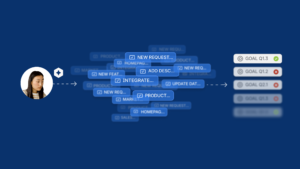
AI at work has a physical dimension that almost no one is talking about.
Across industries, companies have spent the last two years accelerating individual productivity with AI. Drafts get written in seconds. Code gets reviewed in minutes. Research now takes days, instead of weeks. And yet teams don’t feel faster. Decisions still stall. Projects still drag on. The bottleneck hasn’t disappeared, it’s just moved elsewhere.
Our research on 12,000 knowledge workers and 172 Fortune 1000 executives reveals why: as AI compresses execution, the constraint shifts to judgment, alignment, and decision-making — the work that happens between people, not inside a single person’s workflow. This constraint adds up, and costs the F500 an annual $1.61B in what we call the fragmentation tax.
Coordination happens online. But even though Atlassian is fully-distributed, we still invest in our offices, because we believe in the value of coordinating in-person. The offices of today, however, were designed under the assumption that the hardest part of knowledge work is execution. Now that AI handles much of that execution at remarkable speeds, the office needs to shift focus to make coordination similarly frictionless.
“What we learned from going distributed-first still holds in the AI era: the office serves as an incredibly important release valve. AI doesn’t need an office, but the humans using it do — for the energy, creativity, and momentum that can only come from being face-to-face,” says Dr. Alisa Yu, Senior Research Manager, at Atlassian’s Teamwork Lab.

our research at a glance
To understand the role of offices in the human-AI era — and what to do about it — the Atlassian Workplace team partnered with Teamwork Lab in an intensive multi-day sprint. We brought together behavioral research on how AI is changing the nature of knowledge work with workplace design expertise on how physical environments shape team behavior. We drew on three bodies of evidence:
- The 2026 State of Teams report — surveying 12,000 knowledge workers and 172 Fortune 1000 executives on how AI is reshaping collaboration patterns, decision-making, and team performance.
- Atlassian’s own office data and experience — utilization studies, behavioral observation, and design research across our global offices. Crucially, we’ve been here before: the shift to distributed work forced us to fundamentally rethink how teams coordinate across distance. AI is an intensified version of that same journey. We’re drawing on what we learned then to move faster now.
- Interviews with Atlassian leaders — conversations with senior leaders across the company about how team needs are evolving as AI becomes embedded in daily work.
The sprint produced a framework for designing offices around the actual flow of AI-augmented work — not the flow of work as it existed five years ago. This framework now serves as the guiding compass for how we’ll be experimenting with AI-enabled offices in the coming year.
The behavioral shift your floor plan hasn’t caught up with
In our research on AI superusers, we found that the highest-impact users don’t just produce faster. They spend more of their time in calibration mode: comparing AI-generated options, challenging assumptions with colleagues, and making decisions together about what to ship.
But 87% of knowledge workers tell us there’s no time or capacity to coordinate. The speed is there. The alignment hasn’t caught up.
Now translate that into physical space.
Most offices today are still organized around two modes: focus at your desk and meet in a conference room. That binary made sense when execution was the bottleneck.
It doesn’t hold when AI compresses execution cycles and pushes more effort into the spaces between. What spaces are best designed for the 15-minute decision that is increasingly the standard unit of progress?
One Fortune 500 executive in our research put it bluntly: “We are an orchestra without a conductor.” AI gave everyone a faster instrument. Now, we need to redesign the concert hall.
A blueprint for the AI-enabled office: Ideate, calibrate, regulate
Traditional workplace design organizes space around Focus, Collaborate, and Connect. It’s a useful shorthand, but it doesn’t account for how AI reshapes what people need from their environment.
We propose three flow states shaped by AI’s presence — and for each, what the work actually is and what the space needs to support:
Ideate (what to build)
When AI can produce almost anything, the scarce resource is knowing what’s worth making. Ideation is voice-first, rapid-generation work: human idea origination before prompting. The creative spark that gives AI something meaningful to amplify.
Ideation spaces support this by minimizing friction to getting started. Think writable walls, informal seating, and low-surveillance environments where half-formed ideas feel safe to say out loud — before they’re ready to be typed into a prompt. The goal is to protect the messy, generative thinking that AI cannot replicate.
Calibrate (what to ship)
When AI removes the cost of execution, the bottleneck becomes coordinating with others on what is right, useful, and ready. Meetings are no longer what we need. It’s decision intelligence: comparing options side by side, challenging AI-generated outputs, committing to a direction together.
Calibration spaces give that coordination work a physical home: shared displays for comparing options, room configurations that support rapid decision-making, environments designed for 15-minute alignment sessions rather than hour-long status meetings.
Regulate (how to sustain)
As AI speeds everything up, protected time to think clearly and connect with others must be built into the rhythm of work — not offered as a perk.
What used to be wellness nice-to-haves has becoming increasingly essential. Research on AI over-reliance found that heavy AI users show signs of what researchers call “cognitive surrender” — deferring their own reasoning to AI, losing the deep-thinking muscle that makes their judgment valuable. Regulation spaces are the battery charger: quiet rooms, outdoor areas, social settings without screens. They protect the conditions for original thought in an environment that’s constantly pulling people toward speed.
The role AI will play in office design over time
The second dimension of the framework maps how AI’s physical presence will evolve:
| Now | Next | Later | |
| AI presence | Invisible (screen-based) | Voice-enabled (mics, speakers, pods) | Spatial (light, sound, adaptive environments) |
| Collaboration mode | Embedded assistant | Active collaborator | Ambient teammate |
| Physical expression | No spatial change | Voice-first environments, calibration rooms | AI embedded in environment, responsive spaces |
Most offices sit in the left column — AI is invisible and screen-based, requiring almost no spatial adaptation. But the shift to voice-first interaction is already underway. Gensler’s 2026 Workplace Survey notes that AI agents are becoming “contributing team members” and companies are already asking how they physically show up in the office. When prompting moves from typing to talking, your acoustic strategy, your ratio of enclosed to open settings, and your AV specification all need to follow.
The framework’s value is that it lets you make decisions today that don’t paint you into a corner tomorrow. You don’t need to build for the “Later” column, but you can benefit from building toward it — modular infrastructure, adaptable AV, settings that can evolve as AI capabilities mature.
Importantly, as AI presence rises, so does the need for trust architecture. Employees need to know — visually and immediately — where AI is listening and where it isn’t. Our research found that only one in three people fully trust AI, and 37% prefer not to let others know when AI is assisting them. Clear signaling of AI’s presence is the consent layer that makes everything else work.
What this looks like in practice
Here’s a concrete example of how the framework might play out in practice.
Imagine a product team — six people, working on a feature sprint — currently cycles through their week like this: individual work at desks (generating with AI), a Monday planning meeting (60 minutes, conference room), daily stand-ups (15 minutes, same room), and ad-hoc Slack threads for alignment. The coordination work — “Is this the right direction? Should we ship this version or iterate?” — happens in fragmented, asynchronous bursts that often stall decisions.
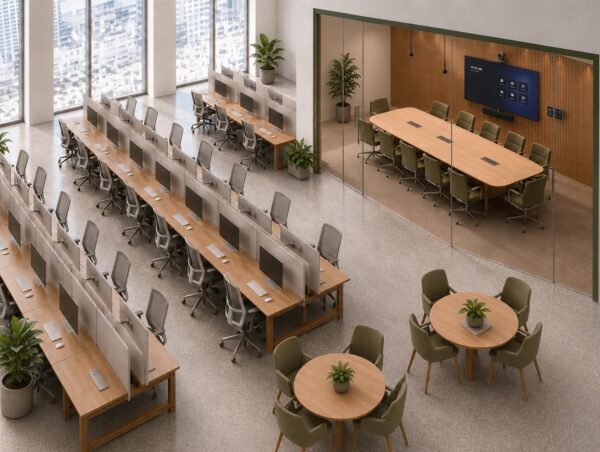
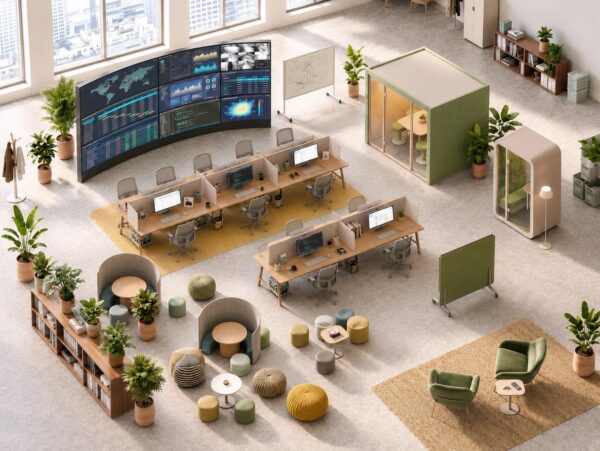
In contrast, an AI-enabled office might feature a calibration setting: a space with a shared display wall to monitor AI activity, huddle areas for quick alignment conversation. No bookable conference rooms, but a dedicated, always-available decision space designed for 15-minute alignment bursts. Proximity to the right spaces, colleagues, and data empowers teams to make decisions that keep pace with the speed of AI execution.

Six design principles for an AI-enabled office
Whether you’re planning a new headquarters or retrofitting an existing space, here are general principles to consider:
- Show clearly where AI is present — or not. Overt signaling builds trust. Define AI-free zones explicitly.
- Design adjacencies that maintain flow. The shift between ideation, calibration, and regulation should be frictionless. When AI compresses cycle times, transition cost is the new productivity drag.
- Voice-first over keyboard-first. As prompting becomes conversational, your acoustic plan has to follow. This has real implications for enclosed-to-open ratios and AV specification.
- Treat wellbeing as performance infrastructure. “Off-states” are the counterweight to AI-accelerated pace. Build them in, or watch your best people burn out — or worse, stop thinking critically.
- Experiment over perfection. Pilot modules with explicit hypotheses and success metrics. Don’t commit everything to built outcomes before you’ve validated assumptions.
- Plan for flexibility. Evaluate new settings against your existing portfolio. Design for future flexibility — modular infrastructure that can evolve through the timeline above.
Florian Kaiser, Head of Workplace Design, says that “At Atlassian, we don’t wait for change to happen to us. We use our own offices to experiment with how AI is reshaping teamwork. We test clear hypotheses before scaling across our global portfolio. That’s how we stay ahead of a shift this fundamental.”
Over the past several years, the question has shifted from “do we need an office?” to “what capabilities does our office enable?” And in an AI world, the office that earns its place is the one that makes coordination nearly effortless.