


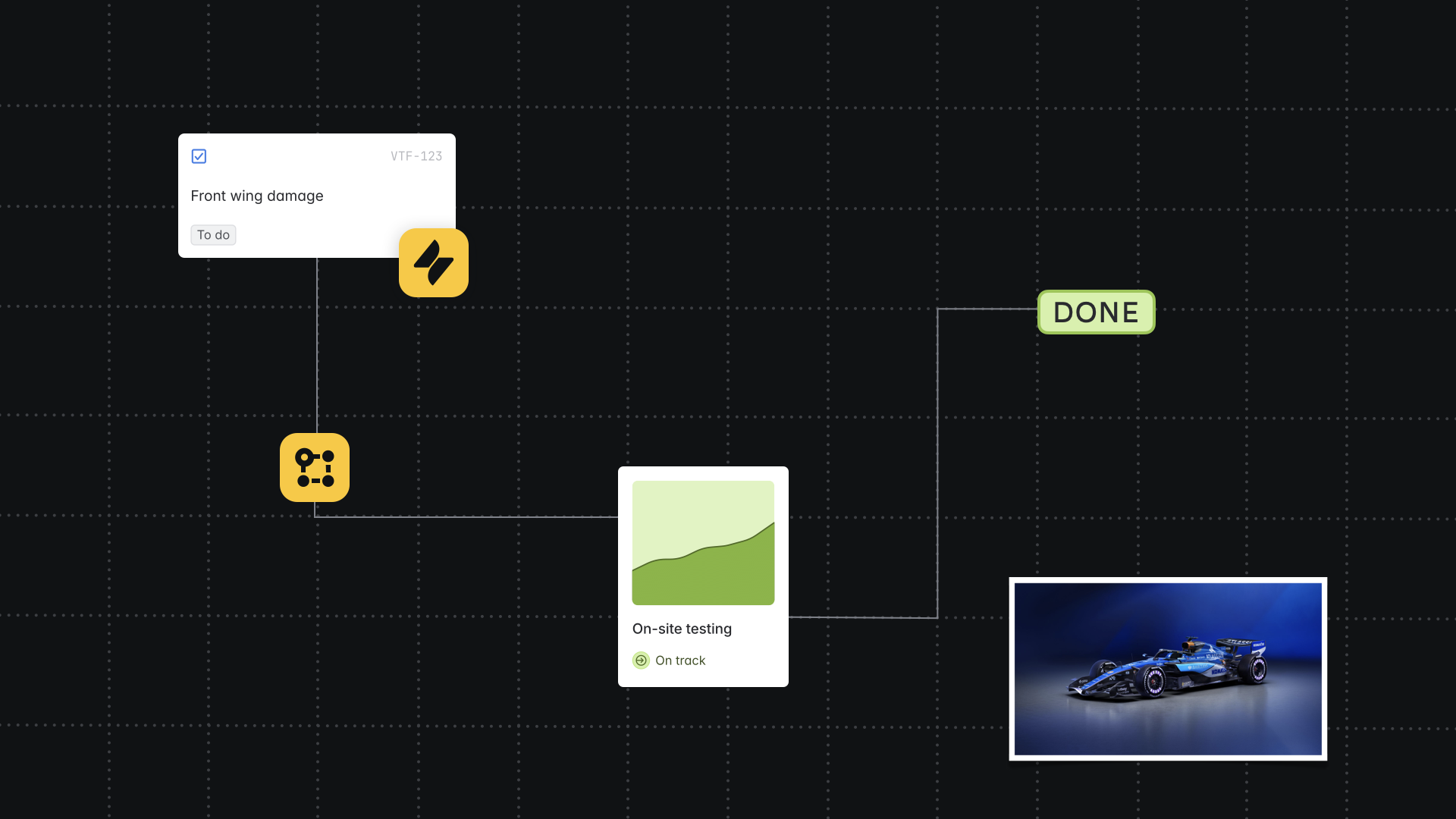
How a Formula 1 team established full asset visibility from the garage to the race track with Assets and Jira Service Management
The learnings in this blog post are based on the webinar, “How Atlassian Williams F1 Team manages their assets.” Watch the webinar on-demand.
24 Grand Prix races. 11 teams. 2 cars per team. 1 goal to be the fastest.
During an F1 season, fans buckle in to watch their favorite team and drivers put on a display of cutting-edge technology, high-speed drama, and extreme athletic skill on the track. But off the track, there’s another battle that requires strategy, engineering, and massive human effort and collaboration.
Atlassian Williams F1 Team was looking for a way to keep track of the thousands of high-value parts, tools, and systems they manage to design, test, and build their cars. That’s why they turned to Assets and Jira Service Management to establish a single, standardized source of truth. By gaining full asset visibility from the garage to the race track, this enabled the team to accelerate innovation and save time in a sport where every second counts.
A 1,200-person team with huge scope
Founded in 1977, Atlassian Williams F1 Team boasts a rich heritage as one of the most successful teams in Formula 1 history. As a team of 1,200 people, everyone operates with the sole purpose of powering performance on the track.
This means cars are always being updated. Parts need to be manufactured or fixed after any damage, which creates a fast-moving, constantly evolving body of work. With the breadth of data teams work with and an unforgiving pace, the organization needed to a way to stay up to speed with everything that is going on.
The “aha” moment: thinking in nouns
When Richard Sworder, Head of Product Ownership at Atlassian Williams F1 Team, first encountered Assets at Team ’25 US, he didn’t see a IT asset management tool. He saw a way to describe the business, and associate work and context important to the business.
When we think about assets at Williams, we think about them in terms of the nouns of our business… If you sit in the canteen queue, all we talk about is the next race event, the parts we’re making for it, the upgrades, the wind tunnel tests, the [Computational Fluid Dynamics] test runs. These are the things that come up again and again.”
Richard Sworder, Head of Product Ownership, Atlassian Williams F1 Team
In particular, Richard saw significant value in what he calls the ability to “decorate” assets. Every time work is done, such as logging a fault on a particular car part, that context is always associated with the car part moving forward.
We get this asset, and you decorate it, and you decorate it… and eventually you’ve got this really rich description of the work, and nobody’s really actually done anything different. You’ve just put the asset in there.”
Richard Sworder, Head of Product Ownership, Atlassian Williams F1 Team
Over time, this context accumulates to tell a powerful and complete backstory whenever needed. It was clear Assets could bring order to Atlassian Williams F1 Team’s complex asset landscape with a single, standardized source of truth that made fast-moving work findable, traceable, and reusable.
Every car part has a story. Now the team can tell it.
The first place Atlassian Williams F1 Team was looking to bring order? The garage.
The team is always looking for ways to improve the car, and part of that process naturally involves faults. Faults can include any issues with the car, such as damaged parts, issues with the power unit, etc.
As a result, the team saw an opportunity to make capturing hardware faults easier and make that data more visible with Assets and Jira Service Management. Every time the car runs, new faults are identified and they can now be logged as a Jira Service Management ticket.
Because the team are tracking their 350,000+ parts in Assets, when one of the trackside team raises a fault in Jira Service Management and selects the relevant part asset, they instantly get the rich metadata without needing to hunt for information. Links to important context like like a 3D render of the component, the assembly drawing, the full assembly context, the designer’s name, and the release history are all at their fingertips.

the results
- Improved traceability: Atlassian Williams F1 Team can now track the full journey from the fault occurrence to the resolution. They know which parts had the fault, when it was resolved, and when the part is ready for use and arriving at the track.
- Improved searchability and correctness: The team have all the context they need now. When they are looking at a part, it’s not just a piece of broken carbon fiber. They see the story behind the part, from a link to the design system, the designer of the part, etc.
- Improved ways of working: With all this context readily available, this means less clicking, less chasing, less busy work, and more time helping the cars go faster. Additionally, the friction of learning and implementing this process with Jira Service Management and Assets was very low, putting minimal burden on the team despite a new process.
Built to scale
Williams doesn’t just have 350,000+ car parts they are tracking. They also have over 1,700+ factory machines they have synced into Assets.
Recently, the Material Science team approached Richard and mentioned they were looking to track the downtime and schedules of the machines they were using to run hardness tests to avoid double-booking and understand when machines wouldn’t be available.
That’s when the lightbulb went off for Richard. The hard work of importing all assets important to the team was already done and now they could scale the ways they use Assets.
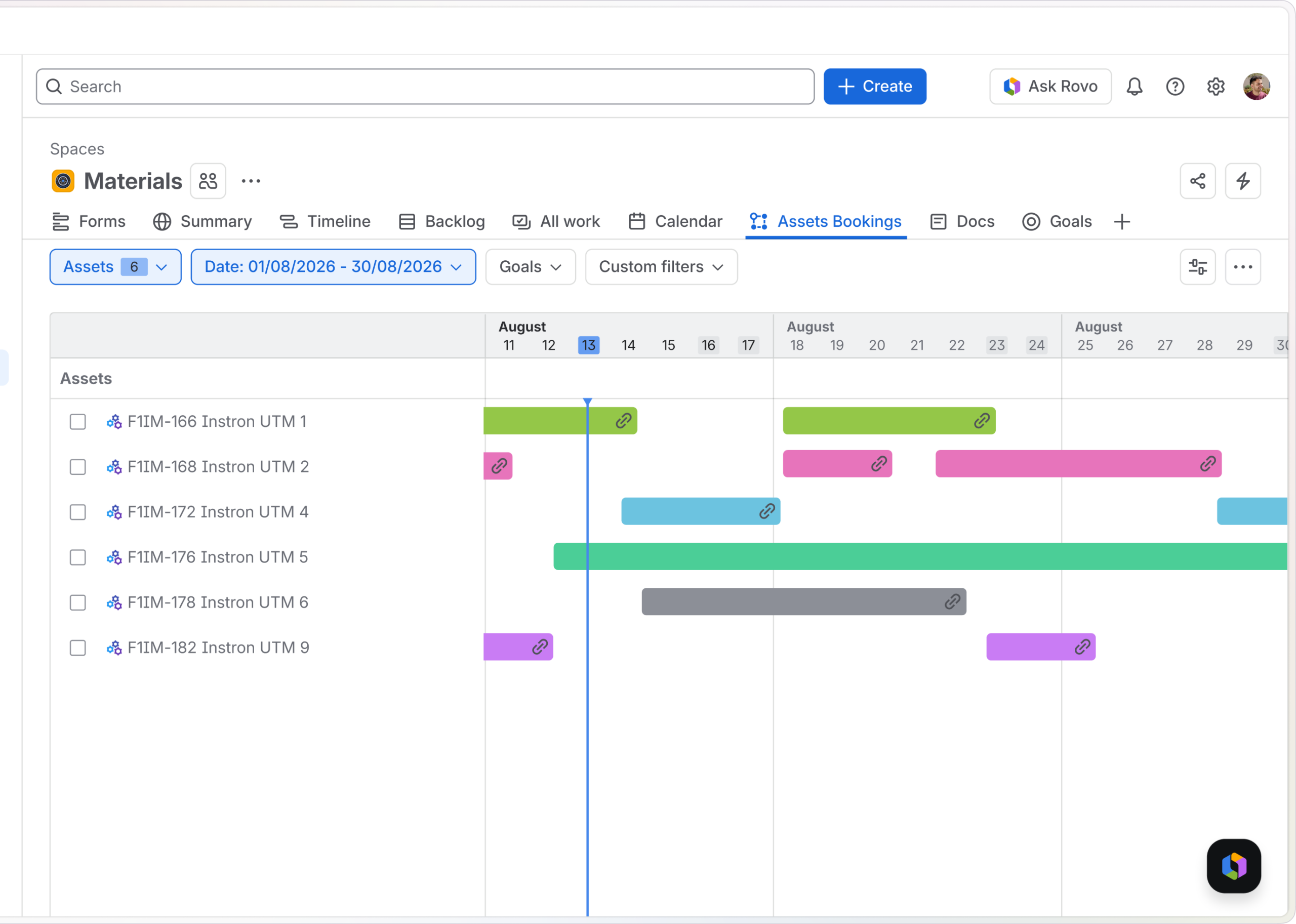
When tickets are filed to book machines, a field was added for which machine was being used as well as the start and end date of testing or downtime. The final product: a self-built Forge app with a calendar visualization that leverages the machines living in Assets to show all booking and downtime.
the results
- Improved visibility: There’s now a centralized system that visualizes all work in a calendar so the Material Science team can see when there is work on a particular machine, they can avoid double bookings, and understand the impact of downtime.
- Focus on higher value work: Material scientists no longer need to worry about administrative work and can focus on the work that matters.
- Ability to scale: The hard work was done once in syncing their assets, from car parts to machines. Afterwards, the organization can reap the benefits of compounding value. For example, the Test & Validation Team came to Richard a few weeks after the Materials team had their use case built with the same need of a booking system for the prototype and test lab. Atlassian Williams F1 Team was able to use a near identical model, with no separate system needing to be built and no additional monetary cost or tech debt acquired.
Richard’s advice based on the journey at Atlassian Williams F1 Team
Whether you’re an organization just getting started on their asset management journey or are further along, here’s what Richard had to say from his own experience of working with Assets.
1. Start with what you care about.
Ask yourself “What does my organization care about? What are people talking about?” Once you have that answer, Richard recommends getting it into Assets like they did with their nouns of car parts, machines, and more.
2. Establish your synchronization.
Getting source data into Assets is the steepest part of the climb, but it’s more approachable than it sounds. The APIs are published and ready to use and, in an era of AI-assisted development, Richard, who is not a software developer by training, has written multiple integrations himself.
3. Start decorating.
Once the data is in, weave the asset into the processes that already touch those nouns. You don’t need your teams to change how they work, but think about where you can add asset fields and add color to your assets to make it a part of your work.
4. Expose your data.
The real power multiplier comes when Atlassian data meets other systems of record like your ERP, your PLM, your design system. Use the APIs, use data shares, surface your assets in analytics or via Rovo as this is where Atlassian Williams F1 Team has seen the value curve get really steep.
Achieving full asset visibility from the garage to the track.
It’s clear that the race doesn’t just happen on the track. There’s a whole world, filled with thousands of parts, machines, and components that make up the car that the team also needs to be thinking about.
We’re really seeing [Assets] as a way of achieving full visibility of the things we care about from the entire lifecycle.”
Richard Sworder, Head of Product Ownership, Atlassian Williams F1 Team
For a team constantly updating their racing cars to push the limits of what’s technologically possible, visibility isn’t just a nice-to-have. It’s how they go faster, and Atlassian Williams F1 Team is doing it with Assets and Jira Service Management.
Want to see how other organizations are using Assets in Jira Service Management? Download the Assets customer ebook or explore Assets in Jira Service Management.


