


Ever wondered what’s possible when you connect service management, knowledge, and AI on a single platform? Meet Neta, the proprietary software platform for energy and utilities of Engineering Group (ENG)
ENG is a global Digital Transformation Company with more than 14,000 employees across 50+ subsidiaries in 21 countries. Neta is supported by a dedicated team of around 700 professionals across Italy, Spain, and Brazil, delivering a modular platform for energy and utility providers that covers the entire “meter-to-cash” lifecycle, from CRM and billing to metering, ERP, and workforce management. They also provide Application Management Services (AMS), and the AMS team ensures business continuity and user support to a mission-critical platform for Utilities, combining application governance, domain expertise, and structured operational capabilities.
The problem: too many escalations and siloed knowledge
Before Jira Service Management, Neta’s AMS team was running on an older version of BMC Remedy. It worked, but it wasn’t built for what they needed next. The team needed a new approach with an effective, innovative tool that made AI an essential component for the evolution of service.
The challenge Neta faced was familiar to a lot of support organizations: junior agents couldn’t handle complex tickets on their own. They’d need to pull in an already busy senior product expert. Knowledge lived in silos, scattered across teams and tools, and finding the right documentation to resolve a ticket ate up time that nobody had.
“Our vision was simple,” Grazia Maria Zucca, Head of Application Management Services, told us. “Anyone in the AMS team — even at the junior level — should be empowered to be a product expert. That’s what we set out to build.”
Connecting Jira, Confluence, and Jira Service Management
Neta was already using Jira and Confluence for development and documentation. When they started exploring AI capabilities inside the platform — especially Atlassian Rovo agents powered by their Confluence knowledge base — they saw an opportunity to rethink their entire support model, not just swap one ticketing tool for another.
“It’s not a substitute, it’s so much more,” Giuseppe said. “We wanted something smarter — a platform that could connect tickets, knowledge, and AI so our people could focus on higher-value work.”
Neta’s first AMS group went live on Jira Service Management Premium with 100 agents, a shared Confluence knowledge base, and a suite of custom Rovo agents tailored to their specific products and workflows.
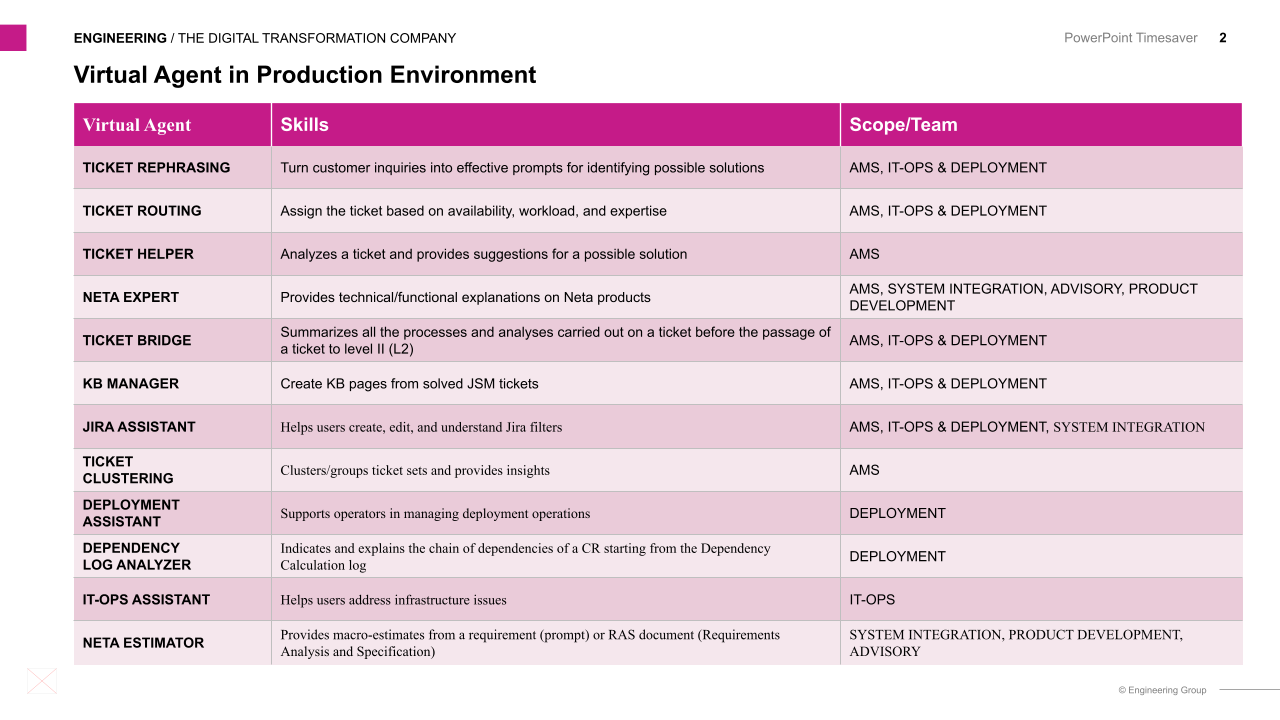
AI meets the support workflow
Now, with a connected platform, when a customer opens a ticket through Neta’s Jira Service Management portal a custom Rovo agent kicks in automatically. It analyzes the ticket, searches Confluence and previously resolved issues, and instantly suggests potential solutions — right there in the ticket. Similar tickets surface immediately. The Rovo agent helps the human agent reuse that knowledge instead of starting from scratch. In tickets that do require human engagement, automated triage and assignment ensure the ticket is routed to the right team — no manual handoff, no delay.
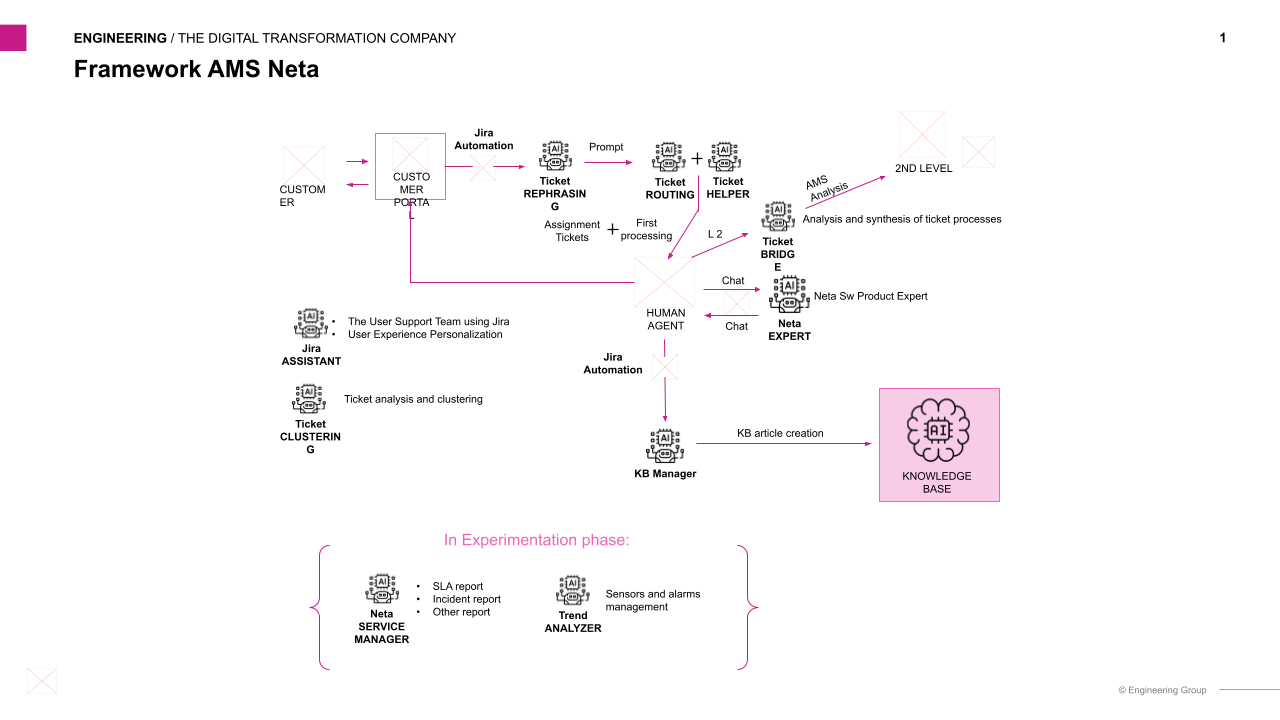
“Previously, assigning tickets and finding the right documentation took precious time,” Federica Santoni, Functional Lead for Metering and Credit Teams, explained. “Now, when a ticket arrives, an AI agent suggests content and sends it directly to the right people. The average assignment time? Essentially eliminated.”
That combination of guided resolution and automated routing means L1 agents handle more tickets, faster, and with fewer escalations.
Creating a “shared operating brain”
Neta put Confluence at the center of their knowledge strategy before layering on AI. They consolidated more than 7,000 documents, including around 6,900 pieces of technical documentation, into a shared Confluence knowledge base. Then they connected Rovo agents directly to that content.
“Confluence has become our shared operating brain,” Grazia said. “AI doesn’t replace people — it enhances human value. It helps us find answers faster, improves quality, and reduces resolution times.”
For the AMS team, that means new employees can self-serve answers via AI instead of waiting on a human. The same curated knowledge powers tickets, training, and day-to-day troubleshooting. And because Neta monitors AI suggestions, collects feedback, and iteratively refines their agents, the system keeps getting smarter and improves over time.
Standing up Rovo agents in weeks
Neta didn’t just flip a switch. They experimented, designing, testing, and rolling out multiple AI agents over a few intense weeks, each tuned to a specific workflow:
- Neta Advisor — the flagship agent for AMS, helping agents resolve complex product tickets
- Estimator Agent — automating change-request estimation
- IT Ops Tuning Assistant — supporting application tuning and performance issues
- IT Ops Deployment Assistant — handling deployment-related questions and incidents
- Knowledge Base Manager — helping curate and enrich knowledge base content
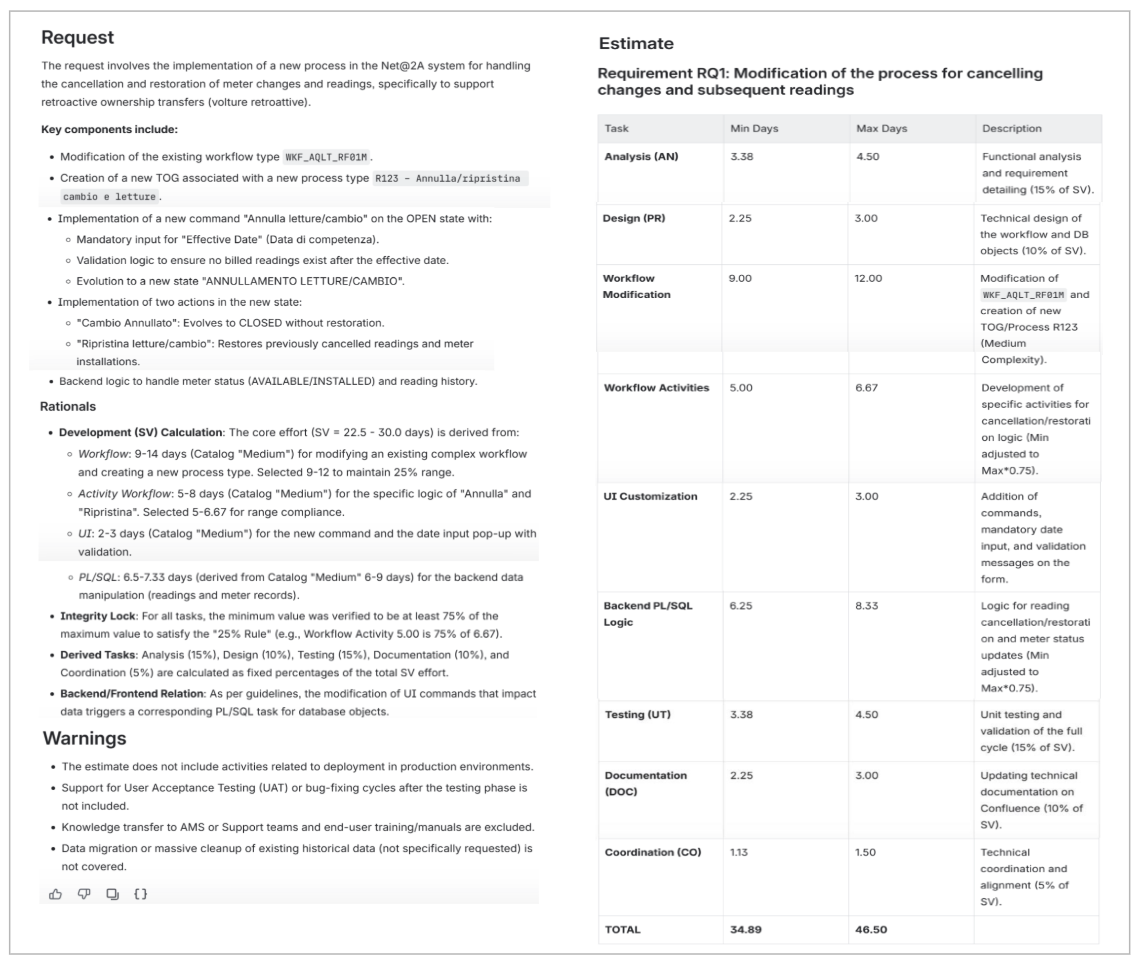
It took just over two weeks to get functional agents aligned with their workflows. And the team continues to refine prompts, add custom intents, and optimize based on user feedback.
“One positive surprise was how quickly the team began to trust the agents and use them as day-to-day support,” Giuseppe Torraco, Tech Strategy and Innovation Lead, said. “That freed up valuable time for senior specialists, who can now focus on higher value-add activities.”
35% fewer escalations with Neta Advisor
The standout Rovo agent is Neta Advisor. It integrates with Neta’s Confluence knowledge base, pulls from technical documentation, use cases, and best practices, and understands ticket context to deliver actionable responses. Before Neta Advisor, requests related to billing always required a product specialist. Today, a junior agent can handle the ticket independently, with the AI agent suggesting solutions directly, drawing from the knowledge base.
“In the past, those requests were managed exclusively by experienced personnel,” Giuseppe explained. “Now, Neta Advisor has dramatically reduced the number of escalations to senior levels.”
Neta’s AI-enhanced Jira Service Management setup is still relatively new. But the impact is already clear: 35% reduction in L1-to-L2 escalations. Thanks to AI-driven suggestions, automated triage, and agents like Neta Advisor, far fewer tickets need to be bumped up to senior specialists. That means experts spend more time on strategic, complex work — and less time answering the same questions. Plus, it led to faster and more autonomous onboarding for new hires, better workload distribution, and a stronger sense of trust and motivation within the team.
“This improvement resulted in a significant decrease in the operational burden for senior advisors,” Grazia said, “while helping to ease the pressure on the second level of support.”
An internal survey of AMS team members revealed:
- 69% actively use AI features — especially automatic ticket suggestions and the AI chatbot for deeper insights
- 55% reported 10–30% time savings in ticket resolution; another 8% reported savings greater than 30%
- 63% said the AI suggestions at first ticket analysis were relevant and often decisive for resolution
Extending service management across Neta
Today, the AI-enhanced Jira Service Management model supports Neta’s AMS team, plus their Deployment, IT Ops, and System Integration groups. But the vision is bigger. Neta is exploring how to extend the platform to Advisory, Sales, and Marketing, building toward a transversal Enterprise Service Management model that delivers a consistent, intelligent experience across the entire organization. They’re also preparing to bring AI-powered support directly to their end-customers, expanding the experience beyond internal teams.
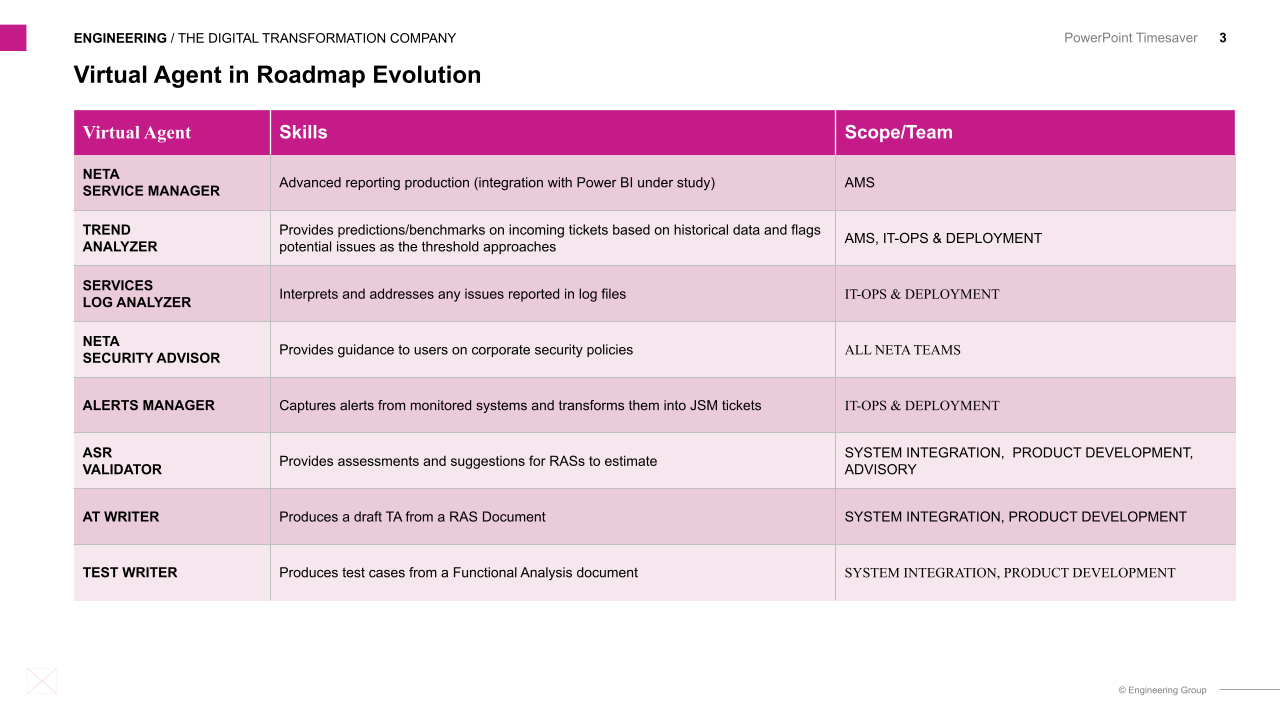
“We believe this evolution can represent an important step forward in the digitization of our business processes,” Giuseppe said, “and in the creation of a more efficient and integrated work environment.”
4 takeaways for all teams
Neta’s journey offers some practical lessons, whether you’re just getting started with Jira Service Management or looking to add AI to your service workflows.
- Start with knowledge. Neta invested in consolidating their documentation in Confluence before layering on AI. A strong knowledge base is what makes AI agents effective.
- Experiment and iterate. They built multiple agents, tested quickly, collected feedback, and refined. You don’t need a perfect agent on day one — you need one that’s good enough to start learning from.
- Let AI elevate your people. The goal wasn’t to replace agents — it was to make every agent more capable. Junior hires now handle tickets that used to require a specialist.
- Measure what matters. From escalation rates to time savings to adoption surveys, Neta tracked the impact from the start so they could prove value and keep improving.
“We have transformed our service model: from reactive support to an intelligent knowledge-based system. Artificial intelligence does not replace people, but amplifies their capabilities, improving the quality, speed and consistency of the service,” said Daniela Ciccomartino – Head of IT Operation, System Integration Application Management.
Get started
Want to see how Jira Service Management and Rovo AI can transform your team’s service operations?


