Update, October 20, 2026: Clarifying Tier 2 rate limit requests after some recent questions and inquiries: Tier 2 rate limits use per-tenant quotas, and were designed for apps that serve multiple customers. If your app was built for your organization’s internal use, Tier 2 rate limits do not apply.
As AI takes on more of the work around people decisions, our opportunity is to become fully present in the moments that define them.
We believe this is a once-in-a-career moment for the HR craft. If we get this right, HR practitioners will spend less time on administrative coordination and more time on the work that drew most of us to this field: landing the right person in the right role, helping a manager lead a team through a crisis, coaching someone who is struggling into confidence and performance, resolving a conflict before trust breaks, designing an org structure that unlocks something a leader thought was impossible.
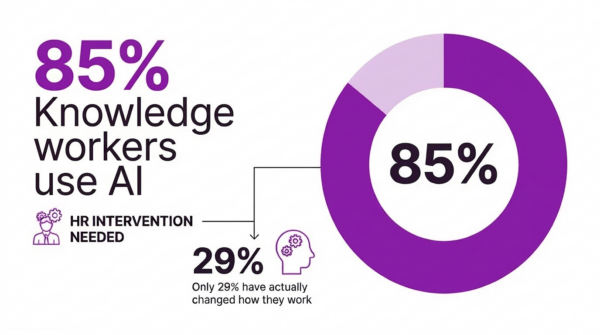
Atlassian’s State of Teams 2026 report found that while 85% of knowledge workers use AI, only 29% have actually changed how they work. Closing the gap between using AI and actually working differently is the opportunity in front of us.
Therefore, it starts with us. HR is uniquely positioned to drive this change for ourselves and for the business. HR can’t guide the future of work unless we reinvent our own craft first. We have to live it early, experiment with it ourselves, and help organizations learn their way into new ways of working.
What Atlassian believes
Five working hypotheses. Five 12-month bets. One shared experiment.
1. HR will become the architect of organizational capacity.
The new frontier of workforce planning is existential. We need to move from managing “headcount” to architecting “capacity” – the total mix of human talent and agentic capability.
Which work should be done by people? Which by agents? How do you design a team when some contributors aren’t human? Where must human judgment remain non-negotiable?
HR will also own one of the most consequential new trade-offs: the balance between human capital cost and token cost. As agentic capacity scales, every workforce decision will carry an implicit build-vs-deploy calculus – invest in a person’s growth and judgment, or allocate that work to an agent at a fraction of the marginal cost.
Getting that balance wrong in either direction is expensive: over-index on automation and you erode the institutional knowledge, creativity, and trust that only people provide; over-index on headcount and you lose the speed and leverage AI makes possible.
These aren’t tech questions; they are people questions, and they place HR in one of the most strategic positions to answer them with both heart and balance.

what we’re testing
- New models for team formation and capacity planning that account for both human and agentic contributors.
- Skill-based work allocation frameworks that map tasks to the right type of capability – human, AI-assisted, or fully agentic.
2. HR org design will increasingly be organized around outcomes, enabled by AI-native products and automated workflows.
For decades, HR has followed the Ulrich model, organizing around functional silos. But this era isn’t about specialization; it’s about integration. HR is increasingly shifting toward organizing around end-to-end workforce outcomes focused on the employee journey – hiring great talent, onboarding effectively, improving manager capability, enabling internal mobility, resolving employee issues, strengthening team health, and helping people grow.
And we should expect those outcomes to evolve. As AI changes the nature of work, HR will need to organize around evergreen challenges as well as new questions: How adaptable are our teams? Where are skills becoming obsolete faster than our systems can see? How do we measure the health of human and agentic teams? How do we design organizations that can learn, reconfigure, and perform faster than the world around them is changing?
That means everyone’s role will change, and new ones will emerge. We’re already hiring for one: a Director of Capacity Planning – Human & AI, Strategic Modeling, whose job is to build the frameworks and models that help leaders make confident decisions about how human talent and AI capability work together across the organization. That role sits alongside capabilities we see growing across the function: people who can architect the workforce intelligence layer that powers AI-native employee experiences, and people who can embed with teams to redesign workflows end-to-end. The exact titles will evolve. The need for these capabilities will not.
The front door to HR will change, too. Employees and managers shouldn’t have to navigate a maze of tools to get help. The first mile of HR will increasingly happen in chat – conversational, embedded in the flow of work, powered by agents that can answer, guide, and route. The systems behind the scenes still matter. Service management, systems of record, data architecture, and human expertise become the backbone that makes the experience trusted, accurate, and accountable.
WHAT WE’RE TESTING
- Hiring our first workforce intelligence architect.
- Cross-functional workflow teams focused on employee journeys.
- HRBPs operating increasingly full-stack and horizontal.
Update, October 20, 2026: Clarifying Tier 2 rate limit requests after some recent questions and inquiries: Tier 2 rate limits use per-tenant quotas, and were designed for apps that serve multiple customers. If your app was built for your organization’s internal use, Tier 2 rate limits do not apply.
3. Intelligence × Context = Exceptional Employee Experiences.
Data quality has always mattered, but the definition of “quality” has shifted. In the AI era, quality means rich, connected context. We’re moving from “data as record” to “data as context” that enables reasoning.
This is the shift from data as record to data as context. An AI-fluent HR needs an intelligent, dynamic workforce intelligence layer – an integrated understanding of roles, skills, capacity, learning, collaboration patterns, manager effectiveness, employee experience, and organizational risk. Without that foundation, employees get faster answers but not better ones. Leaders get more dashboards but not better judgment. The quality of every AI-enabled HR experience will only be as good as the context underneath it.
The shift: DATA AS RECORD → DATA AS CONTEXT
WHAT WE’RE TESTING
- Personalized learning and coaching recommendations generated automatically from work patterns.
- Employee experiences that understand context before an employee asks for help.
4. Talent programs will move from fixed jobs and annual cycles to fluid skills, teams, and pathways.
In an AI-native environment, tasks, skills, roles, and capabilities will evolve faster than ever before. Employees will have greater leverage and reach; teams will form around outcomes rather than org charts; roles will blur; and agents will become part of the workforce system. The half-life of skills will continue to compress.
Most talent programs were not designed for this. They were built for a world of stable roles, predictable career paths, and annual cycles, and they will need to be fundamentally redesigned. Take performance management – in an environment where goals shift quarterly, work is done alongside AI agents, and contributions span across teams – today’s processes no longer make sense. When talent systems no longer reflect how work actually happens, they become a constraint on adaptation and employee trust.
The next generation of talent practices will need to be more fluid. Skills-based staffing, continuous performance signals, AI-augmented management, dynamic internal mobility, personalized learning in the flow of work, and workforce planning that accounts for both human and agentic capacity will be essential.
WHAT WE’RE TESTING
- Skills-based staffing and deployment models that prioritize capability.
- Broader compensation architectures and differentiated rewards for scarce skills, leverage, and business impact.
- Capability-based progression models that place less emphasis on career ladders and more on growth, adaptability, and contribution.
- New ways of matching people, teams, and work as organizational needs evolve.
5. HR is not going away — but it is transforming.
There is a growing narrative in the market that AI will replace large parts of HR: that most people processes can be fully automated, and that the human layer is overhead to be optimized away. We believe something different.
As AI takes on the administrative weight – policy questions, salary prep, onboarding logistics – what remains is the work that runs on relationships. Every significant organizational shift starts in ambiguity: new structures, new operating models, new ways of working that don’t yet have playbooks. People don’t navigate that uncertainty by consulting a decision tree. They navigate it by trusting someone enough to think out loud, pressure-test a risky idea, or admit they don’t know what comes next.
Automation narratives tend to undercount this work because it’s the hardest to see on a process map – it doesn’t show up as a workflow step, but it’s often the reason the workflow succeeds or fails. And unlike administrative tasks that reset each cycle, the trust and context a human HR partner builds with a leader compounds over time. An AI can brief a manager on their team’s data, but it can’t carry forward the history of a coaching relationship or know when someone is deflecting. That compounding quality is what makes the human layer durable, not overhead to be optimized away.
WHAT WE’RE TESTING
- TA workflows where AI does end-to-end administrative / coordination work, but humans own the high-stakes judgment moment.
- Manager enablement tools that use AI to build compensation, performance, and talent review packages with humans accountable for final calls.
The future of HR isn’t a clean operating model or a technology roadmap; it’s a redesign of how work happens. It will be shaped by the teams willing to experiment their way forward. As AI changes the cost and availability of intelligence, HR is being handed one of the most consequential mandates in the enterprise: lead the redesign of how organizations work.
The five beliefs above are our working hypotheses. They’re 12-month bets we’re asking our team to test together. We don’t have all the answers, but we’ll experiment, learn together, and share our progress along the way.