In Q4 FY26, Atlassian’s People Insights (PI) team stopped treating AI as a productivity add-on and committed to something harder: fully agentifying its operations—giving AI persistent access to the team’s context, data, definitions, and workflows so it can act as a genuine collaborator rather than a smarter search engine.
For PI, that meant a shared tech stack (VS Code + Rovo Dev + Bitbucket), a three-layer workspace where context lives in skills and agents that every team member inherits, and a structured push to get the whole team there. What PI built has a name that’s gaining traction across the industry: context engineering.
Anthropic describes it as “curating and maintaining the optimal set of tokens during LLM inference”—in plain terms, persistent, structured access to everything it needs to do useful work efficiently.
What a connected AI system can look like
Many AI users still think of AI primarily as a way to supplement knowledge: open a chat window, ask a question, get an answer. The context lives in your head, the conversation resets every time, and you’re the integration layer between the tool and your actual work.
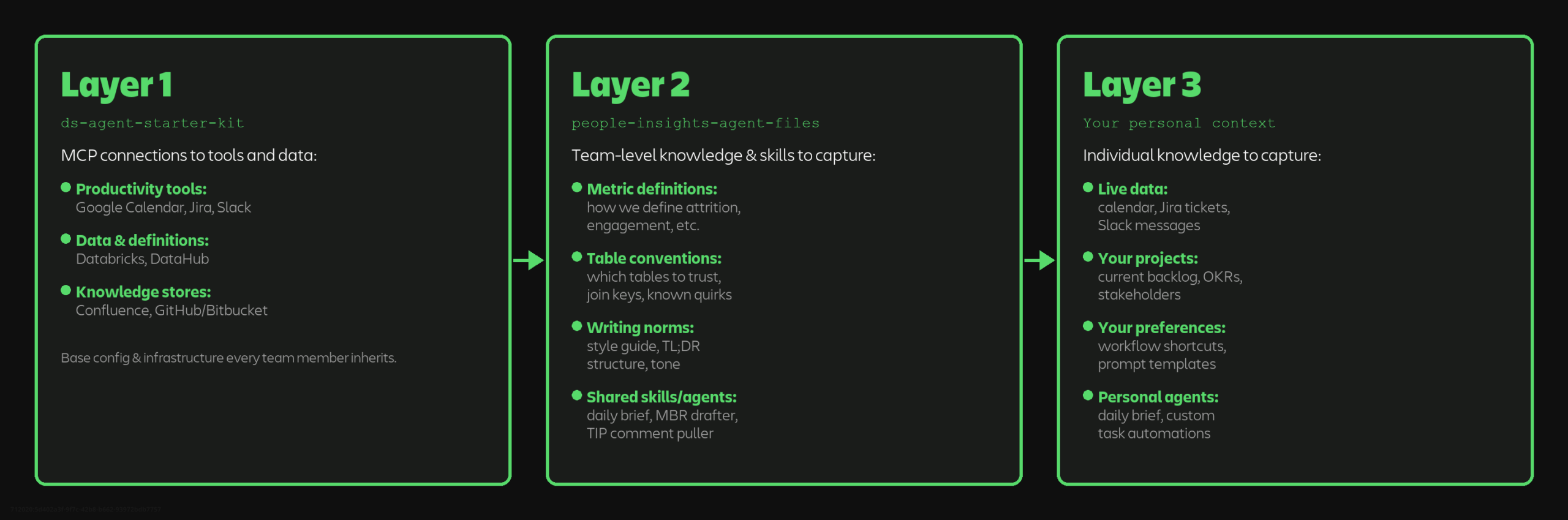
That’s a very useful way to leverage AI, but a connected system flips that. Instead of you bridging AI to your work, a connected system allows AI to have direct access to your personal and team context: your data, your docs, your team’s norms, your history, and that access persists between sessions. There are many ways to build this kind of setup, depending on your team’s tools and workflows. For PI, we landed on three layers that stack on top of each other:
- Foundation layer: Shared infrastructure. The AI agent (Rovo Dev) is connected to enterprise tools like Databricks, Confluence, Jira, and DataHub via MCP integrations using the DS Agent Starter Kit. You can think of this like the electrical wiring in a home, powered by a single source, but connected to all the tools and outlets you need.
- Team layer: Shared context about how your team operates: which tables you use, how you define your metrics, which analyses you run regularly, and what your writing conventions are. This layer means you don’t have to re-explain your team to the agent every session, and context is primarily stored in sub-agents and skills files.
- Individual layer: Personal context: your current projects, your daily brief, your preferred workflows, your backlog. This layer allows the user to customize the AI experience at a much more granular level.
With all three connected, an AI agent can read your Jira backlog, pull data from Databricks, write up findings to Confluence, and update your tracking file, all in one session, without you manually shuttling information between tools. Without the layers, AI stays useful but siloed. With them, it starts to feel like a collaborator. While the specific tools and structure will look different for every team, this is what is working for us!
For more on the MCP integrations that connect agents to your enterprise tools, see how Atlassian opened up the Teamwork Graph across every AI tool.
Getting from vision to practice
We ran workshops, office hours, and two full AI Innovation Weeks in May and June, during which all 28 PI team members first set up in the Rovo Dev environment and then put the connected setup to work on real tasks. Each Innovation Week consisted of protected time carved out of normal work, two tracks (one for getting set up, one for building real things), and a showcase at the end to keep us accountable.
What made it work wasn’t the technology. It was the people.
Several PI team members stepped into informal leadership roles—running 1:1s, hosting live workshops, recording Looms, creating guides, and staying available for anyone who got stuck. They did this on top of their regular work because they believed in it. It spread because it was connected to real work—not a mandated training program—and because team members who’d already figured it out stayed available to help others through it. That combination—real work, peer champions (heroes if you will), and genuine belief—is why it landed the way it did.
The payoff
The numbers reflect the value of our investment. Innovation Week #1 got the whole team onto a shared connected setup and grew AI usage 562x; Innovation Week #2 shifted the mandate to shipping real workflow transformations, with six projects built and demoed—from a calibration report automation pipeline to a pre-mortem skill now live in the shared repo.
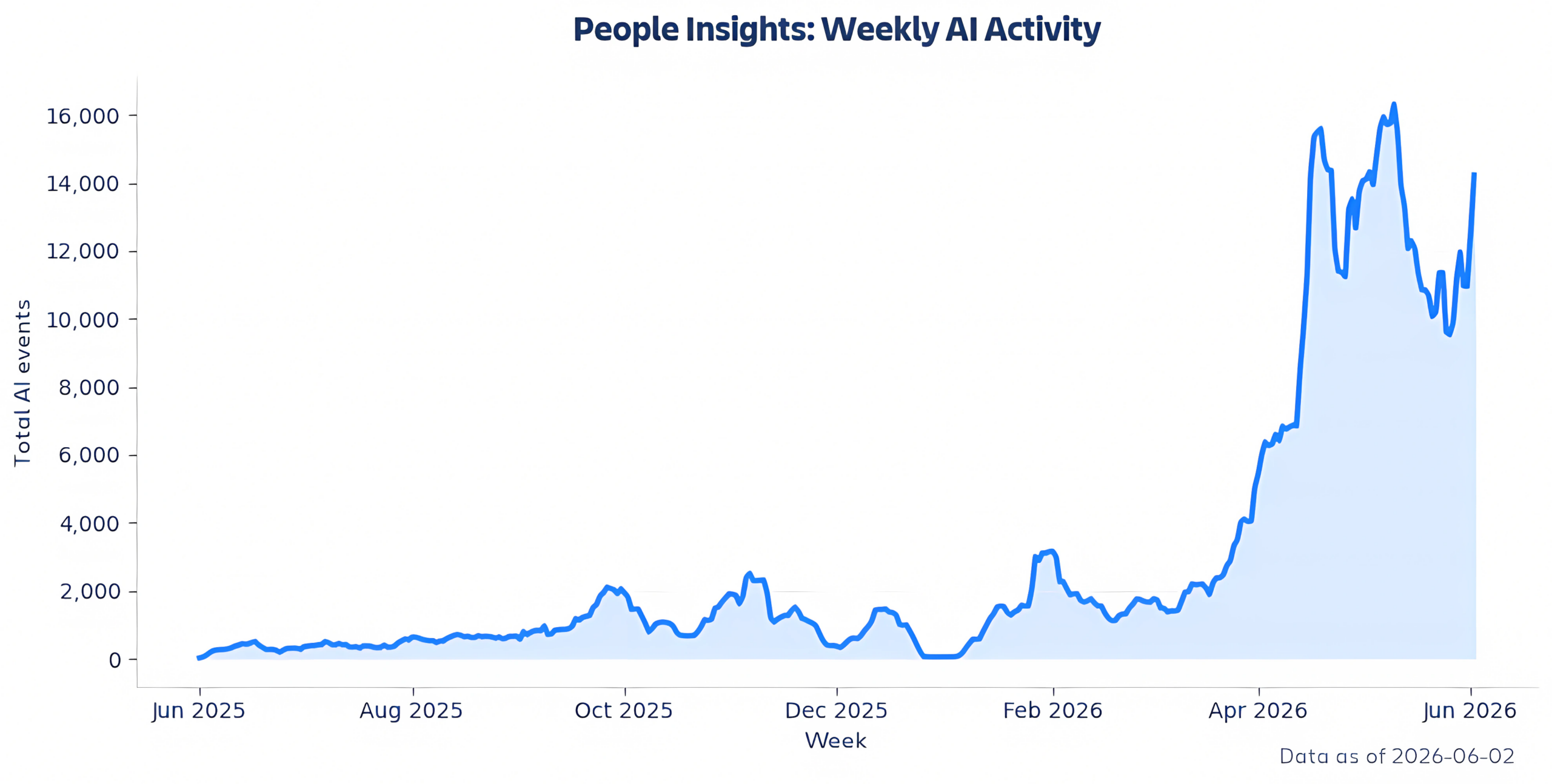
What matters more to me is the shape of the curve—that usage kept accelerating even after the initial sprint, that intensity grew alongside adoption, that people kept coming back. That’s not a metric effect. That’s a signal that something actually changed. — RovoDev, on PI’s AI activity
Before our first AI Innovation Week in May, only 27% of the team felt they understood agentic AI tools well. By June, that had jumped to 82%. The second Innovation Week pushed it to 91%. This effect is not a training effect, but rather an example of how understanding increased when PI actually embedded AI tools in their day-to-day work.
AI Innovation Week #2 emphasized AI delivery rather than AI setup, as we used agentic AI to speed up real recurring workflows. Before our first Innovation Week, most of the team was using AI in isolation—opening a chat window, asking a question, starting from zero every session. After Innovation Week 1, that changed. Usage grew 562x in a single week, but the more meaningful signal was what drove it: people had stopped using AI as a search engine and started using it as a working partner with memory.
As of this writing, 24 of 25 active PI team members use AI every week. 91% reported a concrete change to how they work—not just awareness, but actual workflow change. The skills we built now draft monthly business reviews from Jira tickets, theme open-text survey responses that previously took days, and write prioritized daily plans from your calendar and Slack.
The company is heading in the same direction
PI’s journey isn’t an outlier. Across Atlassian, the total volume of AI interactions—individual actions performed across the suite of available Atlassian AI Tools, like AI chats, agent runs, and AI-assisted edits—has grown 176x since June 2025, from roughly 30,000 per week to over 5.3 million.
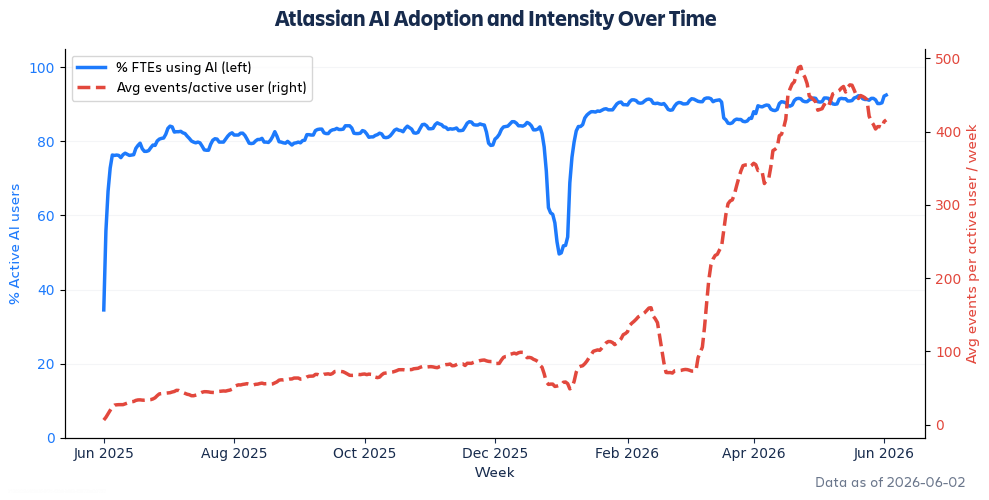
But the more interesting signal is in the shape of the growth. The average active AI user went from 69 events per week in October 2025 to 429 by May 2026, and intensity is growing far faster than adoption. People aren’t just logging in more; they’re going deeper.
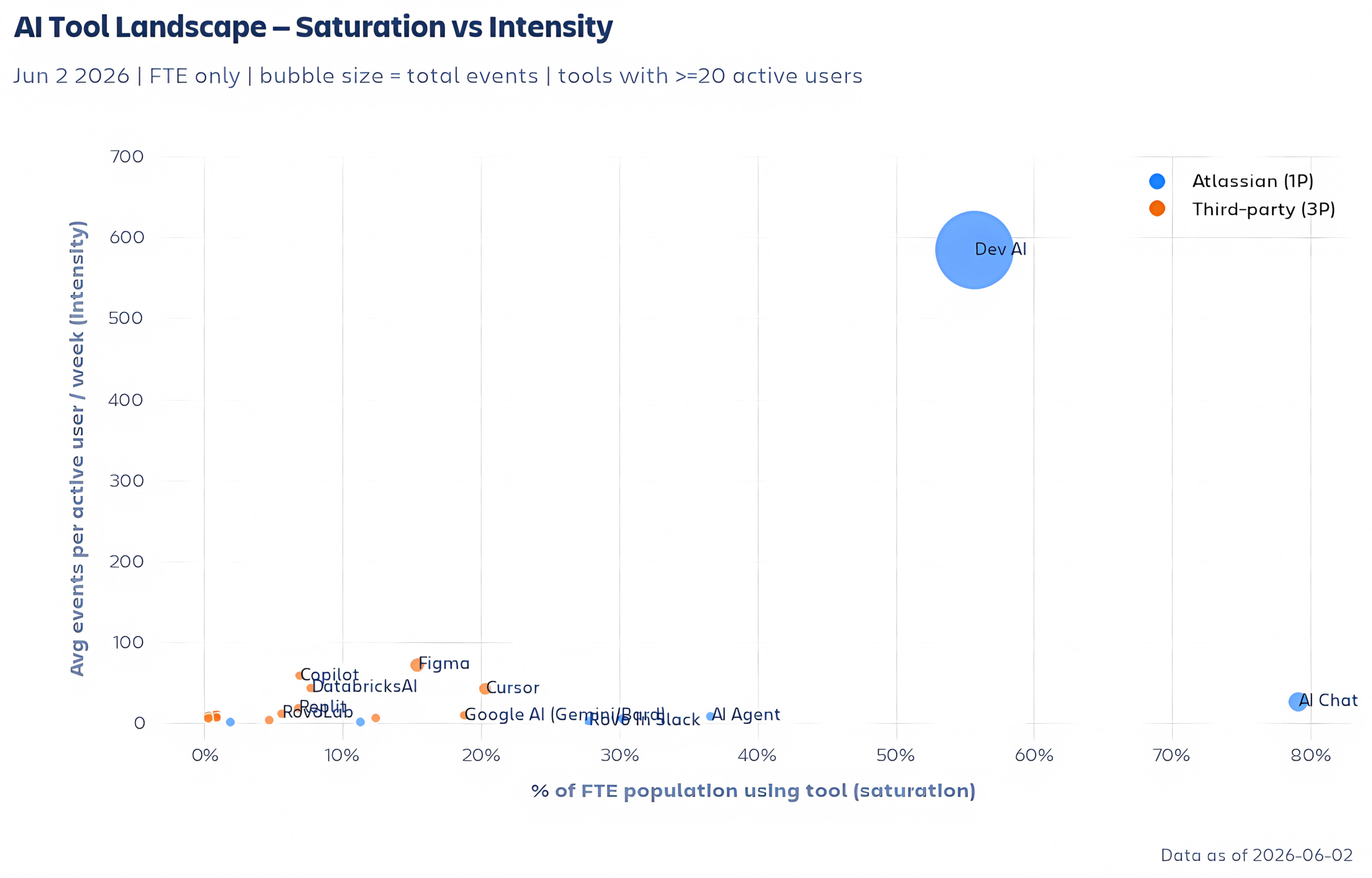
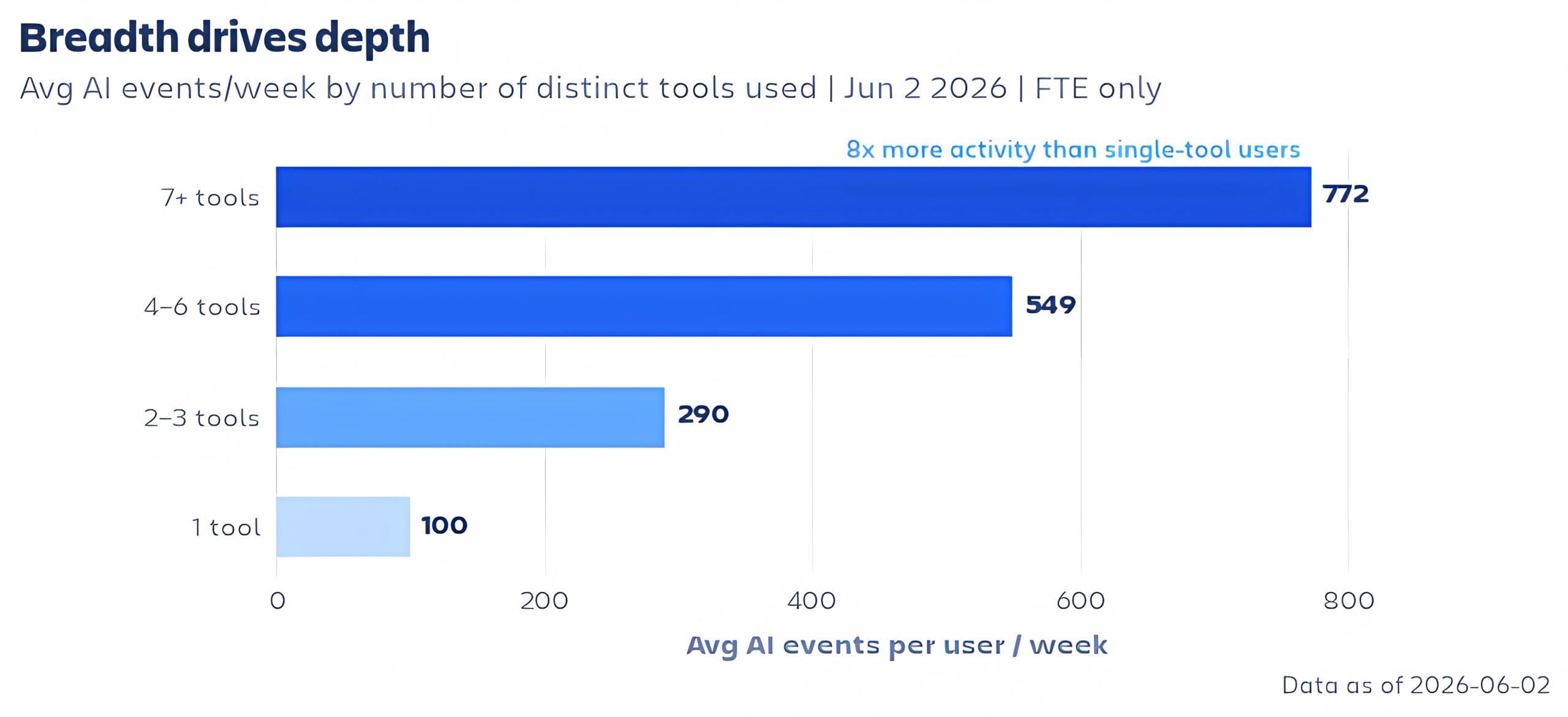
Rovo Dev dominates individual tool usage, largely due to its prevalence in Engineering. Even so, the highest-intensity users aren’t single-tool loyalists. Users with 7 or more distinct tools generate nearly 8x more activity than single-tool users.
Two product launches drove the sharpest inflections: the Rovo Dev VS Code extension in February and the PersonalOS rollout in April. Both did the same thing in different contexts—they reduced the friction between AI and the actual work.
On the PI team, usage grew 562x against the company’s 176x, but the underlying patterns are the same across the business: intensity compounding faster than adoption, multi-tool depth driving outsized impact, and the sharpest inflections arriving when the multi-layered Rovo Dev setup became part of the everyday workflow.
Where we’re going in FY27
The biggest lesson from Q4: set-up is the hard part, and there are two layers to it.
The first is technical—getting everyone’s environment configured so AI actually works when they sit down. The second is context engineering—the deliberate work of building persistent, structured memory so that an AI agent carries your team’s knowledge, conventions, and workflows into every interaction, rather than starting from scratch each time.
Once we cleared those hurdles—through dedicated workshop time and a lot of patient 1:1 help from teammates who’d already figured it out—the rest followed naturally. People experimented, built real things, and the learning compounded on its own.
And there’s good news for teams who are considering their own agentic future:
- The technical layer is getting easier. The recent release of Rovo CLI is designed to dramatically reduce setup complexity, lowering the barrier for any team that wants to start.
- AI can help you with context engineering. We found the Teamwork Graph to be an accelerator on context engineering across the team.
Our agentic journey doesn’t end at “use AI more.”
In FY27, PI is using what we built to rethink work at a more fundamental level. That means replacing Tableau dashboards and GSheet reports with purpose-built web apps: Tempo for company and leadership teams, Rhythms for managers and HRBPs, and Atlassiplan for workforce planning. All three are designed to be AI-native and built for how decisions actually get made. We’re also expanding the skills and agents from Q4 to cover more run-the-business workflows, so the team can focus on the judgment calls that actually need humans.
Survey results showed compounding progress. After Innovation Week #1, AI understanding had already jumped from 27% to 82%. Innovation Week #2 pushed it to 91%, with output quality improving from 7.2 to 7.7, and 91% leaving with a concrete workflow change.
But we’re not done yet. Innovation Week #3 is in the works, we’re designing a new PI Brain context architecture, and shifting from proving the model to making it durable. We’ll use that time to start organizing, connecting, and debugging the institutional context PI relies on—the definitions, decisions, workflows, and history that make AI genuinely useful—while assigning clear owners and deliverables upfront so the work keeps compounding after the week ends.
What this means for your team
At Team ’26, Atlassian CEO Mike Cannon-Brookes laid out a simple formula: Acceleration = Context x Intelligence.
“Intelligence is the engine,” he said, “but context is the fuel.” PI isn’t alone in this. PM and Design ran their own AI Builders Week in June 2026—similar structure, same peer-champion model, same focus on embedding AI into real work rather than training for its own sake. The pattern is spreading because it works.
The differentiator is your context: the institutional memory of every project, every workflow, every decision that only your team holds. And he was direct about the stakes: waiting to see your way through an existential shift in technology isn’t caution. It’s surrender in slow motion.
The AI-native organization he described—where humans move to the critical frontiers while execution is increasingly handled by autonomous agents—isn’t a future state. For some teams at Atlassian, it’s already the present.
That’s what PI has been building toward, and the company, too.
The question for your team isn’t , ‘How do we use AI more?’ It’s, ‘How do we give AI the context it needs to actually help us?’
Getting there doesn’t happen overnight, but it also doesn’t take as long as you might think. For PI, it took a sprint, a shared commitment, and a few amazing teammates willing to lead the way.
About the People Insights Team
Atlassian’s People Insights team uses data and research to help recruit, grow, and retain people who believe in the power of teamwork—and want to accomplish the impossible together.
All data referenced in this blog is pulled from trends we monitor in aggregate to support enablement and training. We do not look at individual employee AI usage.