
Strategy usually does not fail because leaders are unclear or teams are slow. It fails in the handoffs between intent, funding, people, systems, and work.
This article is a session recap based on Anaplan’s session “Where Does Your Chain Break? Strategy that lives in boardrooms and PowerPoints” presented at Team ’26 in Anaheim, CA.
For most enterprises, strategy may be clear at the top, but it gets lost along the way to funding, capacity, ownership, and day-to-day work. The Senior Director of Engineering Enablement at Anaplan, Vince Butera, found that the problem was not a lack of strategy; rather, the absence of a connected operating model prevented the strategy from being carried out.
For any company trying to move faster, the strategy is rarely the hard part. The challenge is keeping it connected to where real decisions get made: what gets funded, who has capacity, who owns the work, and what teams are actually delivering.
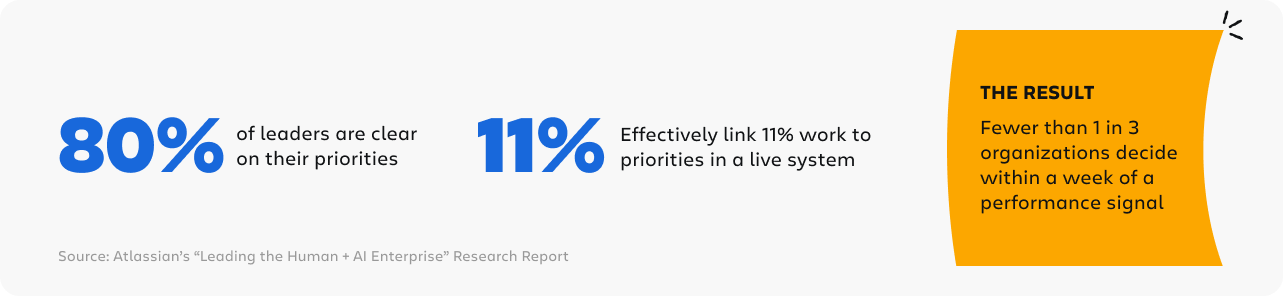
Atlassian’s Leading the Human + AI Enterprise research on strategic portfolio management puts numbers behind the pattern Butera described:
- 80% of leaders say strategic priorities are clear
- Only 11% have 75% or more of portfolio work linked to those priorities in a live system
- 64% say manual reporting through spreadsheets and status summaries is required to understand progress
- 89% rely on manual reporting to identify risks
- Fewer than 1 in 3 organizations decide within a week of a performance signal
In other words: clarity is not the bottleneck. Connectivity is.
Most organizations can explain their strategy. Far fewer can traverse from a strategic bet to the people assigned to it, the funding behind it, the dependencies around it, the work in flight, and the risks emerging in real time. When that path depends on meetings, spreadsheets, and tribal knowledge, the enterprise can only pivot as fast as its manual reporting cycle.
Anaplan’s wake-up call
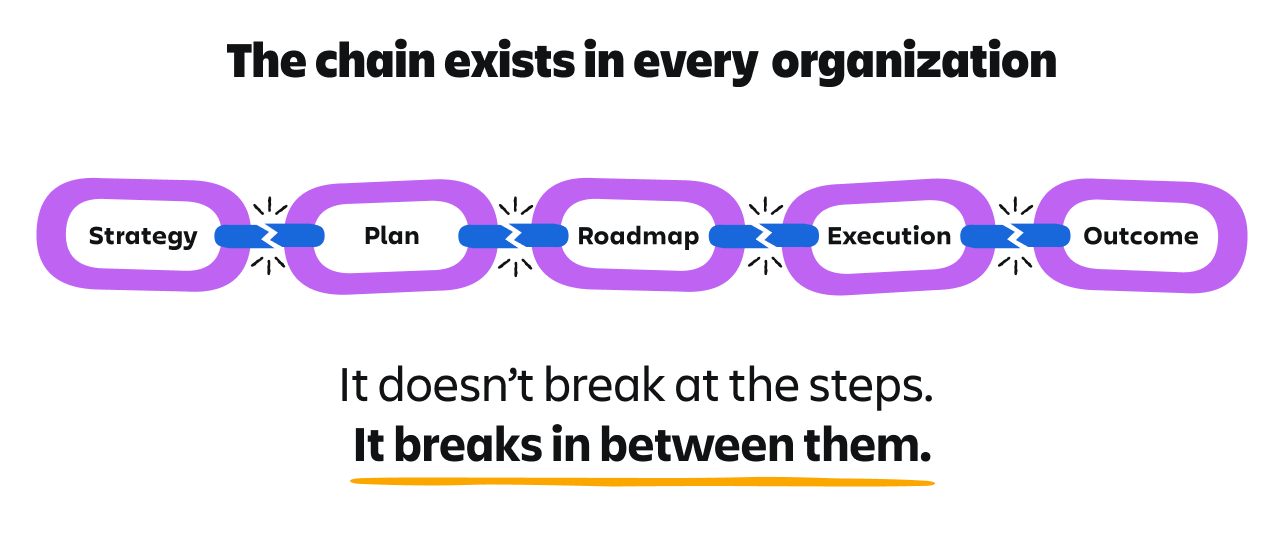
Anaplan spent years deliberately building scaled agile practices, standardizing planning, and generating value-stream signals across health, quality, performance, speed, and durability. Their engineering operating system had matured enough that the CFO could use story-point data to forecast headcount for new applications, and their capitalization process passed audit scrutiny.
And still, the chain broke.
The moment came through a simple off-cycle leadership question: How much capacity do we have for new AI development work?
To answer it, Butera had to connect CEO commitments, engineering effort, product priorities, headcount, skills, and organizational ownership. The information existed, but it lived in different places: Jira Align, Lucid org charts, planning documents, and the heads of different owners. There was no reliable, traversable route between them.
That is where the static planning model shows its cost. When the business needs a fast answer, disconnected systems turn what should have been a quick decision into a reporting project.
The hidden cost of a static planning model
Annual plans, quarterly updates, and executive readouts can create the appearance of alignment, even when they don’t reflect it. But if the underlying model is disconnected, every strategic change creates translation work. Someone has to interpret the strategy. Someone else has to map it to programs. Another team has to reconcile capacity. Finance has to understand what funding is still valid. Product and engineering have to decide what work should move.
That translation layer is where organizations lose time.
Atlassian’s research calls the metric that matters “Mean Time to Pivot,” the elapsed time from a strategic signal to a verified reallocation of people, agents, compute, and spend. In a static, disjointed model, the mean time to pivot is measured in planning cycles. In a connected operating model, it can be measured in days.
This matters even more in the AI era. Only 26% of leaders say they trust AI insights for strategic decisions. That is not just a model-quality problem. It is a context problem. AI can only reason over the strategy, work, people, funding, and systems it can actually see.
From project or product to a living hybrid operating model
Atlassian’s Operating Models Whitepaper makes a related point: neither traditional project models nor pure product models are enough on their own.
Project models are good at time-bound initiatives, funding control, and executive visibility, but they often spin teams up and down around outputs instead of outcomes. Product models excel at durable ownership and continuous value, but they can struggle when work spans teams, platforms, functions, and strategic bets. Modern enterprises need both.
The winning model is a living hybrid operating model: stable teams driving continuous value, time-bound programs for cross-cutting change, and a connected decision system that links strategy, funding, people, and systems.
Anaplan was not simply trying to make engineering data cleaner. They were trying to create a model that could match demand, the initiatives leaders want to pursue, with supply: the teams, platforms, capabilities, skills, and capacity available to deliver them.
The engineering insight: the problem is structural
One of Anaplan’s biggest lessons was moving the conversation away from tooling and toward mindset:
Stop treating it like a tooling problem, start treating it like a data structure problem, and that’ll change the way you think about everything.”
–Vince Butera, Senior Director of Engineering Enablement, Anaplan
Most enterprises already have the raw information they need. The strategy, funding, roadmaps, work, people, skills, and dependencies are usually already there. The issue is that these objects are not modeled as part of one connected system.
That is why broadcasting the strategy louder does not fix the problem. If a strategic priority can’t be carried through into the planning object, the funding decision, the team allocation, the dependency map, and the backlog, then teams are left to interpret intent from artifacts that were never designed to convey operational context.
Anaplan’s ontology: making the chain traversable
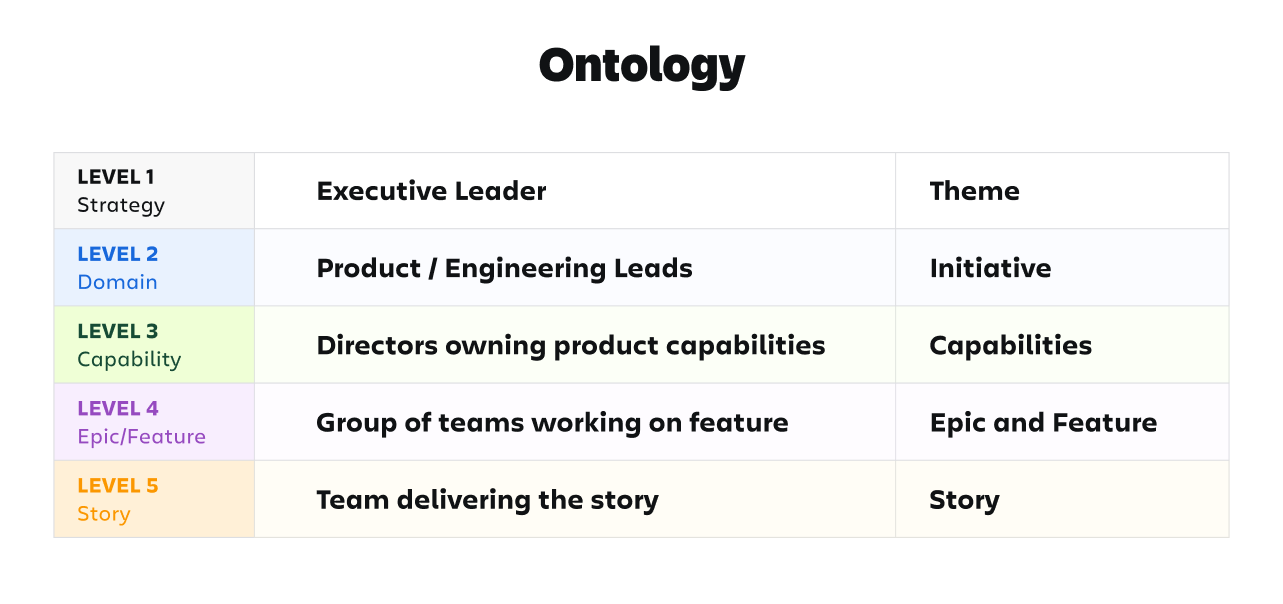
Butera described Anaplan’s approach as an ontology for strategy and delivery: a shared structure for the objects the business already uses. The goal was not to force every function into a single vocabulary, but to instead create a common model that lets different teams keep their own language while still connecting their work.
The model has three important layers:
- Organizational hierarchy: who owns what, from executive strategy through domains, capabilities, groups of teams, and individual teams.
- Object hierarchy: what gets planned and built, from themes and initiatives through capabilities, epics, features, and stories.
- Language reconciliation: how product, engineering, finance, and leadership describe the same reality in different terms without breaking the model.
This last point is where many transformations fail. The product may be organized around how customers experience it. Engineering may organize around how systems are built and operated. Finance may organize around investment categories. Leadership may organize around strategic bets. None of those views is wrong. But without a shared structure, they become disconnected maps of the same terrain.
Anaplan’s approach was to let each group see itself in the system while making the relationships between objects explicit. That is what turns strategy-to-delivery from a presentation exercise into a queryable chain.
Three assumptions that break the chain
Anaplan identified three common assumptions that sound reasonable but often mask the structural disconnect beneath.
Assumption 1: “Our strategy is clear.”
The hidden issue: strategy may be clear in decks and discussions, but not connected to the team-level decisions that determine what gets built next.
Butera noted that: the only strategy that matters is the one that helps a team decide which items in its backlog to work on next. If strategy can’t travel that far, alignment remains performative.
The fix: map strategic objects to ownership levels and make it clear who is accountable for annual planning, quarterly planning, and sprint-level execution outcomes.
Assumption 2: “This is an engineering-only system.”
The hidden issue: many decisions that shape engineering work happen upstream in product, finance, and business conversations, then arrive in engineering tools after the context has been stripped away.
The fix: bring upstream language into the execution system. Define the hierarchy, agree on object types such as outcomes, goals, focus areas, dependencies, and work items, and create contracts for naming and updating them.
Assumption 3: “Product decisions are subjective.”
The hidden issue: decisions look subjective when the inputs are not captured. A priority always carries assumptions about scope, value, risk, headcount, timing, and constraints. If those inputs are missing, the organization can’t learn from the decision later.
The fix: capture the why behind decisions: scoring, assumptions, dates, owners, constraints, and planning horizon. The decision still happens through human judgment, but the system carries the context.
The payoff: faster answers, better pivots
The practical payoff showed up in Anaplan’s AI reporting example. An SVP of Platform Engineering needed frequent visibility into everything related to AI, including costs, headcount, skills, progress, dependencies, and risks. Previously, one team member spent one week out of every two manually assembling the report in PowerPoint.
With a connected ontology and structured data, that kind of question becomes a query instead of a project.
Manual reporting may satisfy a governance meeting, but it can’t support real-time pivots. If risk is visible only after someone compiles it, the organization is already late.
Where Atlassian’s Strategy Collection fits

Anaplan’s challenge, the inability to answer a straightforward leadership question without assembling data from disconnected systems, is exactly why Atlassian believes enterprises need a connected model where strategy, work, people, funding, and AI context live together rather than as separate artifacts reconciled by hand.
That is the role of Atlassian’s Strategy Collection:
- Focus models strategic bets, priorities, and outcomes.
- Jira Align connects large-scale planning, dependencies, and execution against those priorities.
- Talent helps map people, skills, agents, and capacity to strategic work.
- Jira anchors the day-to-day work teams are actually doing.
- Rovo operates across connected contexts to surface drift, find missing information, and help teams act with a better signal.
Atlassian’s research found that planning cadence alone has no predictive relationship with decision speed, AI effectiveness, or dependency resolution. The real levers are system integration, domain connectivity, and dynamic outcome-based funding.
What leaders should do next
If you want to find the break in your own strategy-to-delivery chain, explore Atlassian’s Strategy Collection and start with questions that force a traversal across the operating model:
- Pick a strategic bet and trace it to live work. What percentage of active work is natively linked to that priority in a shared system?
- Follow the money. Can you see which funding, headcount, and compute costs are attached to the bet?
- Test your Mean Time to Pivot. When a performance signal changes, how long does it take to reallocate people, spend, and work?
- Look for manual reporting hotspots. Anywhere a person has to assemble the answer by hand is a place where the model is not yet connected.
- Capture decision inputs. Record the assumptions, scores, constraints, owners, and dates behind priorities so the organization can learn and adapt.
Looking ahead, Anaplan recognizes that the work is ongoing. What’s changed is their ability to see where the chain breaks, build the structure to hold it, and transform static planning artifacts into a living operating model.
That is how strategy evolves beyond a static document to become the living system the business runs on.