
How DHCS connected strategy and governance to accelerate delivery from years to months
This article is a session recap based on DHCS’s session “How California’s Department of Health Care Services Aligns Strategy and Delivery with Strategy Collection” presented at Team ’26 in Anaheim, CA.
Government transformation stories often begin with obstacles. This one begins with momentum and with an agency determined to move faster despite the constraints around it.
California’s Department of Health Care Services (DHCS) had to accelerate delivery in an environment designed for careful control, not speed. Fixed budget cycles, lengthy procurement timelines, deeply embedded legacy systems, constant oversight, and public scrutiny shaped every decision.
Instead of treating those realities as blockers, DHCS built an operating model around them.
The result: a more connected way to turn strategy into delivery, which links requests, goals, work, reporting, and decisions across teams and programs. What began inside one modernization division grew into an enterprise approach that gives leaders clearer visibility, stronger governance, and a more reliable way to prioritize public investments.
Building a source of truth

Many organizations implement new tools and expect transformation to follow. DHCS took a different path. The team recognized that tools alone don’t create alignment. What matters is how work is defined, connected, reviewed, and governed.
By standardizing on Jira and Confluence and supporting integrations, DHCS created a shared source of truth that reduced handoff friction and improved coordination across teams. But the bigger win was not just better execution. It was better decision-making.
“We started really communicating around DHCS that we were building one single source of truth on our Atlassian platform.”
– Christine Corona, Engineering & Operations Support Services Section Chief, California Department of Health Care Services
What changed in practice
As the operating model matured, DHCS improved both speed and visibility.
- One 2020 project took 18 months to reach production and another 18 months to deliver Release 1.0.
- By 2022, a newer project reached production in 6 months and Release 1.0 in 11 months.
- By 2024, a later initiative stood up an MVP in 1 week and delivered Release 1.0 in 3 months.
That acceleration came from stronger reuse, clearer coordination, and a more disciplined approach to delivery.
Adoption expanded, too. What started with around 1,000 users grew to roughly 5,000 as more business and operational teams joined the platform. Jira and Confluence were no longer just for technical teams. Programs across procurement, communications, fiscal functions, and delivery began working in the same connected environment.
Key lesson: Visibility is useful, but it is not the end goal. The real value comes when visibility supports documented, defensible decisions.
From tracking work to guiding strategy

As DHCS scaled, leadership gained greater visibility into the work but also saw a new challenge. It was easier to see activity, but harder to answer higher-value questions:
- What should we prioritize first?
- Which initiatives tie most clearly to strategic outcomes?
- What should we stop, defer, or sequence differently?
- How do we defend funding and trade-off decisions under public scrutiny?
To answer those questions, DHCS evolved beyond work tracking into a connected operating model that links:
- Intake
- Idea shaping
- Strategic goals
- Delivery execution
- Shared reporting
- Decision documentation
This shift mattered because in government, a dashboard is not enough. Effective strategic portfolio management requires a way to preserve the reasoning behind decisions, especially when mandates, audits, budgets, and cross-agency coordination all collide.
A model built for real government conditions
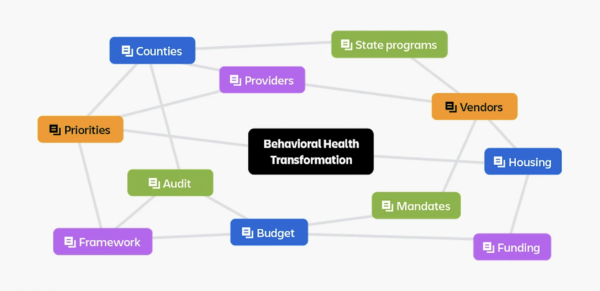
One of the most compelling aspects of this story is that DHCS did not force every team into a single rigid process. Different groups could use different intake approaches based on their needs, while still feeding a shared visibility and governance layer.
That flexibility helped the model work in the real world, where operational teams, enterprise programs, and executives all need different levels of structure. DHCS also simplified terminology, tailored views, and removed unnecessary complexity so more users, not just technical teams, could participate meaningfully.
“Another big win for us is that we’ve got executives actually feeling comfortable enough to get into Jira Align.”
– Christine Corona, Engineering & Operations Support Services Section Chief, California Department of Health Care Services
When executives are comfortable using the system directly, the platform stops being a reporting layer and starts becoming part of how the organization runs.
From faster delivery to lasting change

DHCS shows what success looks like when a platform becomes operational infrastructure—not just software.
Their success wasn’t just about adopting new technology, but rather, strengthening the organization’s ability to deliver lasting change:
- Faster delivery: teams reduced timelines dramatically
- Better alignment: leaders could connect work to strategic goals
- Stronger governance: decisions became more visible and defensible
- Broader adoption: business and technical teams worked in one environment
- Scalable transformation: early wins expanded into enterprise change
For public sector organizations, and really any complex enterprise, the takeaway is clear: connecting strategy to delivery is what turns visibility into action and action into outcomes.
Download the whitepaper to get the full story on how DHCS built a better way to make decisions, scale change, and serve the public with greater clarity and accountability.