In 2025, companies spent a collective $581 billion on AI. The results were underwhelming: according to a study by MIT, 95% of Enterprise AI pilots showed zero impact on organization’s bottom lines. In short, the vast majority of AI pilots are unsuccessful.
The reflex is to blame the models. The evidence points somewhere easier to control: context.
Every answer AI produces is assembled from a context packet—the material used to respond to the presented prompt. The quality of that packet decides how reliable the AI-generated answer is, and how many tokens it takes to produce.
Unlike model quality, which is controlled by a few frontier labs, you can control and manage the quality of the context your agents reason over.
Because our platform is open and sits at the center of many key workflows — planning, building, shipping, supporting — Atlassian has been able to identify what kind of context drives work forward, and what contributes to its quality. In this second installment of our context series, we’ll go over how to manage your context, and why it’s worthwhile to get it right.
The three levers of context quality
High quality context is the difference between an agent that feels like an experienced teammate, and one that feels like a new hire.
For example, imagine an on-call engineer paged at 2 a.m. Their agent surfaces a generic runbook, which may be technically relevant but is not actually useful in this scenario. The agent doesn’t know the related service was redeployed yesterday, or who owns it, or that a related incident was resolved last week with a specific workaround discussed in a Slack thread. With that context, the agent would be able to get right to the workaround and save the engineer a deeper search in the middle of the night.
Supplying good context can save agents and humans time and tokens, but high quality context is often hidden away due to insufficiently connected tools and undocumented or outdated information. This is where humans can step in.
Through Atlassian’s work on the Teamwork Graph and CAFE(s) framework, we’ve identified many factors that influence context quality. To develop a practical, measurable approach to managing context, we distilled our research findings down to three key drivers of context quality: completeness, connectedness, and relevance.
1. Completeness: Having the right sources and the right depth
Completeness measures the extent to which an organization’s context graph provides the full picture that AI needs to be effective.
Completeness has two parts:
Breadth: if a team lives in Figma for design, Slack for decisions, and Google Docs for specs, but only two of those systems are integrated, AI is reasoning with missing pieces.
And depth: indexing a document’s title is not the same as indexing its content, comments, and edit history.
In order to build high fidelity context, teams must connect to where work really happens, not just the obvious systems or fields. This also comes down to daily habits and organizational practice, because it helps to also enrich the artifacts (ie real PR descriptions, clear acceptance criteria, populated runbooks) so there’s something worth indexing.

2. Connectedness: Making meaning from links teams already draw
While completeness measures whether AI has access to everything an organization knows, connectedness determines whether it can identify pieces that belong together.
When connectedness is sparse, AI searches repeatedly to work out what belongs together, which consumes tokens and slows performance. When relationships are missing, AI retrieves and treats each object independently which reduces quality.
Every time someone pastes a Figma link into a ticket, attaches a doc to an epic, or references a PR in a Slack thread, they draw a line between two pieces of context. When AI can follow those lines, it moves from “this service is failing” to the team that owns it, the deploy that changed it, and the spec that defined the expected behavior.
This is where a context graph like Atlassian’s Teamwork Graph is especially valuable. Context graphs take data points and assemble them into the most relevant context packet that AI can reason over for the most effective results. Teamwork Graph, and Atlassian’s platform on top of that, makes it easy to build connectedness because teams are constantly using features that connect the dots. Even reacting to a Confluence page draws a connection between a person and a page.
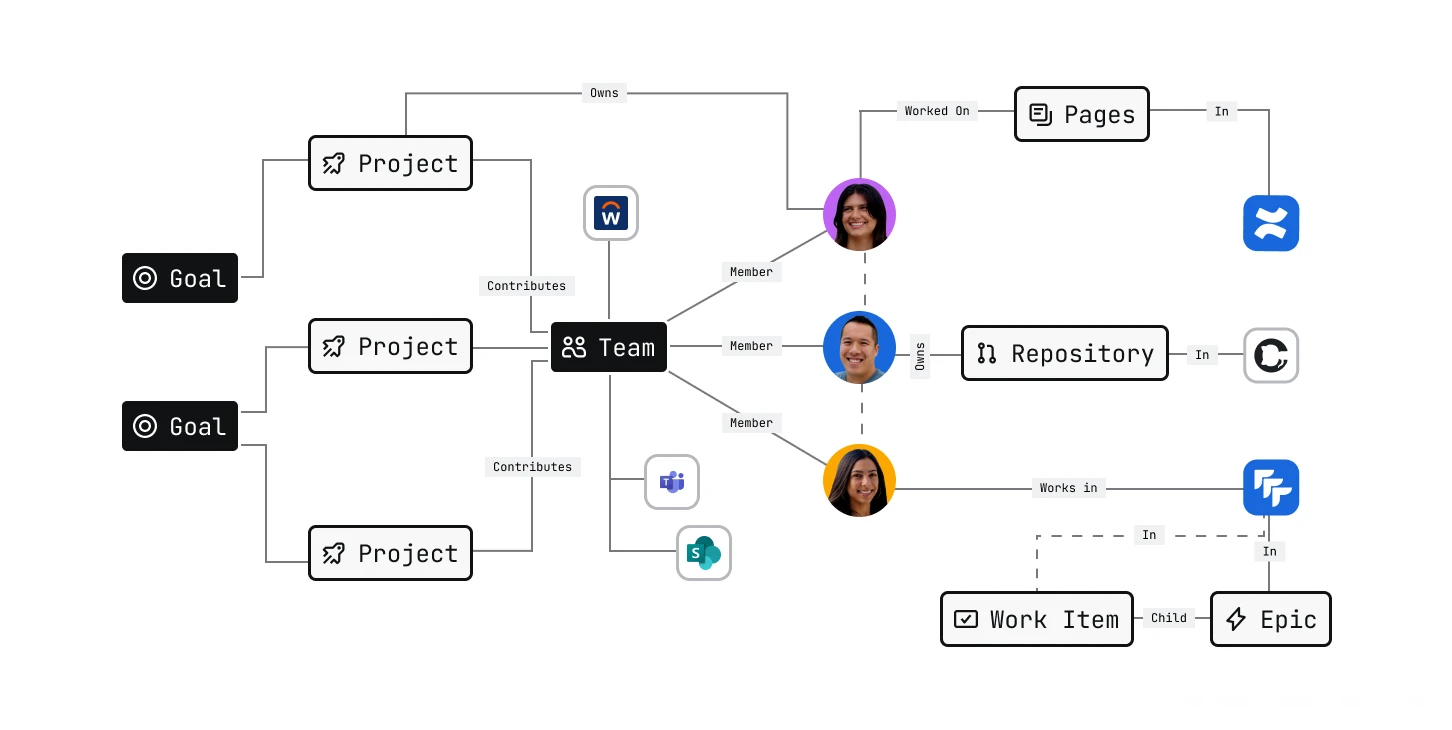
Over time, your graph grows organically as you work.
3. Relevance: Ensuring context is up-to-date and governed
If completeness and connectedness determine what AI can reach, relevance determines what it should use.
A knowledge base full of two-year-old pages introduces noise, not signal — AI should weight last week’s incident over one from three years ago, and it should not access or reveal sensitive information. Not everything should be visible to everyone, and not everything useful to everyone. Plus, recent isn’t always right. An older approved policy can outrank yesterday’s Slack thread.
AI can infer some relevance, but a combination of human oversight and good governance is critical. Establishing rules to automatically classify sensitive material and archive stale content, and setting up data security policies can help increase relevance and reduce risk. Team members can also make it a habit to make authority visible by marking official pages as final, assigning owners, and archiving or linking superseded versions to their replacements.

With proper data classification and hygiene in place, you can use technical controls at the integration layer to ensure proper context governance. For example, using Atlassian MCP server controls with Atlassian Guard, organizations can govern which Jira and Confluence content AI agents can access, scoping permissions across sites, projects, or specific classification levels. Teams can ensure that agents automatically bypass data labeled “Highly Restricted” (such as financial or M&A plans) without disrupting how people collaborate on those same pages.

While context search layers and MCP controls like these can help, and even be optimized to point AI at the sources that a team actively uses, this is really where your organization must start to shift behavior to ensure content is labeled and up-to-date.
Managing context like a product: the context quality flywheel
Creating good context for AI is ultimately an active practice. Fortunately, Atlassian offers tools necessary to drive behaviors that will lead to good context. Our platform has always been open and led with the belief that teams are best served when they can work where they want, with unified, governed information. This means we’ve invested in extensibility and connectors at the data level, and built an underlying Teamwork Graph that makes meaning from disparate sources and user behaviors. It infers relevance and maps the relationships between data points for an understanding of your organization that grows richer as you work.
As AI has become more critical to work, we’ve also added features to help you understand the quality of your context for better AI outcomes.

Ultimately you should be able to manage context quality as a flywheel with the following steps:
Diagnose which factors are weakest across the different types of context: maybe code has strong fidelity but no connectivity, or communications are rich but disconnected from the work they drive.
Act on something small: connect a tool, update data security policies, link goals to the projects tracking toward them.
Observe AI outcomes: To keep track, benchmark against previous response spends and keep track over time. Response quality and efficiency should improve in exactly the areas you’re investing.
If this is successful, documented, and shared, the practice should expand to more teams and parts of the business.
Better context is cheaper AI
When done correctly, the benefits of context engineering can show up in your AI spend and in the quality of your AI-driven outcomes:
Fewer retries, less waste: An AI assistant that writes technically correct code the team or another agent has to rewrite because it missed key context hasn’t saved anyone time or money. Rework by an agent or your team shows up directly on your balance sheet: fewer re-prompts, fewer tokens burned.
Less tokens, same result: Context does the work a model would otherwise brute-force. When the the query is well-grounded and the answer is already in reach, you’re not paying for a model to reason its way around a gap in what it knows.
An asset, not a recurring bill: Model spend is a recurring cost that resets every month, but context compounds. Every source you connect and every record you keep current makes every future AI interaction better across every model, every use case, and every team.
What’s next:
We’ve covered the value of context and the factors that contribute to its quality. In the next part of this series, we’ll go a level deeper to explore the architecture of context graphs and how they support agentic autonomy.