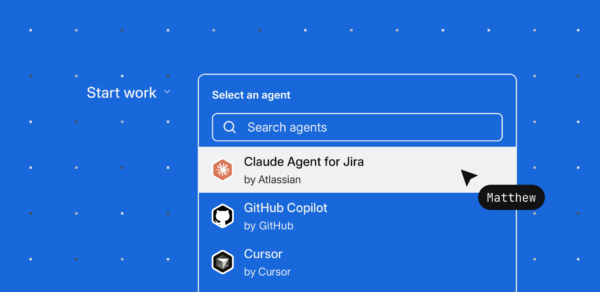
What context really means for agents, why models aren’t enough, and how to engineer context your teams can trust.
Over the coming weeks we’ll be sharing more about context in this content series — including how to engineer context as a product, what a context graph actually is, and what it takes to build one that agents can trust. You can also learn more about how Atlassian is harnessing context in our latest report, Leading with Context.
Imagine you’ve just hired a new person on your team. They’ve got extensive experience, they’re switched on, and excellent with people. But it’s their first week, and they haven’t yet learned the ins and outs of your business. The answers they need exist, but they’ve got to meet with ten different people to get the information for the business challenges they’re here to solve.
This is where Atlassian comes in. Atlassian has been helping teams manage work and knowledge to unleash their full potential for 25 years. We’ve done this by creating shared context to power our platform. That same shared context is critical to getting the most out of AI.
What is context?
Context is the information AI needs to understand what is important in a given moment, based on how your organization works.
It’s drawn from your organization’s knowledge, work, people, communications, code and assets, and how they connect. This includes the continuously evolving history, indicators and patterns that explain why these relationships matter. When it comes to providing context for AI, it is not just the data points, but the ability to connect them so that AI can easily traverse from point A to point B across tools and topics, answering your question directly without wasting cycles and tokens.
Why your teams are still more effective than AI
Enterprise teams are evolving. Collaboration used to be entirely person-to-person, but with the introduction of AI tools and agents at work, team interactions now range from person-to-person, person-to-agent, and agent-to-agent. Agents move quickly and are always working, which makes access to shared information even more important.
The most effective people within your business don’t necessarily have more access to documents or data than others; they understand how to navigate the organization – who to talk to, what information is relevant and what is not.
The same can be true for AI. In our recent survey of over 1000 knowledge workers, only 12% say that AI knows their business as well as a tenured employee.
This is a real problem because it gets to the heart of what AI can do for your business, and the promise of AI overall. Agents without context don’t know that your organization has three projects called “Project Titan” but you only care about the one your team is working on. They don’t know that the meeting you had yesterday reversed a decision listed on a Confluence page written last week. Simply put, they don’t have the know-how to actually get things done.
Standards like Model Context Protocol (MCP) allow you to easily connect many disparate systems to agents for a more complete picture, but these don’t fully solve the problem. The context remains disconnected and the agent must spend valuable time and tokens stitching it all back together every time it runs. The good news is, with a context graph, organizational context can be made understandable for AI with common definitions and pre-inferred relationships.
With over 350,000 customers and billions of workflows spanning every team in an organization, Atlassian understands context and how work moves across organizations. Our resulting Teamwork Graph allows you not only to build a comprehensive blueprint of work that makes AI queries more efficient, but it allows you to bring that blueprint to AI across any model or agent you choose. Our context graph understands the relationships between data points and grows richer over time to holistically build a full picture of teamwork at your organization that you can use to inform smarter AI in any AI tool.
Compounding context as an accelerator for your AI strategy
When generative AI was first released, it was used mostly for creating outputs, such as text, images and code. With the introduction of AI agents, AI is now being asked to take actions – like reasoning across steps, making decisions and running workflows.
The opportunities this presents to accelerate work are enormous. With agents able to execute daily workflows, humans are freed up to do more high-level thinking, and organizations can do more, faster. But AI can only be trusted to work if it can be trusted to make good decisions and take reasonable actions. In short, its true potential can only be unlocked if it has context — if it understands what’s going on, what’s relevant, how work gets done, and how decisions are actually made.
The bottom line is that context must be legible to AI to improve its efficiency, accuracy, and lead to better outputs and actions.
How to ensure context quality
To help you better understand your graph, we’ve introduced the following 6 distinct types of context. They pull from everywhere work happens, across your toolchain. To get the full picture, organizations have to connect third-party apps, ingest data, and understand the relationships behind those data points across all the areas of the business.
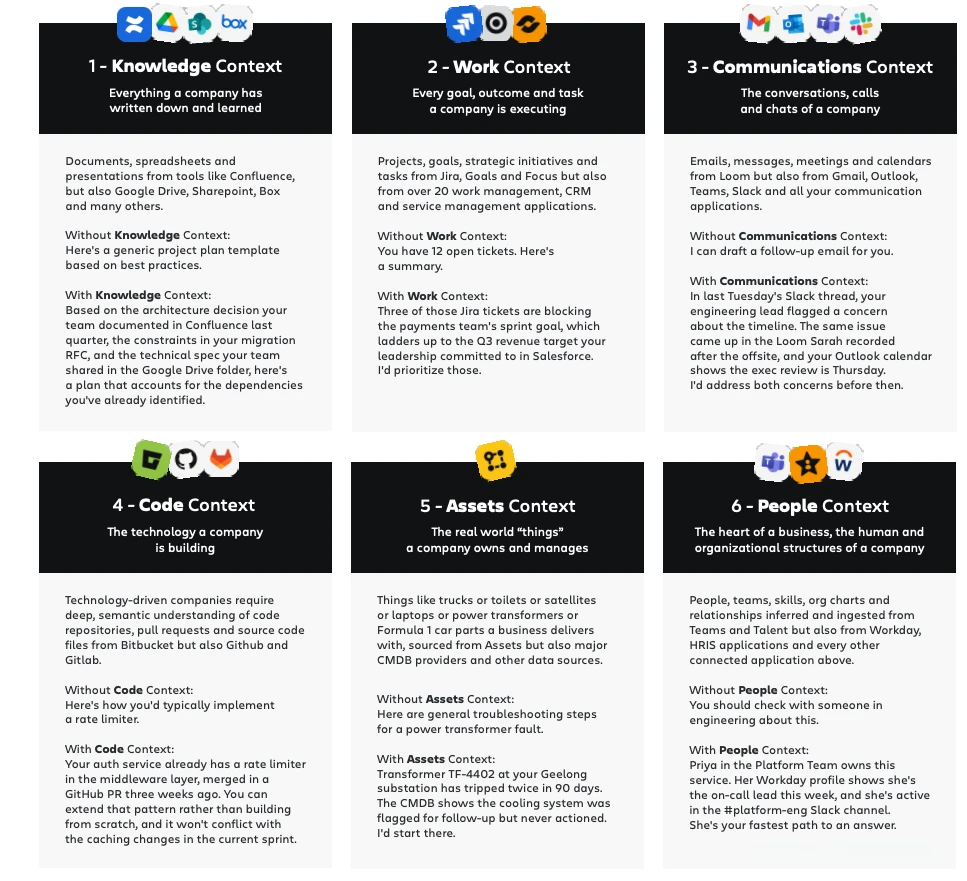
While individually, these pieces of information may be valuable, together they form an integral picture of how your organization works. People context maps the work of your entire organization by traversing your org hierarchy, so your agents know who you work with and who they are accountable to. Work context provides details on what those coworkers are working on and likely to care about. Communications context allows us to understand that the decision shared on Slack yesterday is the more relevant one.
Getting there with context engineering
In a world where enterprise executives are struggling to prove ROI for their AI investment, increasing AI’s efficiency and the quality of its responses through context is one of your biggest opportunities. The process to get there is called context engineering.
Durable, rich context is hard to build overnight because it compounds over time. You need the systems and processes in place to ensure context is captured, connected, up-to-date, and permission-aware so that AI can access it and reason with it safely.
Context engineering figures out what an AI model needs to perform an ask well – such as which data to retrieve (through knowledge graphs), what history to keep across (across multiple conversations), which tools to connect (through protocols like MCP), and how to structure and prioritize documentation so that a model will use the most relevant information.
The good news is that you can grow and optimize your context. You can make it better, and make it work well for AI. We have put together a framework to help you start thinking about this in an actionable way: context quality can be traced back to completeness (are the right sources connected at the right depth?), connectedness (are you able to track how people, work, documents, decisions, and actions connect and relate to one another?), and relevance (is data current, scoped, and safe to use?).
Put simply: context engineering is how you create the blueprint that AI can access effectively to perform tasks more efficiently.
What next?
Your competitors have access to the same models that you do, and models will come and go as new iterations become available. What’s durable is your context, which has been built over time and expands every day. Building the right understanding of your organization, how your teams actually work, and how you make it legible for AI is the single biggest advantage for your AI strategy.
The whole point of context engineering is that AI agents within your organization will stop operating as if they are the new employees on the block. Instead, they start to take the most relevant and up-to-date information into consideration to action tasks more effectively. In short, they feel like an experienced teammate.
Over the coming weeks we’ll be sharing more about context in this content series — including how to engineer context as a product, what a context graph actually is, and what it takes to build one that agents can trust. You can also learn more about how Atlassian is harnessing context in our latest report, Leading with Context.