AI makes it quick and easy to turn rough notes into a clean, easy-to-read document. Job well done, right? Think again. Atlassian’s Teamwork Lab suspected that this professional veneer—what we call “AI polish”—makes it harder to spot foundational flaws and give feedback, so we tested it.
We wanted to know: Does AI polish make it harder to identify problems in early drafts? How can we solve for this blind spot?

our research at a glance
What we did:
- In a controlled experiment, we asked 903 knowledge workers to evaluate a draft proposal that included two fundamental flaws.
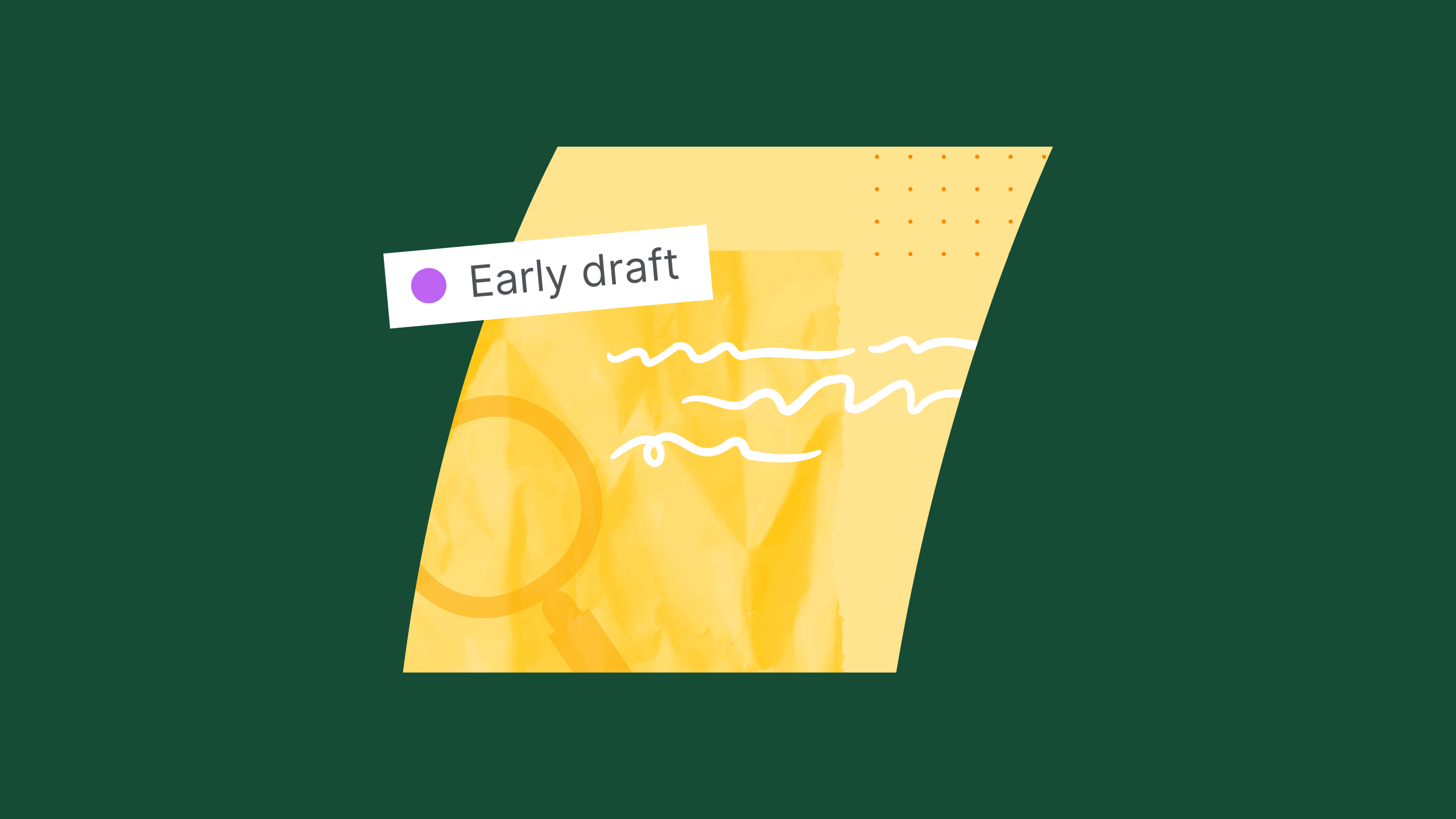
- Each reviewer evaluated one of three versions of the draft: one with no AI polish, one with AI polish but no label, or one with AI polish and an “Early Draft” label.
What we learned:
- AI polish made reviewers significantly less likely to spot flaws and less willing to offer critique.
- A simple “Early Draft” label almost entirely negates the effect — without sacrificing perceived effort.
- Age and experience act as a natural firewall: Gen X and managers were largely immune to AI polish.
AI polish is a powerful psychological signal to drop your guard
It’s distracting and unprofessional to present work with misspellings or abbreviations. But researchers on the Teamwork Lab hypothesized that these rough edges serve as a subconscious signal to readers that the draft needs a more careful review.
To evaluate this premise, Teamwork Lab conducted a controlled experiment, assigning 903 reviewers to evaluate a draft proposal designed to reduce IT tickets. The draft intentionally included two fundamental flaws for readers to discover. First, it did not include an adoption strategy—the proposal builds a self-help hub, but no way to direct employees to it. Second, the proposal measured website traffic as a success metric, rather than a reduction in IT tickets.
Researchers randomly assigned participants into three groups, each receiving a different version of the proposal: unpolished, AI-polished, or AI-polished with an “early draft” label. Participants then answered questions evaluating both the proposal and the colleague who sent it.
Across the board, the AI-polished work was harder to review:
- More flaws went unnoticed: Reviewers were 22% less likely to flag the first flaw and 15% less likely to catch the second
- More effort was required to read it: Reviewers spent 62% more time reviewing, reading it 31% slower
- Less critique came back: Reviewers were 18% less willing to provide feedback

AI Polish, defined
Generative AI tools can quickly turn your rough notes into a clean, professional-looking document by fixing grammar, adding formatting, and swapping plain words for polished business language.
At the same time, the effects were not all entirely negative. A polished draft signals that the work has been “done.” When AI polish is used, our study discovered that:
- Reviewers were 1.7x more likely to agree that the author put in high effort.
- They were also 2.5x more likely to rate the draft as highly finalized.
An “Early Draft” label fixes the AI polish effect — and boosts perceived effort
Luckily, you don’t have to introduce misspellings into early proposals to get good critiques. An AI-polished draft paired with a simple warning cue (in this case, “Status: Early Draft”) and an explicit request for feedback almost entirely negates the AI polish effect.
Crucially, the effort ratings remained high with an early cue. Reviewers of an AI-polished piece that’s marked as “Early Draft” still conclude that the writer put in a high level of effort.

- Perceived finality dropped from 37% to 21% with a label, while willingness to critique went back to baseline levels.
- High‑effort ratings were higher for AI-polished drafts with an early cue (69% as compared to 64%), which suggests that the label increases perceived effort.
Notably, both older employees and managers are largely immune to AI polish. Their experience acts as a firewall—they spotted flaws, with or without AI polish.
- Gen Z and entry-level employees both saw steep drops in flaw detection.
- AI polish did not meaningfully change the flaw detection rates for Gen Xers or managers.

“Polish signals effort — but it also makes mistakes harder to spot. The fix is easy: polish your draft, then tell people it’s early. You get the credit for the effort without losing the chance for meaningful feedback.”
The bottom line: Include a warning on early drafts for useful feedback
Generative AI tools can serve as a helpful digital copyeditor. But for best results, use them judiciously. If you want meaningful feedback, sending an unpolished version is both faster and easier for your colleagues to read and react to. But when you’d like a quick review and you’re less interested in receiving critique, AI polish signals effort, and an “Early Draft” label can largely negate any negative effects.
Mid-career and older employees are harder to fool with AI polish, but all team members can benefit from being aware of its effects. Labeling early drafts is a simple workflow addition that can prevent more serious problems later on.
Methodology: To assess whether AI polish affects reviewers’ ability to find fundamental flaws, Atlassian’s Teamwork Lab recruited 950 full-time knowledge workers. After filtering out suspicious responses, 903 were analyzed across three conditions: a proposal with no AI polish, one with AI polish, and one with AI polish and a warning label.
The proposal was about reducing IT support tickets and contained two deliberate flaws: no adoption strategy, and success metrics tied to website traffic rather than ticket reduction.
We measured flaw detection, reading and writing time, willingness to critique, perceived effort, and perceived finality. An LLM coded all open-ended responses. Participants were also segmented by age — Gen Z (under 30), Millennials (30–45), and Gen X+ (46+) — and by organizational level: Individual Contributors and Managers/Leaders.