


The past couple of years have changed how my team operates. We’ve experimented, adjusted quickly, and seen meaningful early results. That momentum got me excited about where marketing is headed in the age of AI, even as we continue learning along the way.
Since then, we’ve witnessed what holds companies back from succeeding with AI.
Atlassian research found that 94% of marketers use AI at work, yet only 3% of marketing executives feel confident they can show clear, organization-wide return on investment.
That gap comes down to strategy, not technology.
At Atlassian, my team runs multi-channel marketing campaigns across our entire product portfolio. Our campaigns reach everyone from individual developers to enterprise decision-makers across dozens of global markets. For a long time, we were doing what most teams do by experimenting broadly, learning in isolated pockets, and struggling to connect those individual AI wins to broader outcomes.
Things changed when we stopped adding more AI tools and started focusing on how we used them. Instead of spreading our efforts thin, we made three focused, connected investments that transformed how we work.
Three AI bets transforming the way we work
Marketing leaders managing large global portfolios know the challenge of delivering high-growth goals across multiple channels, agencies, and internal teams while managing stretched resources and complex workflows.
The goal is now about reaching the right person with the right message at the right time, while making every program work harder, a much more complicated task than just reaching the masses.
AI is helping us become smarter and more precise in how we engage customers, while making our marketing spend and programs more efficient and effective. To address this, we’re using AI to solve the specific problem across three distinct focus areas:
Bet #1: Optimize paid media budget dynamically to improve spend efficiency
Every dollar spent on the wrong channel at the wrong time is completely wasted, and by the time a quarterly review reveals you poured six figures into a saturated channel three months ago, that money is already gone. We built this engine because we simply couldn’t afford to keep playing post-mortem marketing: we needed to see when performance was changing, shift investment before waste compounded, and adjust our approach mid-campaign.
Our machine learning budget tool detects diminishing returns per channel in near real time and recommends where to shift budget on the fly.
Because we reallocate budget as soon as signals shift, we’re aiming to boost overall cost-per-conversion efficiency by at least 10%. More importantly, our team moved from guessing to making decisions backed by clear data.
Bet #2: Personalize multi-touch user journeys across channels using lifecycle signals
When customers aren’t ready to buy immediately, we need to meet them exactly where they are. Our machine learning models now coordinate messaging across landing pages, email tracks, and in-product touchpoints so that every interaction actively learns from the last.
The AI determines the right message, the best channel, and the ideal timing based on real-time lifecycle signals. It becomes even more effective when those signals are enriched by Atlassian’s institutional memory. For Atlassians, the Teamwork Graph connects context on the audience, our messaging, and work across the organization, helping models make more informed decisions and deliver more relevant experiences over time.
For buyers, that means a smooth, connected experience at every step. For our team, it saves hours of manually stitching campaigns together.
Bet #3: Scale creative optimization to solve for ad fatigue and increase relevance
You can reach the right person at the right time, but if you approach them with the wrong creative asset, you have still lost the moment.
Creating localized, role-specific ad variations used to require endless cycles with creative teams, adding weeks to launch timelines. Our agentic creative tool now learns which assets perform well and generates tailored, localized variants at scale. That setup cuts personalization costs while raising campaign performance through more relevant ad creative.
AI compounds when intentionally connected
The value of these investments compounds over time because every interaction creates learning that improves the next decision. Budget signals sharpen our understanding of where investment works, journey data shows how customers respond, and creative performance reveals which messages resonate. When those insights flow back into the system, each campaign becomes more intelligent, helping us make faster, more precise decisions while increasing the return on every new experiment.
That interplay highlights our biggest takeaway: AI builds momentum when you connect it intentionally. Standalone tests stay isolated, but a connected system learns and grows.

how our three bets interact
These are not three separate, siloed initiatives, because they form a fully connected system. The budget optimization tool tells us where and how much to spend, the user journey orchestration engine decides when and what to say, and the creative optimization tool ensures we match our visuals to those exact moments. Each individual tool makes the other two significantly more powerful.
The experimentation agent: visibility across the org
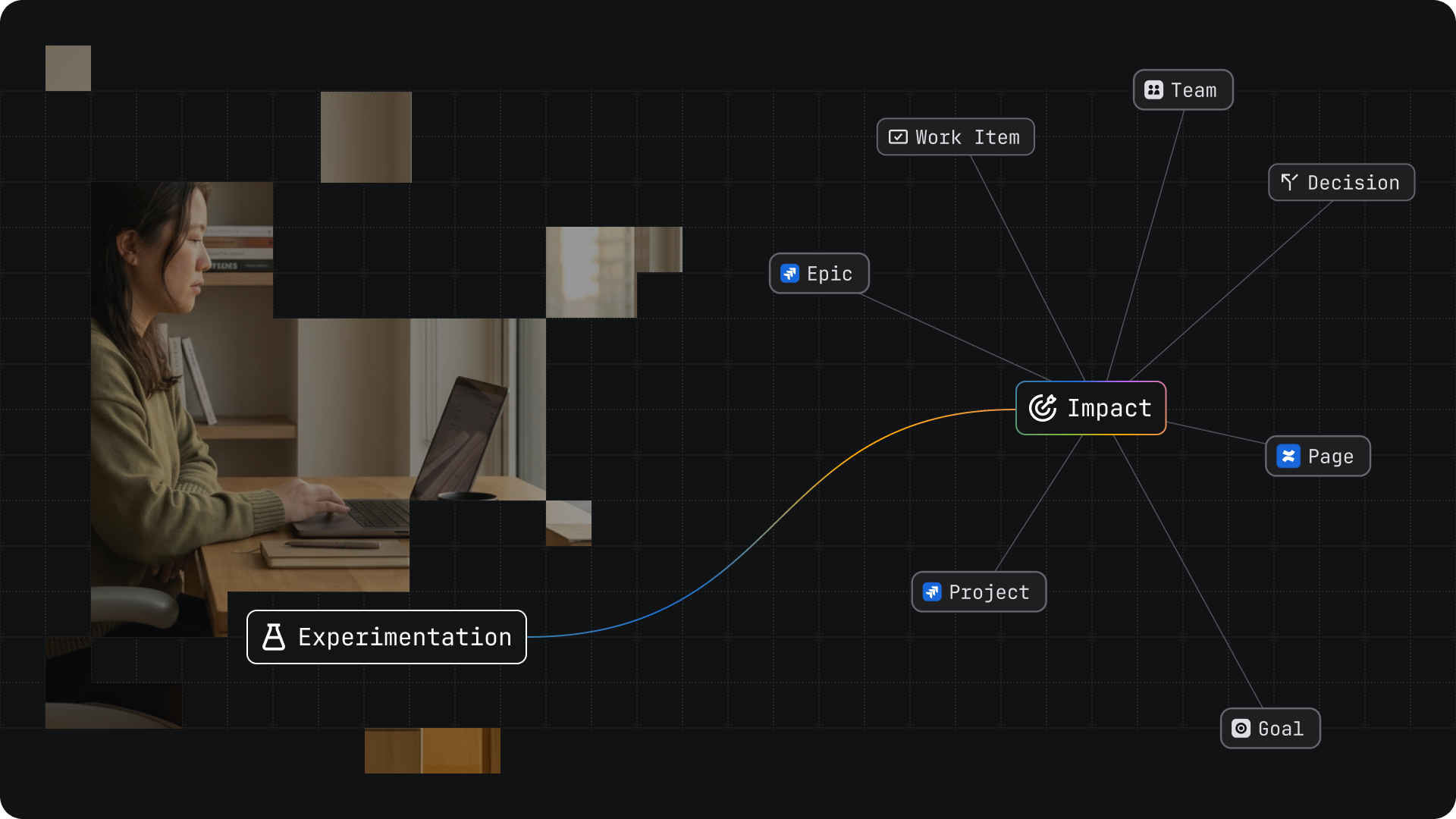
An experimentation agent built on Rovo, Atlassian’s AI solution, gives a clear picture of how AI improves daily team collaboration. Rolling it out gave us faster answers when metrics shift, fewer surprises on launch days, and full visibility across team projects.
To see why this mattered, look at how we used to work. Dozens of teams were running simultaneous experiments across product, growth, and performance marketing. Projects lived scattered across Jira Product Discovery boards, Confluence pages, Atlas tickets, and Slack threads. Whenever a core metric swung on a Tuesday morning, teams scrambled in Slack to figure out why by digging through boards and refreshing pages to spot unannounced tests.
Now, our Rovo agent consolidates all of that experimentation status, ownership, and results into a single queryable dashboard. It monitors everyone’s individual Jira Product Discovery boards, pulls in launch dates, catches trending signals, and gives us a real-time view filtered by product, channel, and workstream. Critically, it achieves all of this without changing how any individual team runs its internal processes, meaning we never have to ask anyone to conform to a rigid new system, because the agent automatically pulls together the relevant pieces.
The lesson we learned the hard way: keep humans in the loop
We also learned that automated AI isn’t always good AI.
In early tests, we let external ad platforms automatically optimize top-performing creative assets. The algorithms aggressively chased conversion rates, but they had zero context for brand identity. Within days, our ads looked generic, clinical, and stripped of personality. Conversion rates looked great on dashboards, but the actual ads made us cringe.
That mistake reshaped our approach to AI governance. While we rely heavily on agent recommendations and automated scaling, humans review and approve everything before it goes live. AI accelerates work, but humans protect the brand.
What this means for marketing leaders
If you want to move beyond superficial AI activity and create real impact, start with a focused, connected approach. These principles can help your team build a stronger foundation and turn one clear win into momentum for broader adoption.
- Before anything, clean up your foundations: align your context, processes, and workflows. Adding AI to a broken process only produces faster, lackluster results.
- Invest heavily in change management so your team can move beyond tedious execution and focus on strategic oversight.
- Start using AI on one broken process that drives your team crazy, then measure the results and use that win to build momentum.
- Feed context to all your systems so AI can connect the right information, workflows, and decisions across your organization.
Ready to move beyond the AI hype? Stop bolting AI onto broken workflows and start with Teamwork Collection – the connected foundation that helps marketing teams deliver across planning, creation, and reporting.


