Expanded product coverage, sharper task execution, and lower AI overhead across your entire workflow
When we delivered Atlassian MCP a little under a year ago, the idea was simple: let the AI tools your teams already use – Claude, ChatGPT, Cursor – reach the work that lives in Atlassian. The response was immediate. Now, we’re seeing more than 15M calls a day as it’s become the first thing teams reach for when they want to connect AI to their work. But teams have made it clear they want more. More products, more context, and more of the whole job done.
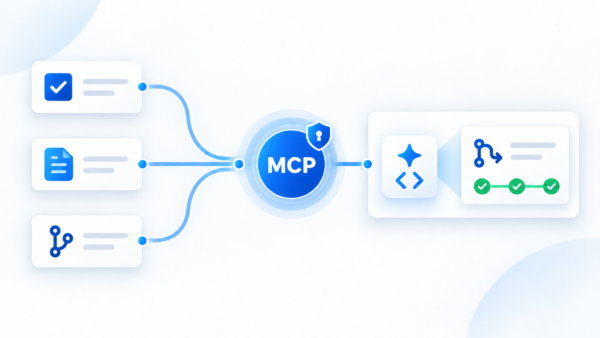
So we rebuilt it to deliver exactly that. Atlassian MCP now connects more Atlassian products to the AI clients you love to use. It’s been redesigned from the ground up with efficiency at its core, delivering 220+ tools without bloating your context.
And even with a broader surface, it runs significantly leaner. Based on internal benchmarking on Claude models, it can save up to 25% tokens compared to the previous version on the same Jira and Confluence work.

“Atlassian’s MCP is one of the most-used enterprise MCP integrations on Claude, helping knowledge workers get work done. Our teams are collaborating closely to build the best possible MCP experience for our mutual customers, enabling them to turn enterprise context into action while maintaining the permissions and governance businesses require.”
Connected across your workflow
We started by connecting Jira and Confluence, and teams realized they already had the most valuable ingredient for enterprise AI: the day-to-day context living inside their Atlassian work.
Now, the Atlassian MCP Server connects that full lifecycle, giving your AI tools the complete picture across your workspace.
- Strategy and ops. Executives don’t want to hop between tools to piece together what’s happening. They want one view, grounded in the latest context. Through MCP, Code Context brings what’s shipping, Jira the state of the work, Goals and Focus Areas the priorities it maps to, and Confluence the deeper documentation behind it, all in one place.
- End-to-end software delivery. You can move from architecture to deployment without losing context: inspect pull requests and branch state in Bitbucket Cloud, explore codebases semantically with Code Search, and manage service workflows in Jira Service Management (coming soon).
- Richer collaboration and media. Connect agents to your visual, dynamic, and video content. Confluence support extends across creating and editing pages, live databases, and whiteboards, while Loom brings video transcripts and agent prompts straight into your workflow. Tell an agent to “use this Loom to draft release notes in Confluence,” and it executes the entire multi-step handoff from brief to final sign-off.
A single request can span your entire software lifecycle, connecting the red thread across code, deployments, designs, documents, and strategic goals no matter where the work lives.
“With Rovo and the Atlassian MCP, we’ve built agents that can summarize a month’s worth of work across five different platforms in 10 seconds. We’re not just saving time; we’re eliminating the friction of context switching.”
The whole job, not just the lookup
Many AI tools stop at shallow lookups. We built Atlassian MCP for the messy middle of multi-step workflows, tangled dependencies, and teammates collaborating in real time. Now, you get:
- Complete context over quick summaries: Ask “Catch me up on this ticket,” and your agent analyzes the full comment thread, inspects the field-by-field changelog, and parses linked pull requests and documents to give you the full story of why decisions were made.
- Execution from unstructured conversations: When you say, “Take the recording of this meeting and draft the launch checklist and action items,” your assistant reads the Loom transcript, isolates decisions and action items, and immediately drafts the corresponding Jira work items and Confluence pages.
- Surgical, conflict-safe edits: When you ask to “update the rollout plan and undo the timeline changes,” your assistant diffs document versions and modifies only the specific section you requested. If a teammate updated the page while you were working, it pauses to prevent overwrites and lets you preview changes before publishing.
Powered by the Teamwork Graph
Access to raw data isn’t the same as understanding. If an AI assistant only searches keyword matches, it misses the living narrative of your work. The most valuable context lives in the spaces in-between: how a debate in a Slack thread alters an architectural spec in Confluence, or how a design change in Figma shifts a quarterly goal.
The Teamwork Graph maps those relationships across Atlassian and your wider tool stack. Because Atlassian MCP spans your entire workflow, your context compounds exponentially. Every work item updated, customer feedback snippet recorded, or pull request merged enriches the graph. When an agent acts on a request tomorrow, it draws from a deeply connected organizational memory that your teams contributed to today. What’s more, external models pull pre-stitched context on the first turn, preventing prompt bloat and ensuring each step is grounded in the full picture.
“Atlassian holds our company’s institutional memory. By using the MCP with Rovo, we can securely plug that entire context layer into our everyday AI workflows. Questions that used to take days of alignment across teams are now answered in seconds, allowing us to unlock organizational knowledge wherever our teams are working.”
Enterprise-ready, by design
As with every Atlassian update, enterprise security and governance remain foundational:
- Identity and permissions: Our MCP is Atlassian-hosted and secured with OAuth 2.1 and PKCE by default. Every request strictly respects each user’s existing permissions; using an agent will never grant access a user didn’t already have.
- Data protection with Atlassian Guard: Enforce Data Security Policies (DSP) and Data Loss Prevention (DLP) across MCP connections, ensuring agents only touch data appropriate for their role and environment.
- Granular scoping and risk tiers: Access is scoped by toolset rather than broad product access. Read, write, and destructive actions are separated so clients can require explicit confirmation on higher-risk steps.
- Centralized admin controls: Manage domain allowlists, read/write/search permission scopes, and IP allowlists directly from the Atlassian Admin Console, backed by organization-wide audit logging.
Built for an open ecosystem
Because no enterprise relies on a single AI harness, we designed Atlassian MCP to meet teams wherever they work. Whether engineers are coding in Cursor, product managers are exploring ideas in Claude, or ops teams are running custom scripts, your organization’s context travels with you.
Now, we’re opening up new ways for developers and partners to build. Developers can build custom MCP tools with Forge or extend Atlassian Marketplace apps with MCP capabilities. You can also expose custom Rovo agents via MCP.
Start today
Atlassian MCP is generally available now, with more relevant context, stronger workflow coverage, and more efficient AI requests across your Atlassian products.
Explore more at Team ’26 Europe
We announced these updates at Team ’26 Europe, our annual user conference, along with the rest of this year’s news. The sessions are available live and on demand if you want to go deeper.