


Engineering teams today are shipping more than ever. Sprint boards move quickly, work items are completed on schedule, and releases move forward with steady momentum. As engineering output scales, so does the time spent across the broader software development lifecycle (SDLC).
Jira continues to play a critical role as the system for organizing, tracking, and delivering work. But as organizations scale, the challenge expands beyond tracking tasks to something more fundamental: ensuring the full context surrounding that work is accessible, connected, and actionable.
Engineers spend just 16% of their time writing code according to an IDC Survey Spotlight. The remaining 84% supports execution, searching for documentation, clarifying requirements, switching between tools, waiting on reviews, and aligning across teams.
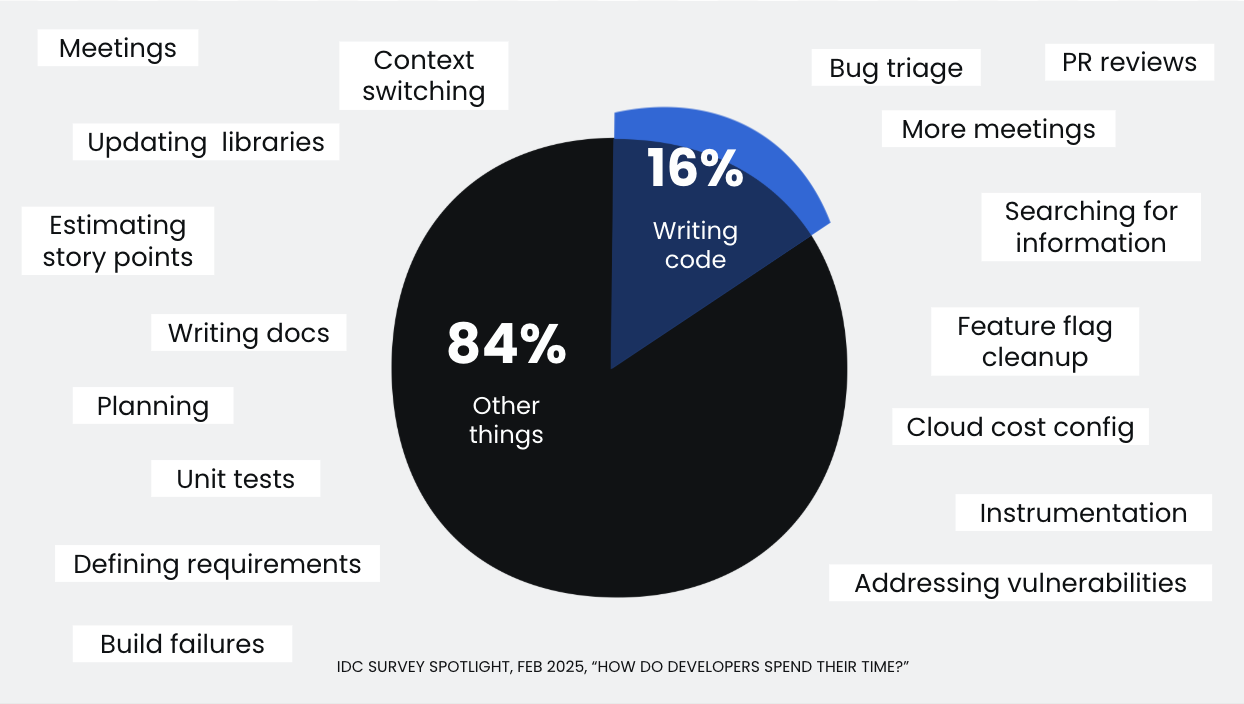
This 84% is essential. It’s how work gets coordinated, reviewed, and delivered. But as systems grow more complex, this is also where inefficiencies begin to surface. The more effectively this work is connected, the more efficiently teams can execute.
Where Jira’s value expands
Jira provides the structure and clarity to what’s being built. who owns it, and how it’s progressing. But most engineering orgs treat Jira as a digital to-do list, failing to utilize its full potential.
In modern engineering environments, work doesn’t exist in isolation. It’s shaped by product decisions, architectural tradeoffs, prior incidents, and ongoing cross-functional input. Think about where that context exists: often outside the ticket, spread across documentation, conversations, and tools.
When that context isn’t easily accessible, teams spend time piecing it together in the moment work is being executed. When it is connected, the experience changes. A work item becomes a starting point that includes the relevant history, decisions, and inputs needed to move forward.
This is the shift from tracking work to enabling execution. Teamwork Collection brings together Jira, Confluence, Loom, and Rovo (Atlassian’s AI solution), creating a connected, more powerful system from the one you already have. Teamwork Collection unlocks the compounding value of Jira by surrounding your tickets with the context, communication, and intelligence needed to execute autonomously and scale.
Where context breaks down in execution
As organizations grow and ship more, a greater share of time is spent across the broader software development lifecycle. The question isn’t whether that 84% exists – it always will. The question is how efficiently it operates. For many organizations, inefficiencies don’t show up as obvious failures. Work continues to ship. But friction appears in measurable ways across the system.
Here are signals your organization may be experiencing friction in how context is managed:
- Development cycle time increases as tickets stall in QA or UAT due to missing or unclear context
- Mean time to resolution (MTTR) extends and engineers understand what broke, but not the decisions behind how it was built
- Context switching becomes constant as projects grow more complex and information is fragmented across a Confluence spec, a message thread, and a Figma file
- Onboarding time goes up as new hires rely on tribal knowledge instead of becoming productive within the first week
- Cross-functional alignment weakens as teams lack shared visibility into what’s being built and why
These signals don’t mean execution is failing, they are indicators that the systems supporting execution – communication, knowledge, and coordination – are not fully connected. With most time dedicated to supporting execution, optimizing how that work happens directly improves velocity, consistency, and scale.
How Teamwork Collection compounds value
The magic sauce is the Teamwork Graph, Atlassian’s underlying intelligence layer. The Teamwork Graph is the shared data model that maps people, work items, knowledge, and relationships across tools.
Rather than operating independently, Jira, Confluence, Loom, and Rovo become part of a connected environment where relationships between work and context are preserved and build on one another.

Teamwork Graph enables:
- Faster, more relevant search and discovery
- Contextual insights and recommendations from Rovo
- Permission-aware AI grounded in organizational context
- Connections across both Atlassian and third-party tools
As a result, your tools gain connective tissue. The more you use Teamwork Collection, the more powerful it becomes. A developer opening or creating a Jira issue can immediately access the surrounding context such as related documentation, past decisions, conversations, and dependencies, without having to reconstruct it manually. This allows your teams to move from a system of record to a system of action, and lays down the foundation for autonomous execution at scale.
Improving how communication flows across teams
Engineering teams rely on a mix of meetings, documentation, and written updates to stay aligned – approaches that, while necessary, often make context difficult to revisit, reuse, or connect directly to the work. The opportunity is not necessarily to replace meetings, but to extend their value. This is where Loom – shareable video communication – plays a key role.
According to a Forrester Total Economic Impact study, organizations using Loom experienced a 15% reduction in meeting time, 30% faster ramp to productivity for new hires, and 232% return on investment over three years.
These outcomes reflect a broader shift: context no longer remains static. Loom captured content is indexed into the Teamwork Graph so that context is always flowing across the system. Teams can capture async updates on their own time or record live meetings using Loom Meeting Notetaker and:
- Summarize key discussions and decisions
- Extract action items and next steps
- Automatically create or update Jira work items and Confluence pages
- Connect conversations directly to ongoing work
This unlocks automated task management. For example, a Loom meeting or walkthrough recording can generate suggested Jira updates based on what was discussed, turning conversations into structured, actionable work.

Loom adds value to the meetings that need to happen, enabling more automations and reducing the need for manual follow ups. An async demo reduces sprint review bloat and let’s developer stay in deep work longer. As a result, teams can spend more time on delivering customer value and obtain 53% faster project launches.
The agentic future: Human-AI collaboration
A standard automation we all know is: “If X, then Y.” Agentic experiences are: “I need to release capability; find the documentation gaps, notify the stakeholders, and draft the release notes.” With Rovo agents in Jira, teams can introduce adaptive, context-aware collaboration directly into their workflows.
Teams can now:
- Assign work to Rovo agents to triage issues and analyze bugs, accelerating release cycles and reducing manual coordination
- Mention agents in comments to summarize discussions, draft updates, or answer questions, helping new hires ramp more quickly
- Embed agents into workflow transitions so analysis, categorization, or documentation happens automatically, reducing time spent on coordination
Teams can also work with third-party agents, such as GitHub Copilot, directly within Jira, with full visibility into the work and its context. This creates a model where agents handle the “work about work”, allowing engineers to focus more time on shipping.
Many Teamwork Collection users are already reporting gains, such as:
- 80% of tickets from new hires answered by Rovo Agents at Sprout Social
- 75% reduction in time spent writing quarterly roadmaps according to the Head of Engineering at Procore
- 100+ annual hours saved per engineer with Rovo at Atlassian
Activating Teamwork Collection: A practical how-to
Adopting Teamwork Collection is about unlocking more value from the systems teams already rely on. By connecting work, knowledge, communication, and AI, it builds on existing workflows and compounds in value over time. Here are 4 steps you can take to get started:
1. Connect knowledge to execution
The first step is linking knowledge directly to the work being done.
By connecting Jira projects with documentation and decision-making artifacts through the Teamwork Graph, context becomes part of the execution layer. Product specs, architectural decisions, and prior incidents are accessible within the flow of work. As Rovo indexes this environment, it becomes easier to discover, maintain, and act on that knowledge.
2. Can you Loom that? Shift how context is captured
Once knowledge is connected, the next step is improving how context is created and shared.
Teams begin capturing key moments – meetings, walkthroughs, discussions – in Loom so they can be reused. That content can then be summarized, turned into action items, and connected directly to work through Jira and Confluence. This transforms communication into a persistent layer of context.

3. Deploy the agents
With knowledge and communication connected, teams can introduce agents into workflows.
For example:
- A Loom-recorded bug generates a Jira issue
- An agent analyzes the issue and recommends next steps
- A developer reviews and refines the solution
- A coding agent (such as GitHub Copilot) implements changes
This allows teams to reduce manual coordination while maintaining visibility and control.
This is just one of many agentic workflows. Rovo Agents can automate repetitive engineering tasks across Jira, Confluence, and Loom, such as:
- Onboarding: Automatically assign Loom-based technical walkthroughs, link relevant Confluence runbooks, and create Jira onboarding checklists for new hires.
- Report generation: Summarize sprint progress, incident postmortems, or design reviews from Loom videos and Jira issues, then publish structured updates to Confluence.
- Content clean-up: Identify and archive outdated or duplicative documentation in Confluence, and create Jira cleanup backlogs.
4. Connect work to outcomes
The final step is linking execution to business outcomes. When Jira work is connected to goals and priorities, teams gain visibility into how work contributes to broader objectives. Leaders can better understand where effort is driving impact and where adjustments are needed, while teams gain clarity on how their work fits into the bigger picture.

What happens to Jira?
Jira remains a foundational part of the system. It continues to provide structure, visibility, and coordination. But it is now supported by a connected layer of context, communication, and intelligence that significantly expands its impact. This is where the original 16% statistic comes full circle. By strengthening how the remaining 84% of work operates across the SDLC – the coordination, communication, and context, teams are able to reclaim time, reduce friction, and focus more on building.
Enter the modern AI era
When context is connected, communication is reusable, and workflows are supported by AI, the time spent across the SDLC becomes more efficient and more valuable. Manual coordination and repetitive tasks are reduced, giving teams more space to focus on building, problem-solving, and strategic work.
This is not a replacement for how teams collaborate, but an evolution of it. By building on existing systems, organizations can move faster with greater clarity, turning the work around execution into a driver of velocity, not a source of friction.
Try automating your workflows today. Unlock compounding value and intelligence at scale with Teamwork Collection.

