


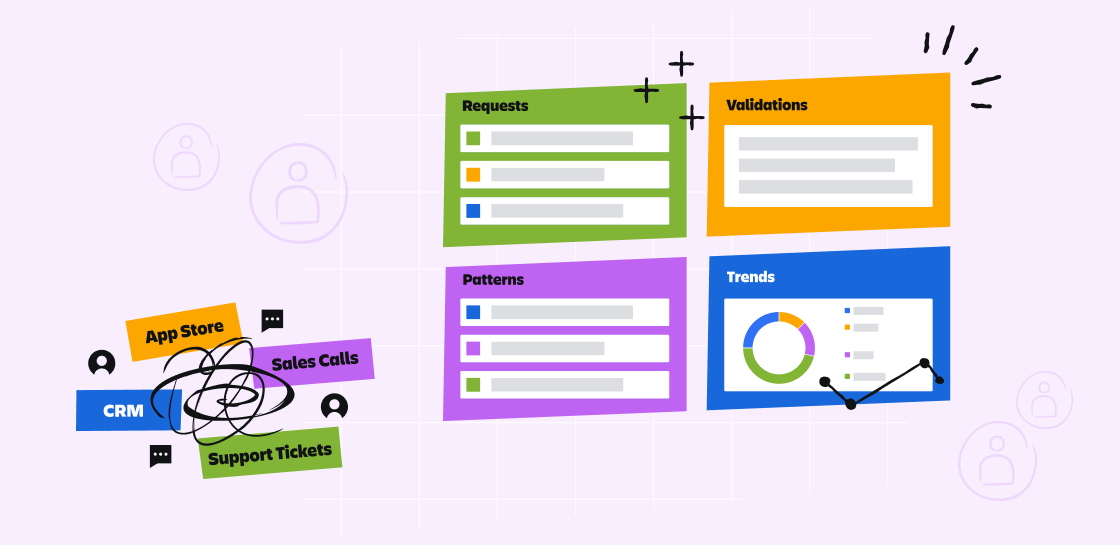
We spent years building and selling a feedback tool. We talked to thousands of product teams. In most of those conversations, the ask was the same: “I want to find trends in my feedback data.” Every time we leaned in and asked “what trends, specifically?” – people went quiet. It was a reflex, not a real need.
Strong product people already have a view on where the product should go. They get it from the founder’s vision, the company’s strategy, and from customer signal. Think of how an LLM works: feed it enough data and it learns to predict the next token. A great PM does the same thing – every customer conversation, every chat with a Sales or Support colleague, every session recording they watch, every review of a usage dashboard, every skim through CSAT responses or online reviews, even playing with new products and vibe-coding their own prototypes. All of it nourishes their judgment until they can make confident calls without a spreadsheet.
A feedback tool does not tell you what to build. It gives you the evidence to build the right thing, the right way. It supplies the rich customer context – the verbatim words, the edge cases, the current workarounds – that no roadmap captures.
But evidence only flows if people keep contributing it. Sales reps logging deal objections tied to product limitations, Support agents flagging the same issue for the tenth time, customers giving up their time to help with your research – they all need a reason to keep doing it. That reason is trust: the belief that their input actually leads somewhere. A feedback system has two jobs: give product teams the customer context to build the right thing, and keep the people who supply that context invested in the process. This article is about how to do both.
Don’t ship what people ask
There is a quote often attributed to Henry Ford: “If I had asked people what they wanted, they would have said faster horses.” Whether Ford actually said it is debatable – but the lesson holds.
Steve Jobs put it more bluntly: “It’s really hard to design products by focus groups. A lot of times, people don’t know what they want until you show it to them.” That line gets misread as “ignore your customers.” Jobs never said that. Apple obsessed over customer pain – slowness, complexity, sync hell, crappy phones – they just refused to let customers dictate the solution. The distinction matters: listen deeply to customers’ problems, not their feature requests. Use your own judgment to design the solution.
A customer who says “I want a bulk export button” is describing a symptom. The underlying problem might be solved in three different ways, only one of which is a bulk export button. If you treat the request as the answer, you skip the most important part of the job.
This is where most feedback systems go wrong. They count requests instead of capturing context. A tally of “I want X” tells you nothing about who asked, how painful the problem is, what they were actually trying to do, or whether the request describes the real need or just one possible solution. Prioritization frameworks can help structure the conversation – but the score is a conversation starter, not the answer. Product judgment closes the debate.
The most visible version of this mistake is the public upvote portal. Upvotes invite customers to propose solutions instead of describing problems. They strip away every piece of context that would help a product team understand what is really going on: the role of the person asking, the workflow that broke, the workaround they cobbled together, how often it happens. What you are left with is a number. And when hundreds of votes accumulate on a feature that never ships, trust erodes – with no context left to explain why the team chose differently.
The alternative is a system built around verbatim customer words, with full context preserved. Not “37 people want bulk export,” but the actual quotes, the actual problems, the actual people – so the team can make a grounded call and explain it.
Build the structure before you collect
Most teams open the intake channels first. Forms, integrations, Slack connections. Then they wonder why feedback piles up with no one acting on it.
The right order is the reverse. Before you collect a single piece of feedback, answer a prior question: what is your product’s taxonomy? Feedback needs a home. A customer complaint about a slow dashboard, a sales rep’s note about a missing integration, a support ticket about confusing onboarding – each of these needs to land somewhere specific, owned by someone specific. Without that structure, nobody owns it. Nobody acts on it. The system quietly fails.
The right structure is a two-level hierarchy: Categories, broken down into Product Areas. Not too flat, not too deep. Two levels is deep enough to create clarity and flat enough to maintain velocity.
The governing principle is MECE – mutually exclusive, collectively exhaustive. Every piece of feedback belongs to one and only one product area. If something can belong to two areas, the taxonomy has a gap. If something belongs to none, it is missing a category. That is the discipline that makes the system usable at scale.
Every product area should have an owner. Align your taxonomy with your team structure and feedback will flow to the right people without manual triage.
Meet people where they already talk
The biggest threat to a feedback system is not a missing channel. Everyone knows that Sales hears objections, Support sees workarounds, and customers vent in community forums. The real threat is friction. If logging a piece of feedback takes more than a few seconds, it will not happen reliably – and the richest signal in your company will stay locked inside people’s heads.
Some feedback is already digital. Support tickets, community posts, in-app forms, NPS responses – these can be piped into your system automatically. The data is structured, the volume is high, and no one has to change their workflow to capture it.
The harder problem is the feedback that lives in conversations. A Sales rep on a call hears a deal-breaking objection. A CSM hears a customer vent about a broken workflow halfway through a quarterly review. A researcher watches a user struggle through a workflow. This is the highest-fidelity signal you have – and it is the most underlogged, because capturing it means someone has to stop what they are doing, context-switch, and write it down. Every time that step feels like a chore, something gets lost. Every time a CSM translates “the customer was furious about the export breaking mid-job” into a two-word ticket – “export issue” – the context that would have made that feedback actionable disappears.
The design principle is simple: make the high-friction sources as close to zero-effort as possible. Browser extensions that let someone capture a quote without leaving the page. Slack integrations that turn a message into a feedback entry with one click. Auto-transcription that pulls signal from recorded calls. The system should meet people where they already talk, not ask them to go somewhere else.
One more principle: recency matters. Yes, recency bias is real – people naturally overweight what they heard last week and underweight what they learned six months ago. In investing or performance reviews, that is a trap. In product feedback, we think the opposite is the bigger risk. Feedback from eighteen months ago was given on an older version of your product, by a user who may no longer be a customer, in a market that has since shifted. Treating a two-year-old piece of feedback the same as a two-week-old one is not being rigorous – it is working with stale signal. Weight recent feedback more, not less. Just make sure you are weighting the quality of the insight, not the volume of the noise.
Close the loop – then write the release note first
If the feedback loop does not close, the system becomes a black box. A Sales rep submits a deal objection – and never hears whether it influenced the roadmap. A customer describes a painful workflow in detail – and never learns whether it was fixed. When people cannot see what happened to their input, they stop contributing, they stop caring.
That is the moment the system fails. Not because the tool broke – because trust did.
Closing the loop – internally and externally – is what builds trust. When a Sales rep can go back to a prospect and say “we fixed that,” stalled deals reopen. When a CSM can tell an at-risk account “this shipped because of your input,” renewals happen. When customers see the product moving in their direction, upsell conversations start naturally. Trust has direct dollar impact. And a customer who trusts that you are listening, is not going anywhere. People do not churn from a company that listens. They churn from one that pretends to.
The artifact that closes the loop is the release note. And the best teams write it before they build anything.
This is not a new idea. Amazon has practiced “working backwards” for years – writing the press release before building the product, so the team has to articulate the customer benefit before a single line of code is written. The release note serves the same function at a feature level. It forces the hard questions early: Who is this for? What problem does it solve? What should someone do differently after reading this?
Writing it first sharpens scope – if a feature does not help deliver the outcome described in the release note, it gets cut or saved for later. It aligns the team around a shared story instead of a spec. And when the feature ships, you already have the exact text to notify everyone who asked – via email, Slack, CRM, or support tool. The release note is not just a communication artifact. It is the thing that physically closes the loop.
“Job’s not finished when it’s shipped. Job’s finished when you closed the feedback loop.”
Your feedback tool is not there to tell you what to ship. It is there to give you the evidence to ship the right thing – and the trust to keep the whole system running. Structure it well, capture real context, and close every loop. That’s how you keep building a product your users love.
Turn feedback into decisions faster – get early access to Feedback. Register now.


