Prefer a PDF?
No worries! Get it here
☁️ From the CEO
Fellow shareholders,
I’m thrilled to share our incredible Q3 results. The entire Atlassian team has been laser-focused on execution, and it shows in our numbers.
🚀 Total revenue was strong at $1.8B, up 32% y/y
🚀 Cloud revenue surged past $1.1B, with growth accelerating to 29% y/y
Service Collection scaled past $1B+ in ARR, growing over 30% y/y
Rovo customers are growing their ARR at 2x the rate of non-Rovo customers
Rovo customers’ AI credit usage is growing 20%+ month-over-month
Teamwork Collection customers use ~2x more AI credits per paid user and have 2x more agents vs. equivalent standalone customers.
Our customers have more options than ever before, and they’re voting with their wallets – expanding seats across our core products and adopting additional offerings, led by Service Collection and Teamwork Collection (our primary AI monetization motion).
They’re signing bigger, longer deals because the Atlassian platform is mission critical in moving their work forward.
We’re seeing momentum across our three strategic priorities: Enterprise, AI, and System of Work.
1️⃣ Enterprise: All up, RPO grew to $4.0 billion, an increase of 37% y/y. We continue to see strong expansion with some of the world’s largest organizations, like Siemens Energy, BBC, Rheinmetall, and Wayfair, who deepened their commitments with Atlassian this quarter. These enterprises want a trusted platform with security, governance, and domain expertise to power their workflows.
2️⃣ AI: We continue to add millions of monthly active users who rely on Rovo to cut busywork and speed up their businesses. AI credit usage is growing more than 20% month-over-month, showing that customers are using Rovo for more complex, higher‑value work. Today, we see customers using Rovo growing their ARR at a rate roughly 2x the rate of those who aren’t, contributing to our strong cloud outperformance in the quarter.
3️⃣ System of Work: Our strategic differentiation is context. By connecting work, knowledge, people, and code in the Teamwork Graph, our customers benefit from one of the richest enterprise context graphs in the world. Their OKRs are in Goals, their workflows in Jira, their knowledge in Confluence, their conversations in Loom, their physical assets in Assets, and their code in repositories deeply integrated with Atlassian apps. The Teamwork Graph gives a complete view of an organization, pulling in context from connected third‑party tools, and is further enriched by MCP use, which is doubling month-over-month. More and more enterprises are embracing our platform-wide vision, using Atlassian’s System of Work to see the ‘full picture’.
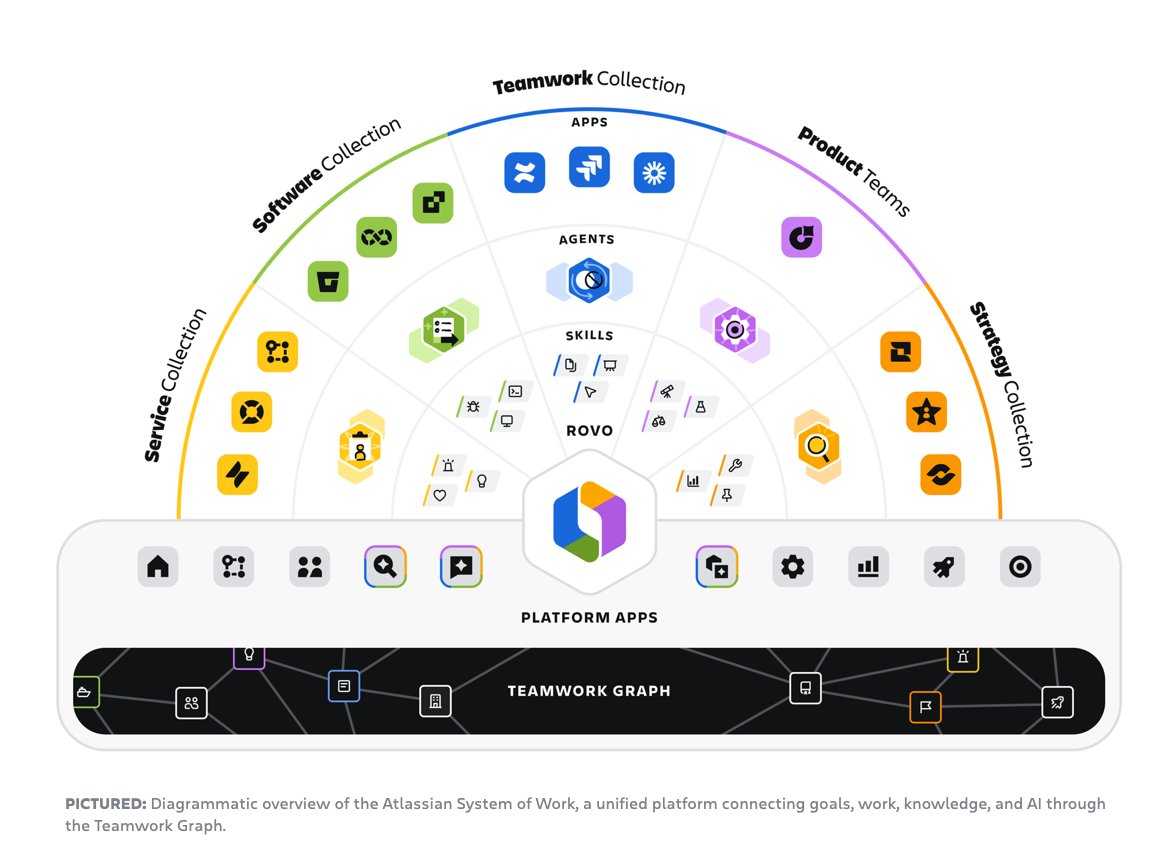
Customers are committing to the Atlassian platform with collections as the on‑ramp. As they add more collections, they deepen the Teamwork Graph, making all of a customer’s AI investments (in Rovo and connected AI platforms) smarter, cheaper, and more valuable. This creates a flywheel of better insights, more automation, and more reasons to expand across the platform.
Last quarter we shared the traction we’re seeing with Teamwork Collection: 1,000+ customers have upgraded, consolidating onto the Atlassian platform and expanding their seat counts by 10%+. Today, Teamwork Collection customers use 2x more AI credits per paid user and have 2x more active agents vs. standalone customers of the same size.
This quarter, I want to dig into Service Collection which is both a key demand signal for AI and the data flywheel that makes Atlassian’s AI better (more teams = more context = smarter AI).
Service Collection Surpasses $1B in ARR, growing over 30% y/y
With Jira Service Management, Customer Service Management, Assets, and Rovo, Service Collection is one of our fastest-growing businesses, and we are taking share from competitors.
Service Collection shot past $1 billion in annual recurring revenue (ARR)1, and is growing over 30% y/y. Today, 65,000+ customers – including over half of the Fortune 500 – trust us for IT, enterprise, HR, and customer service management, with enterprise ARR growing over 50% y/y. A key driver of this strong demand is the AI capabilities we’ve threaded natively throughout.
Service Collection customers who use our AI capabilities are getting results: resolving issues 13% faster than non‑AI users. They’re also resolving 20% more issues overall. And customers are deploying agents at a rapid clip. Today, Service Collection is driving 50% of the agentic automation runs across the Atlassian platform, which are growing 30% month-over-month, underscoring the increasing value we’re delivering to customers through our AI-powered platform.
It’s not just IT teams driving Service Collection’s momentum. Today over 60% of Service Collection customers use it for non-IT functions. HR, legal, finance and marketing teams that previously managed requests through email and spreadsheets are now running structured, measurable workflows on our platform.

MillerKnoll
Before Jira Service Management, service requests for marketing, finance, ops and facilities were scattered across inboxes. MillerKnoll rolled out a “JSM‑first” intake model, turning hidden workflows into structured, measurable processes, using automation to eliminate manual handoffs and dashboards to monitor queues in real time. One employee now supports 20+ workplace apps, and they’re scaling further with Rovo to help non‑technical teams find information and handle workflows faster.
Service Collection turns invisible processes into visible workflows, allowing teams to map and optimize business relationships that were previously impossible to see.”
– Shelby Corbitt, AI Solutions Engineer, MillerKnoll
Mercedes-Benz
Mercedes-Benz is providing employees with better and faster service by standardizing request intake, routing, and service-level agreements with Service Collection. Since the app works hand‑in‑hand with Jira and Confluence and is enhanced by Rovo, users can self-serve in many cases, which has reduced ticket volume and resolution times. Unlocking access to Assets within Jira Service Management Cloud enabled the team to create a single source of truth for the most up-to-date metadata on car models, variants, and components – significantly streamlining impact analysis and change coordination whenever something changes.
Jira Service Management is the backbone of all our support units, helping our customers get the right support. And now with AI built in, they can get that support even faster”
– Tobias Langjahr, Product Manager, Mercedes-Benz
Breville and others have done the same. IT is often the starting point, but the real opportunity is connecting every team on a single, AI-powered platform.
Enterprises are Replacing Legacy ITSM with Atlassian
This quarter was our largest ever for competitive displacements from a major ITSM provider, with broad-based momentum and strong wins across all segments.
Why? Because AI is making the old service playbook outdated. Customers are choosing Service Collection because:
1️⃣ With Rovo, it’s built for an AI-driven world, going beyond basic ticket routing to an experience driven by data and teamwork
2️⃣ The Teamwork Graph context advantage enables faster service and connects every team across an enterprise
3️⃣ It has a modern UX that teams actually want to use, allowing employees to get service wherever they are – website, messaging platform, search or chat tools
4️⃣ It offers compelling value versus legacy incumbents, while also improving faster due to Atlassian’s R&D advantages
Galenica
A leading integrated healthcare network in Switzerland with over 8,000 employees, transitioned from a legacy ITSM solution to Service Collection, extending its use beyond IT to an enterprise service portal that supports over 40 teams across Legal, People & Culture, and Data Governance in managing service requests and incidents. The organization now employs Rovo for knowledge discovery, with plans to further evolve its AI capabilities over time.
More and more customers like Galenica, Bombas, Domino’s Pizza Enterprises, and others are making the same shift to Service Collection, saving time and improving RoI where legacy systems are not meeting the moment in an AI‑driven world.
ENGIE México freed up 200 hours a month for their technical team by automating workflows, reporting, and SLA management in Jira Service Management.
The Warehouse Group cut service costs by 70% and shifted 2.5 full-time roles to focus on strategic initiatives.
24 Hour Fitness consolidated a sprawl of point tools onto a single platform, shaving 37% off their annual IT budget.
AI-Native Innovation
We’re not just winning on breadth and value, we’re shipping innovation that keeps us ahead of competitors both large and small.
This quarter we announced that Rovo Service is now generally available. This human-supervised AI agent plans and executes employee support resolution and onboarding workflows. This means AI actually does the work, and takes action itself rather than just pointing you to a knowledge base article.
We also launched Proactive AIOps, an AI-driven early incident detection and change risk assessment that helps IT ops teams get ahead of problems, instead of just reacting to them. Customers are finding the signal through the noise, experiencing a ~70% compression ratio for alerts and 6x faster post-incident review creation with AI.
Beyond IT, we’ve also extended Service Collection with a new Customer Service Management (CSM) app built on the same AI‑native foundation. By tapping into the same data and context that power Rovo and Jira Service Management, we put the Teamwork Graph into action to give agents a full view of the customer (past interactions, related incidents, deployments, and knowledge) and let AI take action on that context. That means fewer handoffs, faster resolution, and a single service platform that works for both employees and end customers. Internally, our customer support services and Loom team deployments show greater than 70% AI resolution rates across more than 100,000+ conversations.
“Gartner® estimates that by 2030, 30% of organizations will achieve autonomous operations for 80% of their digital workplace services, up from 0% in 2025.”2 We expect Service Collection to be a leader for this, with incredible runway and market opportunity ahead.
Bottom Line Focus: Driving Durable, Profitable Growth
We have strong momentum, and are heads down, focused on executing our key growth priorities: Enterprise, AI, and System of Work.
As we push our advantage on these and drive revenue growth at scale, we’re forging ahead with strong fiscal discipline as we self-fund further investment in AI and enterprise sales, while accelerating our path towards GAAP profitability. I’m energized as we add a new strategic priority: a sharp and sustained focus on durable, profitable growth.
Looking Ahead
We’re expanding within our largest customers and using the power of context across millions of users and hundreds of millions of workflows to deliver AI that’s creating real value for our customers every day.
In a world where humans will run teams of agents, context is the only anchor to avoid chaos. So we’re asking our customers – are you building a company that forgets or one that compounds? And we believe that answer will fundamentally decide which organizations are truly AI-native. With Atlassian, our customers aren’t just choosing software, they’re choosing the kind of company they want to become.
That’s what gives us confidence that our growth is durable and that the AI transformation is expanding our long-term opportunity.
There’s a lot more exciting announcements to come at Team ’26. Don’t just take our word for it. LPL Financial, Cisco, Rivian, Amazon Web Services, CHG Healthcare, Expedia Group and more Atlassian customers will be on stage to share how they are unleashing the potential of their teams with Atlassian.
We hope to see you there.
Mike

Footnotes:
- We define annual recurring revenue (“ARR”) as the annualized recurring run-rate revenue of subscription agreements to our Cloud and Data Canter offerings at a point in time. We calculate ARR by taking the monthly recurring revenue (“MRR”) run-rate for Cloud and Data Center subscriptions and multiplying it by 12. Cloud MRR for each month is calculated by aggregating monthly recurring revenue from committed contractual amounts at a point in time. Data Center MRR for each month is calculated based on the annual contract value from committed contractual amounts at a point in time. Cloud ARR on a single product basis is defined as Cloud ARR from subscriptions for that specific product. ARR and MRR should be viewed independently of revenue and do not represent our revenue under GAAP, as they are operational metrics that can be affected by contract start and end dates and renewal rates.
- Gartner, The Impact of AI Agents on Digital Workplace IT Operations, Stuart Downes, Autumn Stanish, et al., 16 September 2025. GARTNER is a trademark of Gartner, Inc. and/or its affiliates.