



AI is here – kind of.
LLMs and Generative AI aren’t the brand-new, mega-hyped tech of 2023 anymore. But on most teams, they’re not fully normalized, either.

How AI turns product managers back into builders
AI is changing how product teams build, learn, and ship. But “AI fluency” isn’t a status you read your way into. It’s something teams earn by building.Product thinker and Product Growth author Aakash Gupta lays out a practical pathway for PMs, designers, and engineers to level up. In his words, when leaders ask how to […]
There’s anxiety in that gap. What’s actually possible with AI? What does that mean for teams who aren’t there yet?
It’s a potent cocktail of excitement and uncertainty. The pressure to deliver ROI can feel paralyzing – teams are asking themselves what to learn, which tools matter, and what’s at stake if their experiments fail.
Leaders’ job is to use this uncertainty as fuel: make space for it, name it, and convert it into exploration and progress.
If teams feel like everyone’s running faster than them, the leadership trick is helping them realize that feeling is normal.”
Kene Anoliefo, founder at HEARD

We’re featuring voices from our podcast, Product in Practice, where we dive deep with product leaders experimenting in real workflows.
How the expectation gap causes AI anxiety and overwhelm

Kene Anoliefo on turning AI anxiety into AI fluency
Learn how to transform AI anxiety into productive action with product leader Kene Anoliefo. Discover her practical framework for AI adoption—the 3 Ps (People, Process, Platform)—and why context enablement, not just technology, is the key to building AI fluency in your team. From creating psychological safety to rewarding knowledge sharing, get actionable strategies for leading product teams through AI transformation.
Just a year ago, leaders were dabbling with AI curiosity: running experiments, watching demos, and asking “what could this mean for us?”
Now, many expect results. Setting big-picture goals to “10x productivity” or “become AI-native” might feel exciting for boards and executives, but teams are feeling the squeeze.
For many, this moment feels less like a rocket launch and more like turbulence: anxiety over goal feasibility, uneven adoption, and moments of brilliance followed by doubt.
The danger is turning AI into a KPI before strong foundations are in place.
Product advisor Ravi Mehta calls out this familiar gulf: boardroom expectations of “transformational productivity,” compared to the messy reality for people in the execution trenches.
The healthier stance is two‑speed: give teams permission for scrappy exploration while protecting core quality, and translate wins into durable capabilities at a measured cadence.
The path to AI brilliance is often paved with clunky workflows and brittle prototypes.
Let’s get real: the goal is AI fluency, not ‘10X’ing everything in sight

Ravi Mehta on shifting from craft to judgment in the age of AI
When Ravi Mehta talks about AI, he doesn’t start with tools. He starts with strategy. A longtime product executive at TripAdvisor, Facebook, and Tinder, and now a product advisor and co-creator of Reforge’s AI Strategy Program, Ravi helps companies compete and win in a rapidly changing environment. “A lot of people are asking: how do […]
Most beginner runners can get through a kilometre in 6-8 minutes. The world record is held by Noah Ngeny, at 2 minutes 12 seconds.
To 10x your running speed, you’d have to clock in at under 30 seconds.
It’s not a perfect analogy, but it illustrates how dramatic a 10x increase actually is beneath the buzzwords and hype. In a work-related context, 10x productivity would look like completing a month of work in just two days.
Is it possible to set up AI agents and automations that could, say, publish a month of social content or launch three new features in that time? Maybe. But will that output be high-quality enough to drive the business forward?
Elena cautions against this magical thinking: “AI isn’t 100%,” she says. “It’s average intelligence that can take you 40 or 50 percent of the way. The real lift still comes from human judgment layered on top.”
20 days’ work in 16 hours probably isn’t going to happen – nor should it. Some things, like ideation and collaborative discussion, take time to do well, as teams dig deeper to uncover their best ideas.
Aim for AI fluency, not speed for speed’s sake
It doesn’t help anyone if teams madly ship work, but it doesn’t deliver the results the organization needs. “Leaders can’t shortcut fluency,” says Ravi. “It’s not about buying a tool; it’s about building confidence, one workflow at a time.”
What they can do is slowly work to get comfortable with AI tools even as they continue to change. Then, use them to speed up the parts of your workflows that can and should go faster.
💡
That’s AI fluency. It’s not technical mastery, it’s the practical confidence to use AI to think, make, decide, and know when not to. Fluent teams share a few traits:
- They ask better questions of AI, moving from “do this task” to “help me reason about options,” “surface trade‑offs,” or “generate counter‑examples.”
- They understand limits and biases, treating outputs as proposals to be interrogated, not truths to be obeyed.
- They integrate outputs into real workflows, connecting drafts, analyses, and prototypes to the tools and rituals where work actually moves forward.
- They normalize experimentation. Trying, failing, and learning are part of the operating system, not extracurriculars.
In the engineering space, plenty of developers are using AI to 2x, 3x, and yes, even 10x certain self-contained tasks, like translating blocks of code into different languages or writing small, one-off scripts.
The only way to find those opportunities? Experiment, be ready to fail, and give teams permission to embrace the messiness of the journey.
🧪 The antidote: tips and frameworks for AI success, anxiety-free
Channel anxiety into progress
Kene reminds us the AI landscape is meant to be overwhelming right now. Instead of trying to sweep anxiety under the rug, leaders can use it as energy to move forward.
Consider a recurring, time‑boxed forum where people name worries, share near‑misses, and convert them into questions worth exploring next week. The goal is to keep moving together.
Start with high leverage use cases that create momentum
Not every workflow needs AI tomorrow. But you can pick a few where benefits can be felt quickly and risks are low: drafting specs and changelogs, synthesizing customer research, prototyping designs or data flows, generating internal reports.
Elena highlights PRD drafts and prototypes as especially fruitful: Rather than starting from a blank page, let AI create the baseline, then refine it with your team’s authentic expertise. The aim is to build shared muscle and judgment you can use to tackle harder problems later.
Framework: The Builder’s Path
The builder’s path is the journey to AI fluency through making things.
For Aakash, fluency isn’t earned in theory – it comes from building. “Every prototype is a question in disguise,” he says. The courage to ask those questions is where fluency begins.
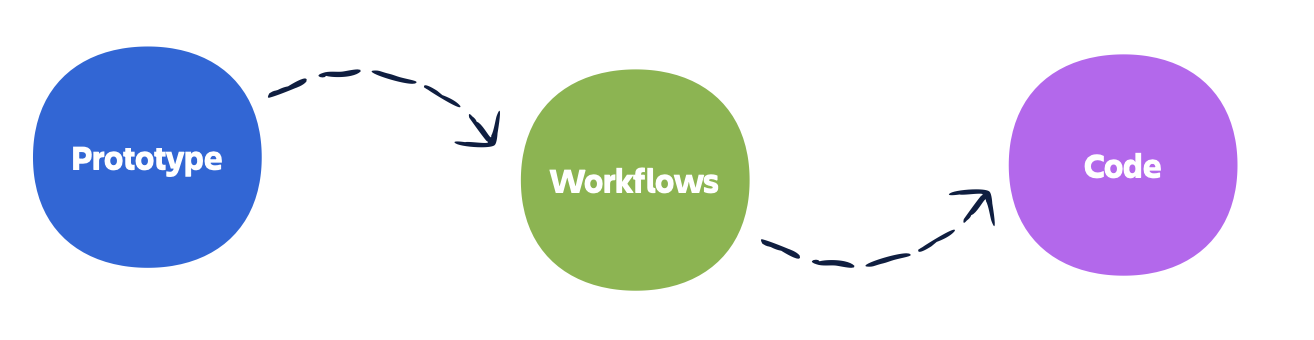
Teams often start with quick prototypes: chatbot mock-ups, automated research digests, feature specs drafted in minutes. The value lies in speed: surfacing what might work without committing real resources.
As prototypes pile up, teams start to stitch them into workflows. A rough experiment becomes a repeatable process that saves time every week. “That’s where the leverage shows up,” Aakash explains. This is the murky in-between: not polished, but already changing how work gets done.
Over time, some workflows prove valuable enough to harden into code. That could mean a custom integration, an internal tool, or embedding AI into the product itself.
Fluency is the courage to take what worked in a prototype and make it real at scale.”
Aakash Gupta
For leaders, the builder’s path is both a map and a mirror. It shows where the team stands today — dabbling in prototypes, relying on workflows, or ready to invest in code — and hints at the next step forward. As Aakash puts it, “You don’t skip the messy middle. That’s where fluency actually forms.”
⚡️Takeaway for leaders
Where is your team on the builder’s path today: prototyping, stitching workflows, or ready for code? What’s the smallest step they can take forward from there?
Framework: Access, expectation, challenge
Ravi, Product Advisor and former CPO at Tinder, suggests that AI fluency depends less on individual skill and more on the culture leaders create around it. He points to three levers that shape that culture.

Ravis starts with access. He has watched teams stall when experimentation requires workarounds or shadow logins. “If every experiment needs a procurement request, people just give up,” he says. The easier it is to reach for AI inside everyday tools like Slack, Figma, and Jira, the more likely experiments will stick.
Next is expectation. Leaders send a powerful signal just by asking the right questions. “The fastest way to show that AI belongs in the workflow is to bring it up,” says Ravi. When managers regularly ask, “How did AI help here?” or “What could we try with AI next time?”, it frames AI use as a norm rather than a novelty.
The third lever is challenge. Ravi encourages leaders to raise open-ended prompts: “How could we do this faster with AI?” or “What part of this workflow could we reimagine?” He stresses the importance of recognizing effort as well as outcomes.
Fluency grows when people feel safe to share the half-finished attempts. That’s how you discover the surprising wins.”
Ravi Mehta
Ravi’s model is less a checklist and more a set of cultural levers leaders can keep pulling. Together, they create the rhythm where experimentation feels normal, and confidence has space to compound.
⚡️ Takeaway for leaders
To accelerate fluency, make AI easy to reach, set the expectation it will be used, and keep challenging teams to stretch.
Go deeper on AI fluency
We have so much more to say about this seismic shift in how we work, collaborate, and build great products together.
In our new ebook, AI fluency: The new product superpower, we’ve gathered even more insights from these experts on how AI is changing our roles and evolving expectations – plus practical advice on how to adapt.

