
What if customer conversations were automatic and human-centric, not ad hoc or manual? Here’s how one Atlassian PM built an AI-powered workflow to close the feedback loop at scale.
When customers take the time to leave feedback, they’re hoping two things happen: someone listens – and something changes.
Avinoam “Avi” Zelenko, a Principal Product Manager on Confluence, set out to close that loop faster and at scale. Using Teamwork Collection and Slack – he’s created an AI powered workflow with Rovo that turns customer feedback into real conversations and team-wide insight – without custom code.
The result? Customer conversations went from occasional and heavy to continuous and lightweight.
The problem: customer understanding shouldn’t be so hard to scale
For Avi, talking to customers is the best part of the job. The friction was everything around it.
A single customer interview took about an hour end-to-end:
- Sourcing the customer
- Scheduling
- Attending the call while taking notes
- Summarizing and sharing afterward
That overhead made customer calls feel costly, so they happened less often – around two calls a month.
There was a second issue, too: even when customer calls happened, insight often stayed with the product manager. Avi had tried bringing engineers customer context through readout sessions, but it didn’t scale. Engineers needed to be building – and it took too much chasing and prep to keep everyone close to real customer feedback.
The spark: “How do we even use this?”
At Team US, Atlassian’s flagship conference, Avi watched excited customers react to the Teamwork Collection announcement – then immediately ask: “How do we connect all these building blocks? How do we actually use them?”
That prompted a challenge for Avi: build something real using the tools already in the Atlassian platform – and prove the “building blocks” could create an end-to-end workflow.
Watch the full demo and hear the story from Avi himself.

Building a continuous feedback engine
How can you get to this level of scaled customer conversations? Here’s a step-by-step of Avi’s actual workflow.
1) From feedback to a personal invite
When customers leave feedback in-product, it lands in Jira. A Jira automation rule then:
- Pulls the customer’s email dynamically
- Sends a friendly email from Avi (not “no-reply”)
- Includes a Calendly link to book time with him
- Makes it clear a real PM is reaching out
2) Capture the call automatically
Once the customer books, a calendar invite appears on Avi’s calendar – he just shows up. During the call:
- Avi’s Loom notetaker joins automatically
- Loom generates a Confluence page with transcript + notes
This removes the “listen vs. take notes” tradeoff and makes the call itself the only manual effort.


3) Automatically turn customer calls into shared insight
A Confluence automation rule waits for Loom notes to populate the full transcript, checks it’s truly a customer call, and then triggers a Rovo agent to:
- Read the Confluence page
- Produce a Slack-ready summary
Avi started from an internal demo agent and then iterated on the prompt until the structure and tone felt right.

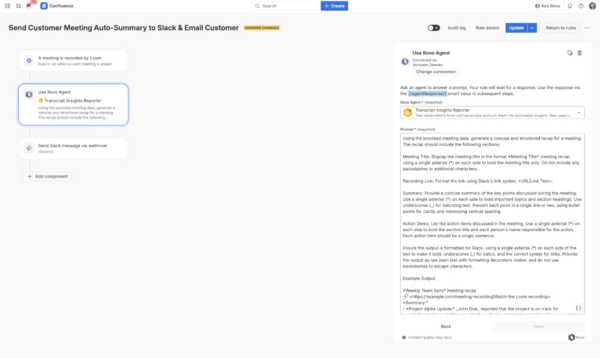
The automation then posts that summary into a public Slack channel he created called “Get Closer to Customers.” Anyone can click through to the Loom recording and full notes when they want deeper context.


Avi also built a follow-up flow that uses an agent-created email variable to send a friendly note to the customer after the call – reinforcing that feedback landed with a human.
The impact: less overhead, more customers, better decisions
Before: ~1 hour per customer conversation end-to-end
Now: 30 minute call – everything else is automated
Before: ~2 customer calls per month
Now: 1–3 per day, roughly 30+ per month
For Avi, that means more time for higher-impact work: deeper PRDs, more collaboration with peers, and decisions rooted in fresh customer reality.
For the team and organization, it means customer insight becomes visible and shared: engineers and partners see summaries in Slack and can dive deeper when needed. It creates shared understanding of what makes customers happy – and what rubs them the wrong way – which helps teams pivot faster.
And for customers, the experience shifts too. When they realize a real PM reached out, conversations get more human. As Avi put it:
“The easiest way to add value to customers is to just meet them like a human being.”