
See how a fast-growing HR leader reduced friction, improved security, and boosted productivity with the help of Atlassian Teamwork Collection.
The learnings in this blog post are based on Personio’s session presented at Atlassian’s Team Europe ’25 conference. You can check out this session and others on demand.
Modern companies are being pulled in two directions at once.
Outside the organization, market and technology shifts demand speed, creativity, and constant adaptation. However, within the organization, fragmented systems and disconnected ways of working quietly undermine everything.
Personio, a fast-growing HR software company based in Germany, found itself right in the middle of that tension. At the time, they aimed to massively scale their impact at work, improving the working lives of four million people by 2026. As they grew to nearly 2,000 employees to support that mission, they realized their existing collaboration tools couldn’t keep up.
Personio’s answer was to unify collaboration on Atlassian Teamwork Collection and use it as the backbone for how work happens across the business. Teamwork Collection is Atlassian’s collaboration stack that brings together Jira, Confluence, and Loom, powered by Rovo.
Internal friction at Personio: systems working against each other
As markets, customers, and technologies evolve faster than their operating models, enterprises feel squeezed from all sides. Beneath the surface, long-standing organizational habits, legacy systems, and ways of working can quietly amplify that pressure, making it harder to adapt with speed and confidence.
At the same time, AI is lowering the barrier to entry for new competitors, shipping cycles are accelerating, security expectations are non‑negotiable, and customer and employee expectations for clarity, speed, and polish continue to rise—leaving market leaders increasingly vulnerable to faster, more agile disruptors.
Personio’s experience will sound familiar to many:
- Disconnected data weakens AI outcomes: Without a unified data foundation, even strong AI investments struggle to deliver meaningful, context-rich help where work actually happens.
- Fragmented employee experiences slow execution: When teams are forced to jump between tools and channels, work gets duplicated, decisions take longer, and critical updates are easy to miss.
- IT is consumed by integration debt instead of enabling scale: Rather than focusing on strategic enablement, IT teams spend valuable time wiring point solutions together, maintaining brittle integrations, and managing Shadow IT.
At Personio, these universal challenges surfaced in especially acute ways, revealing just how much disconnected data, fragmented employee experiences, and integration debt were slowing the business down.
Inside Personio: The cost of fragmented collaboration
After Personio hired a dedicated Atlassian expert, Natalia Lezhai, she soon learned Personio’s collaboration stack had grown fast and organically, but not sustainably.
We had over 300 system admins – not 3, not 30 – we had 300 system admins when I joined.”
– Natalia Lezhai, Senior Atlassian Expert, Personio
Fragmented collaboration across tools
Teams were working in a patchwork of disconnected systems:
- Content and decisions lived across Google Docs, Confluence, Jira, Slides, Notion, Miro, and other tools.
- Employees constantly switched contexts, losing time and focus.
- Finding the right information meant hunting through multiple tools and links, often without confidence that the content was up to date.
Minimal standardization and governance
What Lezhai called a “creatively organized” Atlassian environment came with real consequences:
- More than 300 system administrators in Jira alone
- Little to no standardization across spaces, projects, and configurations
- Redundant tools that did similar things, creating data silos, inefficient processes, and higher license and operational costs
We had no standardization at all. A lack of governance and tool redundancy caused data loss. It made it difficult to audit usage and ensure compliance. Even though Personio is not a heavily regulated company, we do have compliance practices that we try to follow.”
– Natalia Lezhai, Senior Atlassian Expert, Personio
While Personio’s industry does not have to adhere to the strictest standards, meeting compliance is still pivotal to operations. The lack of consistent governance made it difficult to audit who was using what, ensure policies were followed, and maintain accurate, up-to-date content.
Security and data risk from Shadow IT
Security teams had limited visibility into how content was shared:
- Employees were using free or individual accounts for tools like Loom
- Shadow IT made it hard to audit usage or track where sensitive information might live
- Public sharing of content without enterprise controls increased the risk of accidental exposure
As Lezhai continued to surface concrete examples of duplicated work, license waste, and governance gaps, it became clear that simply adding more point solutions would only deepen the problem. Instead, Personio set out to consolidate on a single, integrated foundation that could support cross-functional collaboration, standardize ways of working, and provide the right level of control and visibility as the company continued to scale.
Security teams were not able to properly audit the tooling, the usage and the sharing of the information, and Shadow IT and free individual tool accounts that people had. Public sharing of sensitive content was at risk without enterprise controls. So we knew that it was time to unify everyone on one platform. It was time for a change.”
– Natalia Lezhai, Senior Atlassian Expert, Personio
Personio’s shift to Atlassian Teamwork Collection
To consolidate collaboration, Personio transitioned from using Atlassian’s standalone Confluence, Jira, and Loom apps and upgraded to Teamwork Collection.
Integrated tooling and standardization
Lezhai and team at Personio consolidated their tools by phasing out Notion and migrating their content and collaboration workflows to Confluence. As part of this shift, they also began consolidating their whiteboarding solutions, with Confluence whiteboards emerging as a strong alternative to Miro.

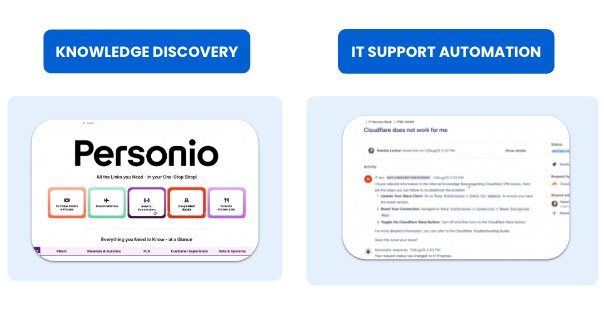
To standardize how knowledge is created and consumed, Personio built an internal “Personio Hub” in Confluence, serving as a unified company knowledge hub. They relied on consistent templates, repeatable navigation patterns, and clear ownership models that could be replicated across different spaces, making information easier to find, use, and maintain.
They also created a single home for work by developing a central landing page where employees can quickly orient themselves across Atlassian products. This provides one starting point for people to access key tools, content, and workflows, reducing friction and helping teams stay aligned.
We love the new feature that Atlassian whiteboards have, where you can basically write a prompt in one sentence, and with Rovo in the whiteboard, you get the full diagram written for you based on that prompt.”
– Natalia Lezhai, Senior Atlassian Expert, Personio
Seamless knowledge management with Jira and Confluence
Personio’s revamped People Workplace and IT hub in Confluence shows what seamless knowledge management looks like in practice: a single, intentionally designed space for the most commonly searched topics, with scoped search so employees can quickly find the right policies, how-to guides, and processes without noise. The experience is driven by analytics that shape hot topics and navigation, and reinforced by strict content hygiene with clear, active page owners and regular reviews so employees can trust that what they see is current and accurate.
On top of this knowledge foundation, Jira and Confluence also standardize and connect core operational workflows: tracking OKRs and projects for People Workplace and IT through Atlassian Goals and Projects, and running legal service desks that handle both customer-facing and internal requests with carefully designed permission schemes to protect sensitive legal information.
AI and automation with Rovo

Once Personio had a cleaner and more unified content foundation, they could unlock real value from AI through Rovo. Employees can now ask natural language questions and receive answers backed by up-to-date Confluence content, complete with clear ownership and the latest updates, which makes knowledge search and discovery significantly smarter and more reliable.
On top of this, Personio’s IT team built a Tier 1 support agent that handles simple requests such as access issues and password resets, automatically searches the right knowledge base, responds with both an answer and a link to the relevant article, and creates a subtask for Tier 2 when documentation is missing so that gaps in knowledge are closed over time.
Rovo is also delivering real-world time savings. In one example, a Personio platform engineer connected slides, Jira tickets, GitHub pull requests, and Confluence pages from the past six months, then used Rovo to generate a performance review draft that would have taken hours to create manually.
As documentation quality improves and data becomes more unified, Rovo’s impact compounds. Employees rely on it more, and the organization becomes increasingly comfortable delegating repetitive tasks to AI, allowing people to focus on higher-value work.
More asynchronous ways of working with Loom
With Loom, Personio smoothly shifted to async collaboration, unifying meetings and communications across time zones.
Guided by the principle “If it can be async, it will be async,” they adopted an “effective meetings only” mindset, moving many discussions that once required live calls into Loom recordings and follow-up conversations in Confluence or Jira comments. Instead of relying on scattered, one-off slide decks, important information and decisions now live in Confluence pages that are enriched with Loom videos.
Loom AI further strengthens this model by adding context to recordings and generating written documentation from videos, which is essential for people who prefer reading or need to skim. Together, these dual formats support very different working styles without requiring teams to duplicate effort.
Everything is really clear and open, and you can find the information easily. The game changer here was also Loom because Loom enabled us to really unlock that power of async working.”
– Natalia Lezhai, Senior Atlassian Expert, Personio
Mitigating security risk with Loom enterprise controls
Loom also moved from being a Shadow IT tool to a secure, integrated part of Personio’s collaboration stack. Enterprise-level controls give security teams visibility into who is creating and sharing videos, the ability to audit sharing patterns and enforce privacy policies, and guardrails that reduce the risk of sensitive content being shared publicly or lost when people leave the company.
Centralized accounts have replaced scattered free and individual instances, which limits uncontrolled public links and ensures Loom is governed alongside the rest of the Atlassian environment. What was once a security concern is now a secure enabler of async work.
The impact of Teamwork Collection on Personio
While the journey is still in progress, Personio is already seeing meaningful outcomes:
- Significant increase in knowledge usage. After revamping their key Confluence hubs, views, and usage jumped quickly as employees discovered a clearer, more reliable knowledge experience
- Faster AI adoption and better outcomes. With clean, trusted content, Rovo searches and agents are becoming increasingly integral to everyday work, from IT support to performance reviews
- Cost and governance efficiencies. Tool consolidation and standardization reduce license sprawl, simplify governance, and lower security risk
- AI-driven productivity gains. Repetitive Tier 1 support and information requests are increasingly handled by AI agents and good documentation, while humans focus on complex, strategic work
Most importantly, Personio has laid a foundation that can scale with the business, rather than holding it back.
We also see the AI-driven productivity gains, where AI will eliminate the repetitive work that people have to do right now so that humans can focus on really strategic, complex work.”
– Natalia Lezhai, Senior Atlassian Expert, Personio
4 practical lessons modern companies can apply
Personio’s experience highlights a set of principles that any company can implement, regardless of its size or industry.
1. Documentation drives adoption
Teams only use tools and processes they understand.
- Invest in clear, well-structured documentation in Confluence and keep it discoverable
- Make sure every key page has a clear owner, a clear “last updated” timestamp, and a clear purpose
- Treat documentation as a product, not an afterthought. It directly fuels Rovo’s effectiveness and reduces support load
When your documentation is clear, owned, and up to date, every tool (including Rovo) works better, and streamlined adoption follows.
Turn learning into action
Check out this Play from Atlassian’s Team Playbook: Team Communication Norms | Improve collaboration by aligning on how your team will connect with each other.
2. Build trust through content hygiene
If employees do not trust what they find, they will stop looking in the system and return to side channels.
- Clean up outdated content and deprecate pages that are no longer valid
- Standardize navigation and templates so spaces feel familiar, not chaotic
- Make it obvious when information is authoritative and current
Trust is non-negotiable. Without it, no platform, however powerful, will see full adoption.
Turn learning into action
Check out this Play from Atlassian’s Team Playbook: Clutter-Free Confluence | Learn tips for keeping documentation clear, open, updated, and unique.
3. Unify data to unlock AI
Unified data is the secret ingredient that turns AI from a novelty into a serious productivity lever.
- Consolidate overlapping tools where it makes sense, so work and knowledge reside in fewer, richer systems
- Connect Jira, Confluence, Loom, and other Atlassian tools so Rovo and the underlying Teamwork Graph can see relationships between work items, documents, and videos
- Start with a few high-leverage AI use cases, such as IT support agents or performance review support, and expand from there
When the data foundation is strong, AI can provide contextually rich, accurate answers instead of guesses.
Turn learning into action
Check out this Play from Atlassian’s Team Playbook: Define AI’s Project Role | Explore and prioritize AI use cases that will help your team increase productivity and innovation during your next project.
4. Show, don’t just tell
Written documentation is essential. Yet it is not always the most effective way to teach or align.
Your teams can use Loom to:
- Walk through workflows and new features
- Replace status meetings and one-off training sessions
- Add human context to important announcements
- Embed Loom videos directly into Confluence pages and Jira issues so context lives alongside the work
Video, combined with text, gives people a choice in how they consume information and helps drive deeper understanding and faster adoption.
Turn learning into action
Check out this Play from Atlassian’s Team Playbook: Record a Great Loom | Take your Looms to the next level with these tips for planning, structuring, recording, and editing.
Transform your teams to handle modern challenges just like Personio
Personio’s journey started with consolidation and standardization, not AI. But, from there, they were able to:
- Remove friction for employees
- Strengthen security and governance
- Unlock real value from AI and async collaboration
Every organization will begin from a different place; some may prioritize speed to market, and others may focus first on standardizing tools and tightening security.
Regardless of the starting point, the pattern remains the same. Build a unified collaboration stack, keep the data clean and connected, and layer in AI and async practices that amplify how teams already work.
Atlassian Teamwork Collection brings that vision to life, enabling your teams to use it every day. Take the next step and put it to work across your organization.