
Discover how Ford Motor Company empowers its people and drives continuous improvement by applying data-driven insights and automation with Atlassian Cloud Enterprise. Learn how a 120-year legacy brand is transforming its culture and operations through connected teams and actionable analytics.
Discover how Ford leverages Atlassian’s Cloud Enterprise to embrace a new era of data-driven, fearless thinking while using the power of cloud and AI.
The learnings in this blog post are based on the session, “From tradition to transformation: Ford’s cloud evolution”, presented at Atlassian’s Team ’25 conference. You can check out this session and others on demand.
Ford is as classic as it gets. What we’re implementing is as modern as it gets.
-Brandon Devito, Transformations Director, Ford Motor Company
As a 120-year-old company, Ford Motor Company has a unique perspective on business transformation. With over 200,000 employees and a deep-seated legacy, from producing the groundbreaking Model T to popularizing assembly line production, Ford continues to cultivate a rich tradition of invention, innovation, and speed.
Their ingenious history has directly shaped the modern world, but could they be considered modern innovators? For Brandon Devito, Senior Director of Atlassian at Ford, the answer is an unequivocal “Yes!”
We are an organization who manifests in real-time. We are six months ahead in doses [planning cycles], so we plan twice a year…There is a constant motion for us, where at any point in time, our peers can challenge what we have on the table and say, ‘Is there a better way of working?’
-Brandon Devito, Transformations Director, Ford Motor Company
On average, a new Ford vehicle is rolling off the assembly line every 13 seconds. But it wasn’t always this way. Like many companies of their size, Ford faced challenges of scale, silos, and legacy systems. Some of their most valuable data about how work got done lived on their Atlassian apps, but without Cloud Enterprise, they didn’t have insight into what was/wasn’t working. To top this off with a struggle between “heritage mindset” and building for the future, Devito and team knew that they needed a transformation: not just technological, but cultural and operational.
Ford’s starting point: a legacy giant facing modern challenges
It all started with identifying their initial problem: how was Ford matching the pace of innovation? The Ford team universally acknowledged they were moving into a new era of technology, where instead of leading a manufacturing revolution, they were facing down a technological revolution.
According to Devito, instead of feeling intimidated by this ask, the team felt excited. After all, this was an ideal opportunity for a company with such a rich, storied history. They used their experience to their advantage, challenging themselves to leverage brand-new things, while still keeping the perspective of a company that’s been manufacturing the same way for decades.
“The first and most important thing we chose to let go of is fear – we became a culture who challenges fear.”
-Brandon Devito, Transformations Director, Ford Motor Company
Now, it’s one thing to claim a fearless culture, but how did Ford take this idea from theory to practice? It all starts with three core practices:
Step 1: Keep the “why” at the forefront and leave “junior” and “senior” at the door
Ford’s Transformation Team takes a unique approach to continuous improvement by classifying teammates based on their skillset, not their tenure.
“I don’t care if you’re new to the company,” stated Devito, “What I care about is that your individual skill set, personality archetype, and needs are what make you valuable.” Instead, his team focuses on identifying champions within their existing team structure and asking questions like:
- Who needs the opportunity?
- Who is capable of this task?
- Who will grow from it?
In Devito’s experience, it all comes down to listening and always connecting progress back to goals. This cultural narrative is why Devito and team religiously rely on the Atlassian Cloud Platform to track work and goals. If everyone can see their impact, it increases engagement, and leaders have visibility into all the great work their teams accomplish.
“When you see a Ford F-150, you see a truck,” illustrated Devito in his Atlassian Super Session appearance. “I see innovation, dedication, and the hard work behind it. I see the customers who asked for fuel efficiency…I also see a hybrid powertrain with reduced emissions that help us meet all of our sustainability goals, and the thousands of [Jira] projects that make all of that possible.”
Step 2: Automation and continuous improvement
“Because we build the same thing over and over and over again, we have a dual expectancy,” explained Devito. “We have to somehow create the same thing exactly as it was. And yet innovate into something brand new that meets the cultural expectations, technological expectations, engineering expectations, and emerging technologies we didn’t know about three weeks prior.”
Innovation for the Ford team is a moving target, wherein each time something fails, they ask themselves:
- What didn’t we do well?
- Are we operating from a diagnostic, use-case-driven mindset or a build-and-deploy mindset?
- Does it align with our overall company goals?
According to Devito, this mindset wouldn’t be possible without access to time-savings via cross-connected platforms.
“One of the things I love about Atlassian Automation is its extensive template library – it lets us streamline workflows across the entire organization,” he explained, “But in my opinion, the work we do with our manufacturing teams has the greatest impact.”
With the assembly line as part of their core DNA, Ford’s teams are always keen to build automations. One of the ways they accomplish this is through an extensive library of automations across the organization – nearly 200,000 per day, to be exact, taking full advantage of their unlimited automations allocation in Cloud Enterprise. In just a single quarter, Ford executed over 16 million automation rules, streamlining workflows and saving significant manual effort.
“Changes to a vehicle’s critical systems carry risks but are necessary for improving our trucks,” said Devito, “Atlassian Automation makes the change process faster and safer.”
He went on to illustrate what that process looks like on a typical day:
- When a change reaches the right status, the automation rule automatically seeks approvals from the QA Lead and Project Manager on the ticket via Slack.
- If tests succeed, the change is marked ‘Done’; if not, defects are escalated to a Principal QA Engineer, who is assigned a sub-task that prevents the change from progressing until it’s approved.
That single rule quietly runs hundreds of times a week, saving hours of unnecessary back-and-forth between teams at Ford.
“You might think, ‘Brandon, I have more complex rules,’ and so do we,” Devito clarified, “But that rule shows that impact doesn’t require complexity. We maintain thousands of rules like that because they’re effective.”
Step 3: Build connected, data-driven insights
Ford’s journey serves as a blueprint for other legacy enterprises: success requires both technical modernization and deep organizational change.
Devito’s main takeaway? “Look at your modular systems,” he challenged, “And ask the question, ‘Where are we not connected?’”
In his eyes, wherever systems are independent of each other, all the moments where failure occurs come from there.
“That’s the virus,” Devito concluded.
A strong statement, but Ford’s team data backs this: their central IT team has already shaved off an average of 3 hours per day by automating project creation. And there’s more coming as they continue to track team data using Cloud Enterprise.
“Trust the Atlassian platform to give you honest metrics about where the work really is and when they’re provided, listen to those metrics, decision off those numbers,” Devito reiterated.
For Devito and the Ford Team, analytics connected to their company goals are something they live by. “If someone in your chain says, ‘Well, I feel like ___, and we should listen to it,’ hear it, but that’s to be absorbed into the ways of working, not the deliverable” warned Devito. “Opinion is not a way of delivering.”
So, what is Ford’s way of delivering? Data. “The numbers tell the truth,” he concluded.

At Ford, data is paramount and informs every decision. But how do they manage to sift through the web of interconnected data?
“With the Data Lake, we can consolidate all of the data we need in one place,” Devito explained in his Atlassian Super Session appearance, “But then the Analytics app allows us to make sense of that ocean of information.”
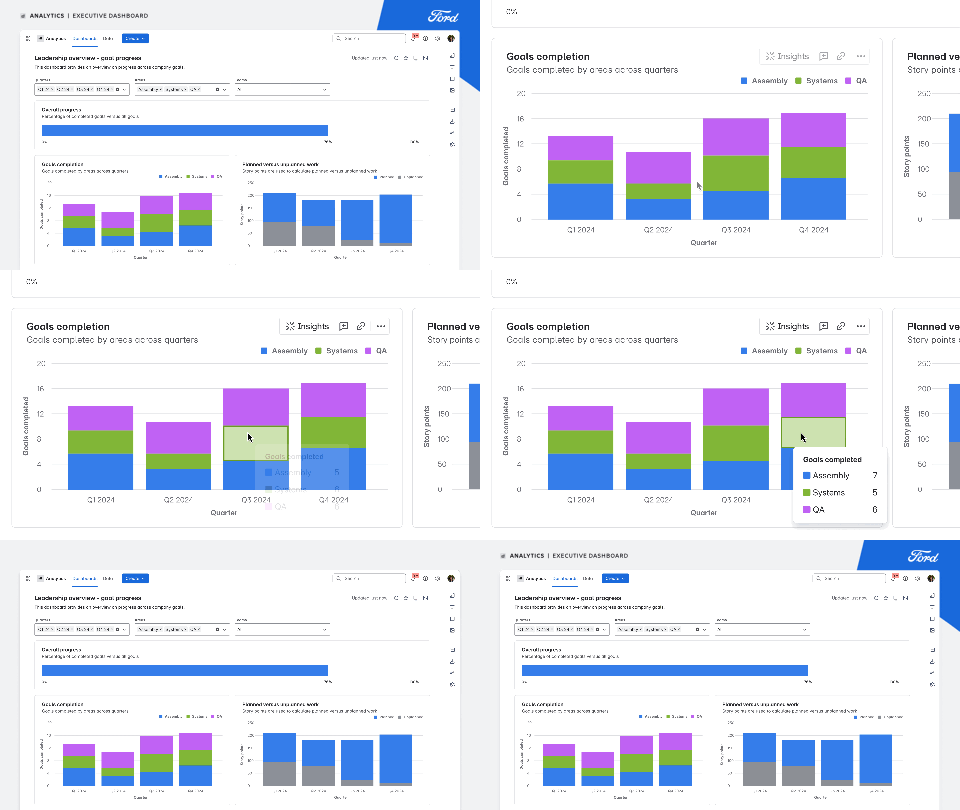
One such example is the Ford Team’s Executive Dashboard, which the Ford Team uses to give their executives a high-level view of goal progress. They also have the flexibility to filter for specific areas and review historical data. This enables them to make informed decisions about reallocating resources or adjusting processes, helping keep goals on track with direct support from the top.

Looking ahead: Ford’s ongoing evolution
As Ford expands from 70,000 to 225,000 Cloud Enterprise users over the next year, leveraging AI and automation, and scaling best practices across the enterprise, they’re sure about one thing: Atlassian remains a long-term partner in Ford’s success.
“Ford has always built the vehicles that take people where they want to go, and Atlassian is our vehicle that gets us to our success points,” Devito declared.
Later on in his Atlassian Super Session appearance, he added, “We see this as a massive transformation in how Ford invests in our most important resource, our people. And it’s possible, thanks to the power of the [Atlassian] Cloud and AI.”
Ford’s transformation is about more than technology – it’s about people, process, and purpose.
Ford’s journey is proof of what’s possible with Atlassian Cloud Enterprise: a connected, data-driven culture of continuous improvement and secure scale. Watch the full session to see how Ford made it happen, then learn more about how Atlassian Cloud Enterprise and Analytics can help your organization evolve with purpose.