


Bitbucket Cloud is more than a code hosting platform. We’re an enterprise partner, helping teams code together at scale with security, compliance, and flexibility at every step.
As part of the Atlassian Cloud platform serving more than 300,000 organizations around the world, we’re continuing to build the next generation of Bitbucket Cloud as your trusted cloud vendor, whether you’re a global bank, healthcare provider, or a fast-scaling tech company.
Here are four ways we’re ensuring Bitbucket Cloud, and Bitbucket Data Center, remains an even more trusted partner in 2026 and beyond:
- Secure code access
- Code compliance at scale
- Automated change management processes
- What’s coming for Data Residency and Bitbucket Data Center
Keeping your code secure
Your source code is the heart of your software service, and Bitbucket provides robust, granular access controls to protect that code at every stage of the development lifecycle and let you tightly manage who can access your code and how.
Built on the Atlassian Cloud platform alongside Jira, Jira Service Management, and more, Bitbucket Cloud benefits from world-class security standards and infrastructure, including:
- Data encryption at rest and in transit
- IP allowlisting
- Enforced 2FA
- SSO with Atlassian Guard
- Comprehensive audit logs
- Meeting global compliance like GDPR, SOC2, SO27001 and others
Bitbucket Cloud is also distributed across multiple isolated data centers for redundancy and disaster recovery.
Read why you can trust the Atlassian Cloud platform.
For code-specific protection, Bitbucket enables fine-grained permissions at the branch, repository, and deployment environment levels—ensuring only authorized users can access or modify your code. This helps you enforce the principle of least privilege and align with your organization’s security policies.
Looking ahead, we’re investing in sharding Bitbucket’s infrastructure and deploying to multiple regions across the world to deliver even greater reliability, performance, and redundancy. This work also lays the foundation for upcoming Data Residency options, giving you more control over where your code is stored (see more on that below).
Developer autonomy and code compliance at scale
Enterprise development teams are often forced to choose between centralized compliance and team-level autonomy.
Not anymore.
Bitbucket makes it easy for engineers to focus on delivering features to customers, while making it easy for platform teams to enforce best practices and guard rails according to their enterprise’s needs. Platform teams can centrally manage compliance workflows that everyone must follow, while developers have the autonomy to customize the rest to their needs.
Here’s two ways how:
Dynamic Pipelines for Secure CI/CD at scale
One of the biggest compliance vs autonomy tradeoffs is in CI/CD. Platform teams want to manage all pipelines to ensure compliance and visibility. Some developers are okay with that (so long as the pipelines work), but others want the autonomy to tweak pipelines to best suit their needs and account for factors like cost, build time, efficiency, and more.
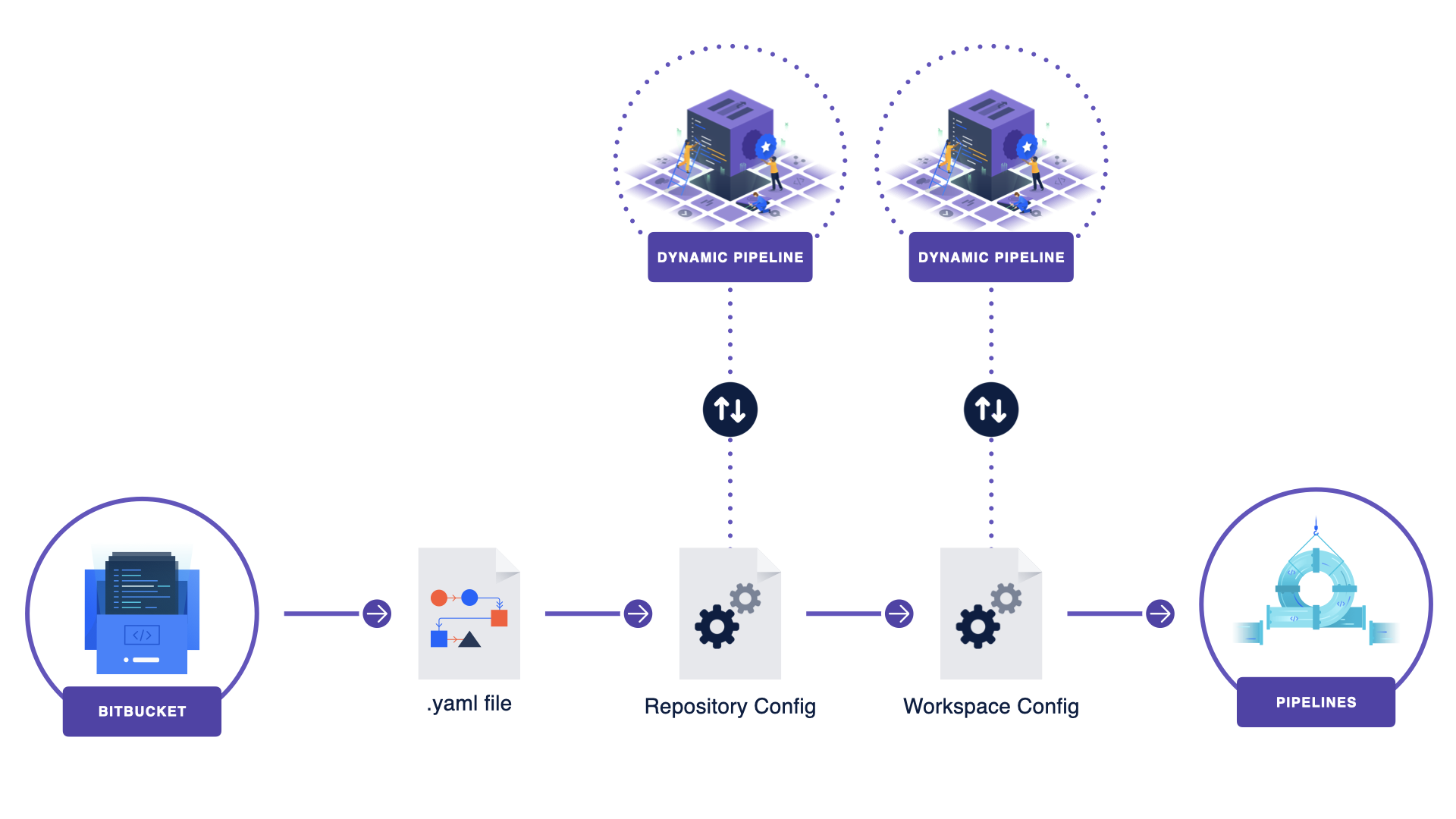
Bitbucket Pipelines is CI/CD that offers both compliance and autonomy with no tradeoffs. The special sauce is Dynamic Pipelines, which allows teams to make modifications to pipelines at runtime using custom logic.
A few examples of what’s possible:
- Enforce security scans as a required build step
- Run builds using only docker images from a pre-approved list
- Run builds using self-hosted runners, even ones behind a firewall
- Implement selective test execution based on what’s changing in the PR (reducing build time and compute usage)
- Assign CI/CD jobs to runner agents tagged with certain cost center codes to automate cloud infrastructure cost attribution
All of these examples can be assigned team-, department-, and organization-wide, so central platform teams can enforce pipeline compliance at scale, while development teams can focus on coding and not wasting hours trying to configure their project’s CI.
See Dynamic Pipelines in action

Enforced, customizable merge checks and approvals
PR Reviews are a core workflow to building software as a team. It serves as a checkpoint, ensuring that code heading to production is bug-free, high-quality, and adheres to the team’s compliance needs.
Each team is different, however, which is why Bitbucket offers the most customizable merge checks of all hosted SCM solutions (at the project or workspace level, which can be required or simply recommended).
Within our own engineering teams at Atlassian, we use merge checks in many ways, such as requiring a certain number of reviewers, requiring that one of the reviewers manages that code base, checking for available support representatives if the deployment is after-hours, and many more.
Merge checks are a powerful tool to ensure your teams follow your own internal rules as a natural part of the code review workflow.
For even more secure merge checks, you can enforce signed commits via GPG or SSH keys, with merge check rules requiring users to authenticate when submitting a code commit (and rejecting unsigned commits).
Workflows to automate change management
Enterprises thrive on agility—but not at the expense of control or traceability. Bitbucket Cloud is purpose-built to help organizations move fast while automatically maintaining rigorous oversight of every change.
Beyond Bitbucket’s own compliance features like merge checks and dynamic pipelines, Bitbucket seamlessly connects to Jira and Jira Service Management (JSM), bringing IT Service Management into the software delivery process.


End-to-End Change Tracking and Approvals
For organizations with strict compliance, audit, or regulatory requirements, every code change must be reviewed, approved, and logged. Bitbucket Cloud’s integration with Jira Service Management makes this seamless:
- Automatic Change Requests: When a pull request is created or a deployment is triggered in Bitbucket Cloud, a corresponding change request can be automatically generated in Jira Service Management.
- Policy-Driven Approvals: Changes can be blocked from merging or deploying until the associated Jira Service Management change request is reviewed and approved, enforcing separation of duties and ensuring only authorized changes reach production.
- Audit-Ready Traceability: Every step—from code commit to deployment—is tracked and linked, providing a complete audit trail for compliance and incident response.
Connected Workflows Across Dev and IT
Bitbucket Cloud and Jira also work together to connect code changes with tracked work items, ensuring that every change is tied to a business objective or incident. Merge checks can require that pull requests are linked to Jira issues, and that all required reviews and builds have passed before merging.
- Automated Where Possible, Manual Where Needed: Routine changes can flow through automated pipelines, while higher-risk or sensitive changes can require manual approval in Jira Service Management—striking the right balance between speed and control.
- Separation of Duties, Without Silos: Developers, platform teams, and IT can each play their role in the change process, with Bitbucket, Jira, and Jira Service Management providing a single, connected workflow.
Jira and Bitbucket are linked to show details and where the change is in production. It’s traceable, so they know what we’re doing and when we’re deploying.
Kyle Gengler, Senior DevOps Engineer, Nextiva (Read More)
Big things still coming to Bitbucket for compliance
Hybrid licenses for Bitbucket Data Center
Unlike other Atlassian Data Center products, we’re committed to maintaining and innovating with Bitbucket Data Center, which will not be a part of the DC end of life program.
We know that source code is not like data about your Jira work items or your Confluence docs. Some enterprises need to self-manage their own code, and so starting in 2026, we’ll offer Bitbucket Data Center customers a hybrid license that allows you to operate Bitbucket Data Center and Bitbucket Cloud. Both, not either/or.
This hybrid approach allows you to keep using Bitbucket Data Center while unlocking the latest Bitbucket Cloud innovations, including AI and CI/CD, at your own pace with newer projects or with less sensitive projects.
While Bamboo will reach its end of life, we’re all-in on Bitbucket Pipelines, our hosted CI/CD system, which we will make work with both Bitbucket Cloud and Bitbucket Data Center (including supporting self-hosted runners).
Data Residency coming in 2026
We also understand that industries have diverse requirements for where and how source code is stored. To address this, we will introduce data residency options for Bitbucket Cloud, starting with support for the EU region in 2026, and expanding to additional geographies over time.
Our goal is to offer the most powerful code collaboration platform in the world, with secure deployment options that suit your needs. In the coming year, we’ll continue to build Bitbucket Cloud for the future of enterprise software delivery—combining robust security, compliance, and flexibility with the innovation and scale of the cloud. Whether you need to self-manage your code, embrace the latest cloud capabilities, or do both, Bitbucket empowers your teams to collaborate with confidence and control.
Want to learn more about the Bitbucket Hybrid License? Read more here, or connect with our sales team.