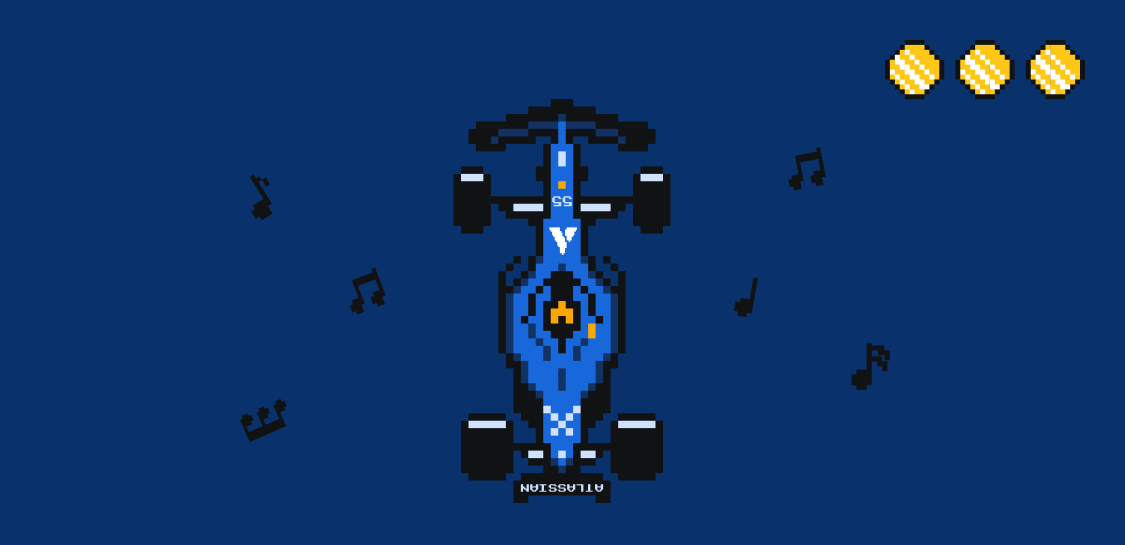
At Atlassian, play is often where the real ideas begin. Earlier this year, during our ShipIt hackathon (where Atlassians drop everything to build bold new ideas), a simple sketch I received sparked something unexpected: Whiteboard’s very first easter egg.
What began as a tiny racing experiment quickly evolved into a fully functional arcade-style racing game hidden inside Whiteboards. We hadn’t planned on building a racing experience or included it as part of our strategy. It was borne from curiosity, giving us the space to use our craft to create a little mischief.

Alex Albon, the official driver of Confluence Whiteboards Race Mode, hits the track.
Keep reading to discover how a scrappy doodle, a modern WebGL engine, and a love for retro arcade vibes came together to create Confluence Whiteboards Race Mode.
Turning a doodle into a digital pit stop
The idea for the Whiteboards Race game came from Confluence Software Engineer Steve Kraynov during ShipIt. He wanted to build a bite-sized racing game to that encouraged teamwork and a little playful competition.

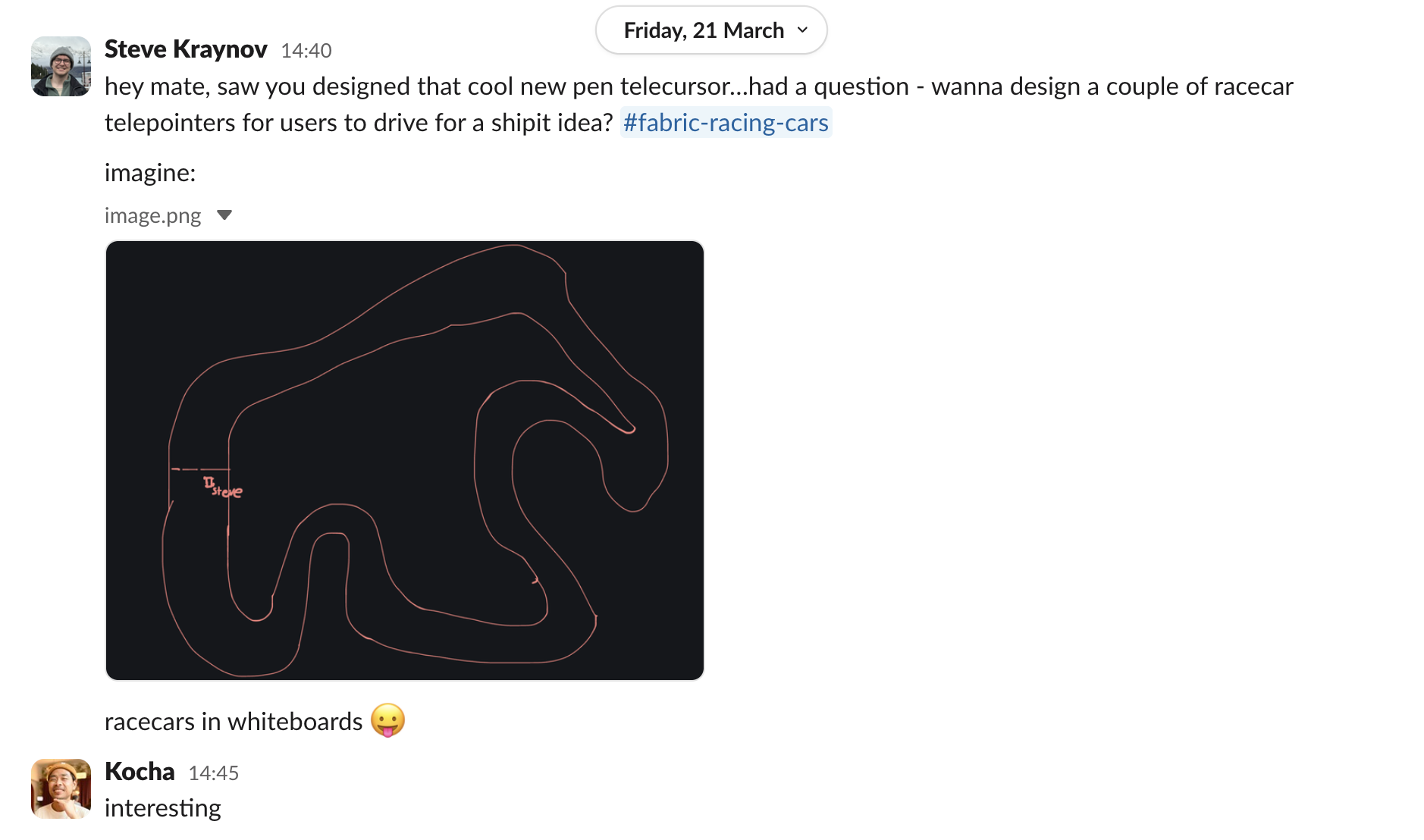
Steve and his Picasso napkin drawing
⚡ The spark
The inspiration behind this project was not technical at first. It was emotional. I wanted to create a opportunity for people to pause for a moment of fun before diving back into work. Joy is easy to overlook within productivity tools, yet it has the power to completely change how people feel in a space. That thought stayed with me. What if Whiteboards had a tiny moment of pure delight hidden inside? Something small and unexpected that makes people smile before they even realize why.
To bring that feeling to life, I leaned into contrast. I wanted to mix old and new by leaning into a retro pixel-art vibe while leveraging WebGL for the engine. The blend of smooth technology and old-school personality gave the prototype instant character, making it stand out from everything else on the canvas.
Our partnership with Williams Racing made the rest fall into place. An Atlassian Williams racing car was the natural main character; it connected the Easter egg back to our brand and captured the feeling of speed and teamwork. It became the perfect anchor for a playful moment tucked inside a collaboration tool.

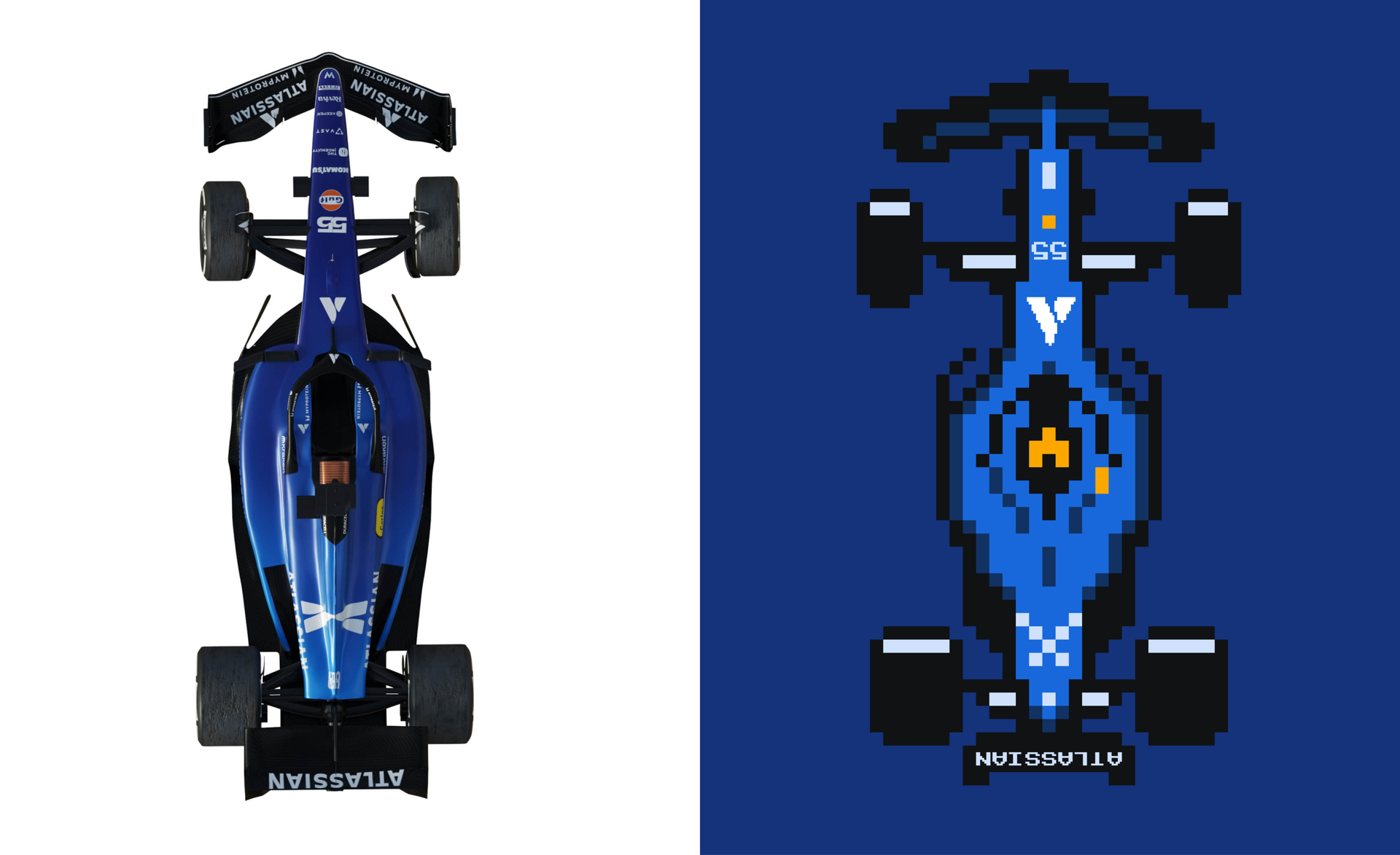
The Atlassian Williams Racing livery reimagined as an 8-bit sprite.
🎮 The game design
Olly Freeman, a Senior Confluence Product Designer, took the wheel on game design, crafting stunning visuals and micro-interaction animations. He shifted gears seamlessly between creativity and coordination. Working closely with Confluence Whiteboard Engineers Steve Kraynov and Tim Hor, he helped build a gameplay experience that was as smooth as it was fun, steering stakeholder alignment and defining what made the race truly fun to drive.
Olly and Emily Ditchfield, a Senior Confluence Product Manager, fine-tuned the game loop, designing clever mechanics that nudge players back to Whiteboards after the race… or tempt them into one more lap.

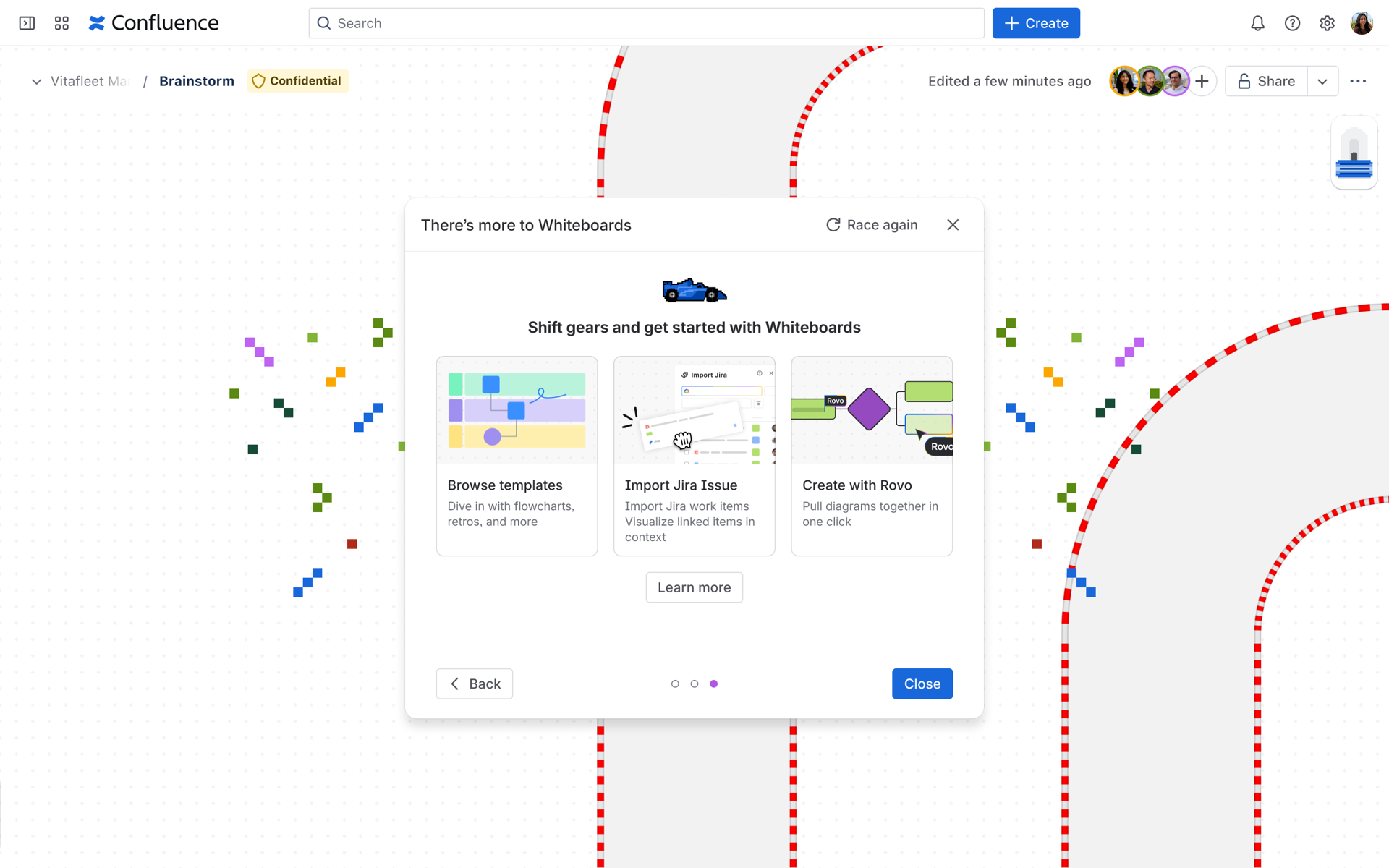
Olly Freeman’s Design
👂 Sound as an experience
When I tried an early version of the game, I was instantly hooked. It was fun and surprisingly addictive for something built inside a collaborative canvas. The racing felt good; seeing my visual and art direction come to life feels amazing.
But even with all of that, something still felt missing.
Whiteboards has always been more than visual. It’s tactile. The product already uses sound cues, like the countdown timer, to make actions feel real and to create a sense of momentum on the canvas. That’s part of what makes Whiteboards feel alive. As I played the early prototype, I realized the game needed that same sense of presence. If this tiny racer was going to have heart, it needed a pulse.
That moment sparked a new idea. If the game needed a heartbeat, sound was the way to give it one. I asked if I could explore the audio side and experiment with bringing the experience to life through sound. Once I got the green light, I suddenly had a whole new creative lane to race in.
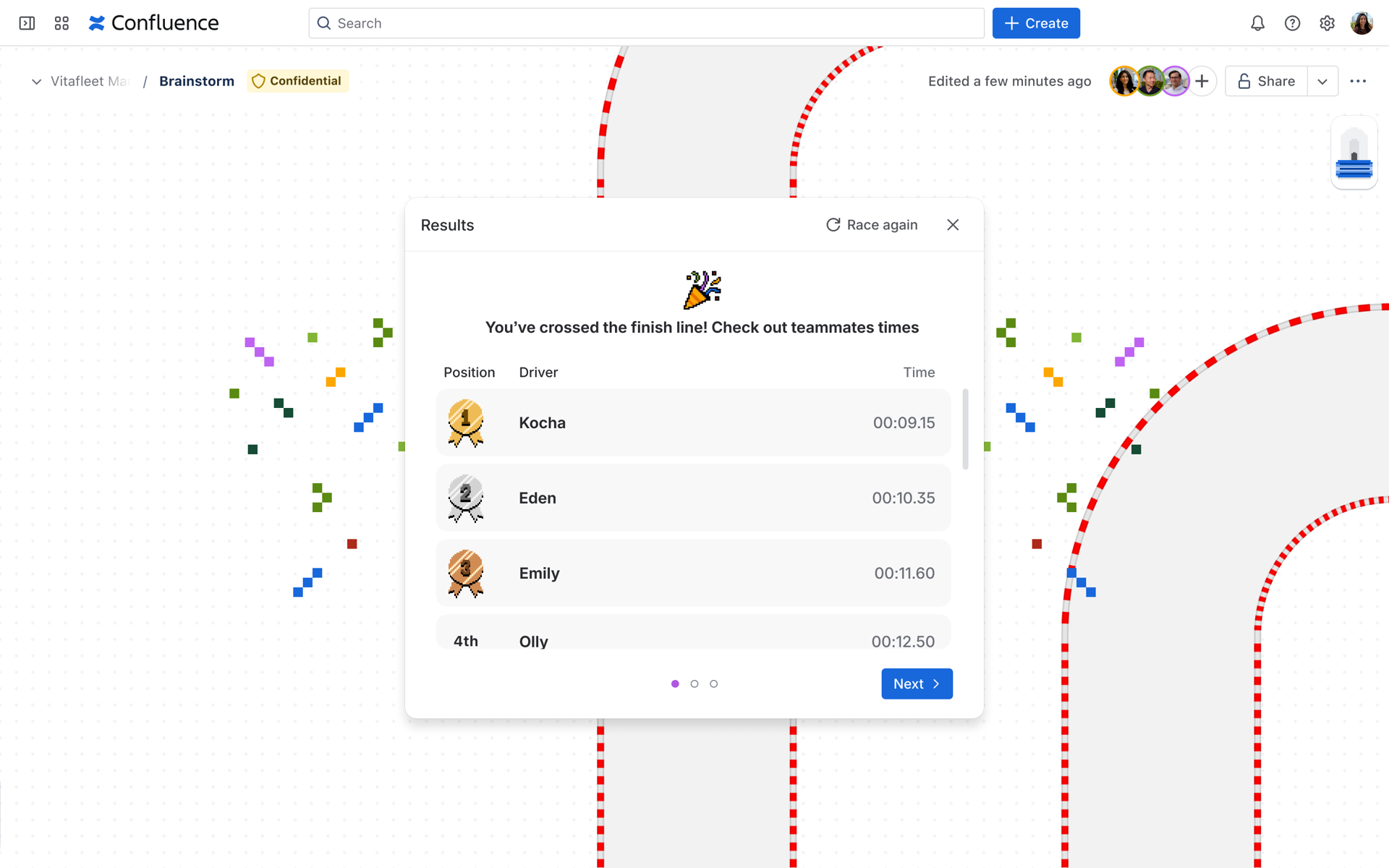
An early snapshot of the race mode prototype that showed us the game was starting to come alive.
🎹 Making of the sound design
The visual style already leaned into an 8-bit arcade aesthetic, so the soundtrack needed to match. I started by looking up how to recreate classic 8-bit sound and quickly discovered that what I was trying to make had a name: NES chiptune. It is the signature style created by the sound chip inside the Nintendo Entertainment System, and it defined the music of an entire generation of games.
Before making any noise, we needed a quick primer on how the NES actually worked.
↳ The basics
The NES chip could only play five voices at once:
- Two pulse (square) waves—melody and harmony
- One triangle wave—bass line
- One noise channel—percussion and effects
With such a tiny toolkit, early game composers had to be incredibly inventive. They used fast arpeggios and clever rhythmic layering to make their music feel bigger than the hardware allowed.
It is a fascinating constraint and a reminder of how much creativity can come from limitation. Now that I knew the basics, it was time to bend the rules a little 😏.

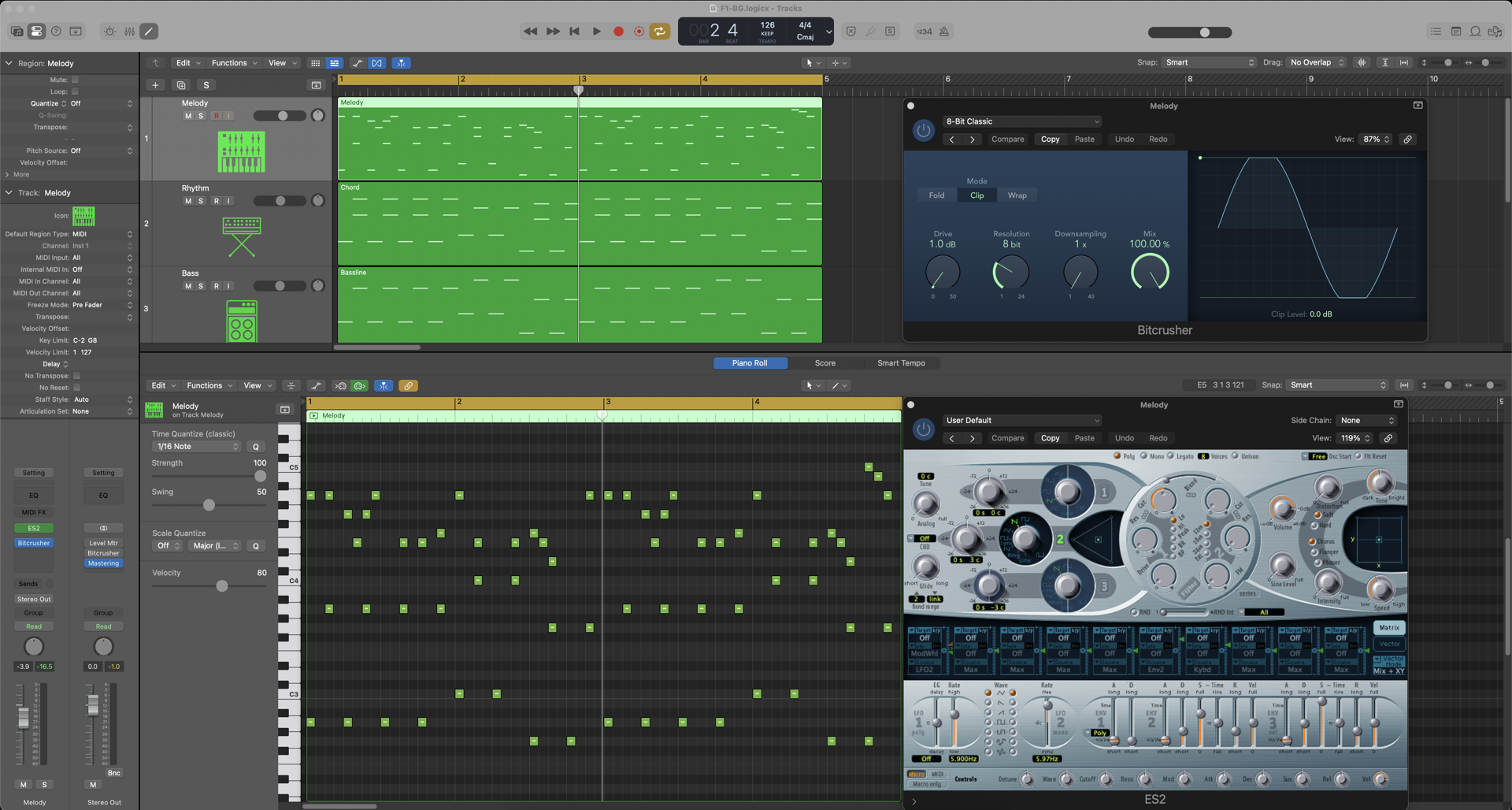
Logic Pro with ES2 Synthesizer VST
🔊 Let’s make some noise
We wanted each track to be lightweight and loop-able so we could add them to the games.
I used Logic Pro as my go-to Digital Audio Workstation (DAW), and limited myself to one instrument: the ES2 Synthesizer. Every sound came from it — from melodies and drums to sound effects. Limiting the entire soundtrack to a single synth gave the process the same feeling as composing for an actual NES. It was a small challenge that made the work more focused and more fun, even if I knew we were still bending the rules a little.
↳ Melody and harmony
High-pitched leads drive the melody, rhythmic pulses hold the harmony and quietly keeps the groove moving below the surface.
Instead of kicking things off with rhythm, like I normally do, I built from the main melody, the emotional anchor of classic NES music.
When that theme locked in, the track assembled itself. I pushed the tempo to 126 BPM to keep the race tense and urgent, then crossed the finish line in a bright C major so players feel that mix of relief and victory.

↳ Rhythm section
I laid down the bass line using the root and octave, and sculpted the noise oscillator into snare, hi-hat, and kick hits. Every sound kept to its own lane, like a pit crew perfectly in sync.BassPercussion
↳ Sound FX
Every countdown and off-track moment started as a single note, then got modulated or pitched up to create variety. Those quick, reactive cues are what gave the race its jolt of adrenaline.

🎶 Putting it all together
Instead of stopping at a simple loop, I decided to build a full track that could support both gameplay and future marketing moments. The audio needed enough depth to stand on its own, while still feeling light and energetic inside the game.
I brought it all together by breaking the melody into fragments and rebuilding it over time, using arpeggios to drive momentum into the main hook, shaping transitions with chromatic runs, adding a Bitcrusher for authentic 8-bit texture, and layering in gameplay sounds like countdowns to set the mood.

Listen to our Confluence Race Mode Soundtrack
And that’s how a Whiteboard Easter egg turned into a mini music production sprint. I’m no professional composer; I’m a designer chasing fun over theory. But creativity doesn’t always need perfect pitch, just curiosity and the will to play.
Thanks for reading (and listening). See you on the next lap 🎶